

RD professionals connecting with HSIs: Insights from SAC Liaison Jorja Kimball, by Elizabeth Festa
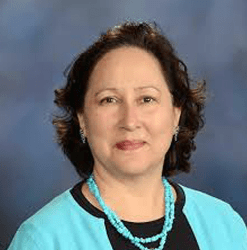
What is the mission of your liaison organization, AHSIE? AHSIE, pronounced “Osh-ee”, is the Alliance for Hispanic Serving Institution Educators. As noted on their website, the mission of AHSIE is to support educators at HSIs “as they seek to provide quality, relevant educational opportunities to large and growing numbers of underserved populations, particularly Hispanic students.” AHSIE’s focus is on the undergraduate population, which makes it distinct from other organizations.
What is your role as a Strategic Alliances Committee liaison to AHSIE? In my role, I work with a specific HSI organization to help link them to resources and initiatives that NORDP offers or has access to. I also communicate unique RD needs of the organization to NORDP, so that we might possibly develop partnerships between the organizations or obtain resources to address mutual needs or goals. That is central to the SAC mission of serving as the professional development arm for NORDP. In uniting AHSIE with NORDP, I hope to strengthen the efforts of both organizations. For instance, one of the longer-term goals I have as a liaison is to facilitate a proposal, such as NSF GRANTED, that includes AHSIE and NORDP members, which will garner more attention and support through the backing of two organizations. It is just as crucial, I believe, to introduce NORDP members to what AHSIE and similar organizations, such as HACU (the Hispanic Alliance of Colleges and Universities), for example, have to offer. I view myself as a point person for the NORDP member who wants to learn more about HSIs and partner with them as well as to support NORDP members at newly designated HSIs. Finally, I am committed to staying abreast of current research trends in supporting Hispanic students and sharing that with NORDP members as potential best practices for use in research development.
Tell me about your professional role. I’m Executive Director of Research Development Services and the Office of HSI and Inclusivity Research Services at Texas A&M University. Texas A&M is an HSI as of last year and a Carnegie Research 1 institution. Research Development Services has three areas of emphasis: support for large proposals, career development for faculty (especially early career faculty), and a focus on submitting for HSI funding opportunities. My role in the Office of HSI is similar to the other two focuses, but with increased attention to communicating HSI funding opportunities to faculty and facilitating the proposal writing process according to faculty requests and needs.
How did you become involved in working with underrepresented scholars? Before coming to Texas A&M, I worked across the State of Texas as Director of Strategic Development for the Texas Engineering Experiment Station, the research arm of engineering for the A&M System. In addition, my doctoral research focused on underrepresented groups in STEM and time to completion of the core body of knowledge at A&M. As such, my background prepared me for this role.
What qualifies a university as an HSI? According to the White House Initiative on Advancing Educational Equity, Excellence, and Economic Opportunity for Hispanics, an HSI must have an “enrollment of undergraduate full-time equivalent students that is at least 25 percent Hispanic students at the end of the award year immediately preceding the date of application.” The federal government also requires that HSIs have educational and general expenditures per full-time equivalent student that fall below the average of similar institutions, as calculated by the U.S. Department of Education.” There are currently 451 HSIs in the United States. One interesting fact is that three states have their own consortia: California, Texas, and Florida.
Could you recommend an article or book on HSIs that may be of interest to NORDP members and the faculty they serve? I’m currently reading Gina Ann Garcia’s book Transforming Hispanic-Serving Institutions for Equity and Justice (Johns Hopkins University Press, 2023). Garcia was the keynote speaker at the recent AHSIE conference, and was also a speaker at a conference that we held at Texas A & M. Garcia, with other scholars, coined the term servingness, which emphasizes the importance of actually serving, as opposed to simply enrolling, Hispanic students. That is an important distinction and a key term for any scholar who is developing research or programming involving HSIs or Hispanic students. This is yet another way that I hope to assist NORDP members through my role as a SAC liaison. Very often, in RD, we need to assist technical faculty in locating publications on best practices for use in broader impacts or educational outreach narratives. My liaison with AHSIE will help to keep me on the cusp of current research, and I will share these resources with NORDP members.
One of SAC’s missions is advocacy. How do you see this as influencing what you hope to achieve as a liaison? One of the goals I have for the next few years is to help with an HSI-specific consulting initiative that is part of or similar to the current project that NORDP launched with HBCUs. This would be a significant undertaking, but a very valuable one in light of the growing college age population in Texas and the nation and the growing interest in DEI. I would love to brainstorm this with the Board and the SAC committee in the coming months!
 NORDP News