The NORDP Innovation Award recognizes individuals, groups, or teams; functional units; or organizations who leverage unique skills or resources to kick-start innovation in research development and advance the profession or the field in ways that generate evidence of promise or demonstrable results. Innovators leverage partnerships, experiment with tools and techniques, or generate and share knowledge to advance NORDP and the work of its members.
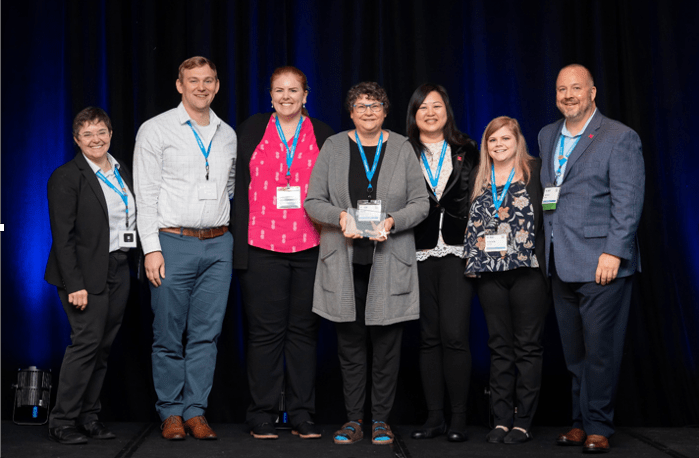
NORDP is proud to spotlight the University of Nebraska-Lincoln (UNL) Office of Proposal Development (OPD), a group recognized May 10 with the Innovation Award. UNL OPD won the award by exhibiting inventive approaches and fostering impactful change on campus through its CAREER Club programming, which is designed to increase faculty success in securing these prestigious awards from the National Science Foundation (NSF).
At the core of UNL OPD’s success lies a team of dedicated individuals with unique expertise and roles positioned within the institution’s central research development (RD) structure. Team members include:
- Amanda Bohlin, Proposal Development Coordinator
- Jocelyn Bosley, Research Impact Coordinator
- Matthew Dwyer, Senior Proposal Development Coordinator
- Tisha Gilreath Mullen, Director of Proposal Development
- Katie Pelland, Senior Proposal Development Coordinator
- Jaclyn Tan, Proposal Development Specialist
In UNL’s NSF CAREER Club, the team employs a three-pronged, integrated approach focusing on programming, personalized proposal development support, and fostering connections among researchers and partners—both internal and external. What started as a one-week program in 2017 has since evolved into a six-month program. Key to innovation is the team’s commitment to constant evaluation and improvement: sessions are evaluated annually and OPD uses data-informed practices to evolve.
Over the years, UNL’s NSF CAREER Club has shifted from didactic-centered interactions to more conversational sessions, assisted networking, one-on-one mentoring, and continued support. Today, programming also emphasizes synergistic networking to catalyze future research through cross-departmental and external collaborations. Through this networking, faculty develop connections across and beyond campus, ultimately increasing the sense of community Principal Investigators (PIs) feel at UNL. OPD offers one-on-one mentoring and safe spaces to create what they call “collateral beauty,” where PIs receive valuable feedback, support on deferment or selecting better fitting mechanisms, or encouragement to submit. These spaces integrate difficult conversations seamlessly into a strategic, positive experience. OPD also developed two new tools to enhance how researchers communicate their vision: a career trajectory graphic that visualizes past, present, and future growth, and a mini poster designed to facilitate virtual conversations with program officers, impact partners, and other stakeholders.
As a testament to their successful innovations, UNL now averages six or more CAREER Award winners per year—a significant increase over the past five years—with a 50% success rate for faculty who complete CAREER Club. Through partnerships with external NSF consultants, UNL OPD demystifies the process, supports their investigators, and ensures PIs acquire the necessary experiences and co-mentorship to achieve their goals.
For institutions wanting to start a similar program, UNL OPD recommends evaluating how programs can work together to maximize impact despite limited resources and bandwidth. Institutions can start by taking inventory of unique assets and strengths, chart them against leadership priorities, then develop objectives and define metrics for success. Consistent messaging and marketing before, during, and after programming is crucial as well.
Additionally, OPD encourages leveraging the wealth of NORDP resources in developing programs. The team conveyed gratitude for the NORDP community’s invaluable expertise and support in catalyzing their innovations from ideation to execution. For example, their mini poster tool was refined based on NORDP members’ input. Many OPD members also applauded the NORDP Mentoring Program as a hub to ideate, problem-solve, and gain resources related to programming. The team praised NORDP’s contributions to the RD field, such as providing a common vocabulary, offering growth frameworks, working toward developing an RD credential program, and creating virtual spaces for engagement. Furthermore, NORDP’s collaboration with other professional organizations, such as ARIS (Advancing Research Impact in Society), has driven the field further. OPD also noted that a former NORDP president now serves as the director of NSF GRANTED, further exemplifying the impact of NORDP involvement.
OPD’s CAREER Club stands as a beacon of innovation and a catalyst for progress. By providing personalized support, fostering connections, and engaging with the NORDP community, the UNL team has propelled researchers to new heights of success. Through constant evaluation and collaboration, they continue to push boundaries and empower researchers to embrace innovation. As institutions seek to innovate, UNL OPD serves as an exemplar that offers tangible steps for success and advocates for the power of networking, resource sharing, and co-innovation within the NORDP community.
 NORDP News