Find me on LinkedIn
🚀 Currently: Michigan Technological University
💼 Formerly: University of Michigan, UP Health System-Portage
🧰 Offering my time and talents to: NORDP2023 Conference (co-chair), NORDP Communications Working Group (co-chair), NORDP-GL Executive Committee, NORDP Mentoring Committee, Copper Country Ski Tigers (Level 1 coach)
I am thrilled to announce the launch of a new NORDP Faculty Development Peer Mentoring Group (PMG). This new PMG is designed to support NORDP members who are dedicated to enhancing faculty research success through holistic professional development programming. This new PMG provides a platform for RD professionals to discuss, share resources, and offer feedback on the design, development, implementation, facilitation, and evaluation of faculty development workshops and other programming.
Faculty development is a critical aspect of research success, as it equips faculty with the skills, knowledge, and support they need to excel in their research careers. RD professionals play a key role in designing and delivering these programs, which can include everything from workshops on grant writing and research team management to training in leadership, mentoring, addressing conflict, and fostering wellbeing.
Using the peer mentoring model, the Faculty Development PMG’s goals are to:
Create a collaborative space where RD professionals can exchange ideas and resources related to faculty development programming.
Enhance the quality and impact of faculty development programs by sharing best practices and evidence-based approaches.
Provide feedback and support for RD professionals who are responsible for faculty development initiatives at their institutions.
Foster a community of practice focused on improving faculty research success through effective professional development.
The Faculty Development PMG is for any NORDP members who are involved in or interested in the creation, facilitation, and evaluation of faculty development programs. We invite all NORDP members to join the Faculty Development PMG and contribute to this exciting new initiative. Whether you are an experienced RD professional or new to the field, your insights and experiences are valuable. Whether you are looking to refine existing programs or develop new initiatives, this PMG offers a valuable opportunity to learn from and collaborate with your peers.
NORDP Members can view and join PMGs via the WisdomShare Platform and / or you can email Matthew Schwartz to learn more about and get involved with the new Faculty Development PMG.
NORDP Members interested in learning more about all seven active PMGs can join the 2024-2025 Peer Mentoring Group Kickoff on Tuesday, September 24, 2024 from 1:00 – 2:00 PM Eastern.
Career & Professional Development:exploring how to become more efficient and effective in our roles
Coaching & RD:developing and implementing coaching as part of the research development (RD) skillset
Collaboration & Team Science:building collaborations and interdisciplinary research programs
Faculty Development:supporting RD professionals who perform faculty development through programming and workshops
Leadership & Management:leading in both official and unofficial capacities
Proposal Development & Project Management for Research:Supporting proposal development for faculty grant seeking and leveraging project management tools and methodologies to enhance efficiency and success in securing extramural funding
Strategic Planning & Advancement:guiding policy and planning for enhanced research and scholarship
PMG Co-conveners: Sonya Craig, New York University Langone Medical Center Anna Ortynska, University of Kentucky Denise Wright, Emory University
We are excited to introduce a new theme to our Proposal Development Peer Mentoring Group (PMG) at NORDP— Project Management. This addition is designed to meet the professional needs of project managers, fostering collaboration and knowledge-sharing within the research development (RD) community.
At the heart of our Proposal Development & Project Management for Research (PD&PM) PMG is the goal to build a robust community of RD professionals focused on advancing their capabilities through collaboration and shared experiences. This group serves as a dynamic platform for discussing challenges, exchanging best practices, and discovering innovative management and RD strategies.
Members of the PMG can look forward to the following engaging activities:
Virtual Meetups – regular sessions to discuss current challenges, share success stories, and explore effective proposal development and project management tools. These meetups offer a forum for real-time interaction and support among peers. Meeting topics will be shared in advance, so that you can attend the sessions that are of most interest to you.
Resource Sharing – allows participants access to a collective repository of tools, templates, and case studies. These resources are intended to enhance practical knowledge and application, equipping members with the materials needed to succeed.
The PD&PM PMG represents an exciting new avenue for professional growth and community building within NORDP. By joining, you’ll be stepping into a collaborative environment where every member plays a pivotal role in shaping the future of project management in research development while learning about best practices of proposal development. This initiative is not just about managing projects—it’s about building leaders and forging a path to greater effectiveness and impact in the research community.
If you’re a NORDP member passionate about project management and/or proposal development and willing to contribute to a community of like-minded professionals, this PMG is for you.
Join us in this journey of growth and collaboration! We invite you to join us to learn more by attending the upcoming PMG Kickoff on Sept 24 — registration is now open.
2024-5 Peer Mentoring Group Kickoff
When: Tuesday, September 24, 2024, 1:00 – 2:00 pm Eastern
Who: Any NORDP members who are interested in learning more about Peer Mentoring Groups (PMGs).
What: The NORDP Mentoring Committee’s Peer Mentoring Groups (PMGs) provide an ideal platform for NORDP colleagues to share ideas and learn from each other.
Registration: Register for the PMG Kickoff here to get the zoom link!!
Contributors: Mentoring Committee Marketing and Communication (McMc) Team
The summer always serves as an exciting beginning to the mentoring year. The typical cycle for the NORDP mentoring year runs from July to June for the mentoring dyad and mentoring cohort participants. The Mentoring Committee, specifically the Match Team and the Mentoring Leadership Team, work in May and June to make adjustments to the WisdomShare platform (more on that in a moment), prepare the application window, and make the matches and verify that good matches are being made.
On June 25, the Mentoring Committee sponsored the 2024 Mentor Program Orientation, introducing this year’s participants to the program and featuring one of the 2024 NORDP Mentoring Award recipients, Paula Carney. Breakouts based on participant’s role as a mentor or a mentee either in a dyad or a cohort, allowed everyone to learn more about what to expect in the year to come.
WisdomShare is a tool that NORDP has purchased to easily and effectively match mentors and mentees. The tool can match individuals or groups based on several criteria such as job level, years in the RD field, preference for dyad or cohort format, and other matching preferences. WisdomShare’s algorithm scores matches, but the Match Team and other mentoring committee volunteers still go through each dyad and cohort with an eye on the human element to make sure the best matches are made.
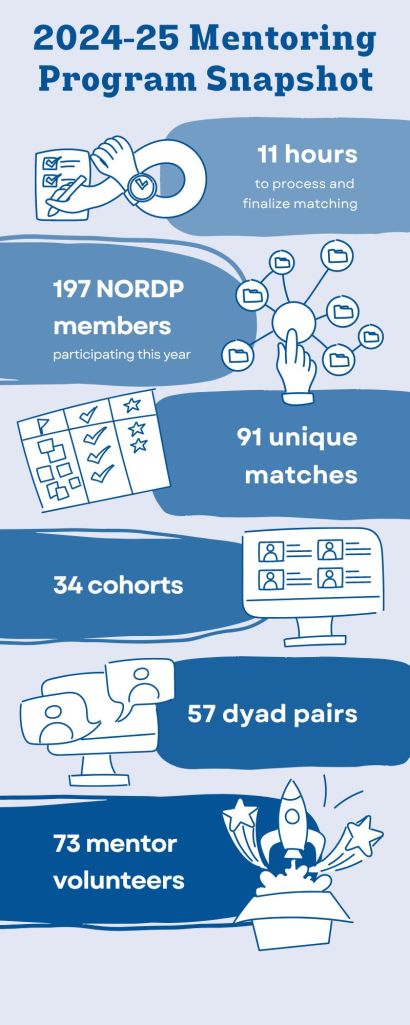
Using this year’s WisdomShare mentor- and mentee-profiles, the Match Team spent approximately 11 hours to process and finalize the matching. Overall, we have 197 NORDP members participating in this year’s Mentor Program. We matched 91 unique matches — 57 dyad pairs and 34 cohort groups, a slight increase compared to 56 dyad pairs and 31 cohort groups in 2023. The Mentoring Committee is especially excited for another year of mentoring cohorts after two successful years. Mentoring cohorts match three mentees to one mentor and they lead peer-mentoring discussions throughout the year. Many thanks to the 73 brave individuals who volunteered to be a Mentor either in a dyad or cohort this year!
Advice for new mentors and mentees (matched participants):
Use the WisdomShare “Learning” tab to help you figure out where to begin.
Log into WisdomShare for your mentor/mentee’s contact information, messaging, and for a suggested milestones list.
Go to the WisdomShare Dashboard to find active Cohort and Peer Mentoring Groups (PMGs) and to join the PMGs you are interested in.
If your mentor/mentee has not reached out to you yet, be the first to contact them! There is no right or wrong way to connect to RD peers.
Look out for future McHuddles – informal gatherings hosted by NORDP Mentoring Committee facilitators and an opportunity to share ideas, ask questions, and collectively learn from other mentees/mentors in breakout sessions.
Contact the Mentoring Committee (mentorprogram@nordp.org) if you have any questions, concerns, or suggestions.
The McMc team is always looking for mentoring dyads and cohorts to profile in a blog post. If you were part of a 2023-24 mentoring dyads and cohorts and are willing to share your experience, contact the McMc team through mentorprogram@nordp.org.
Conferences are a great way to connect to people, network, and learn about new processes, practices, and guidelines. Roshni Singh, an aspiring RD professional, and a first-time NORDP attendee, and Andrea Navas-Calixto, PhD, Vice President of the Colombian Association for Research Management and Administration (COREMA), also a first-time NORDP attendee, found the 16th NORDP conference important, well-balanced, and well-organized. We were impressed by how well the conference was organized with an attractive agenda, well-set goals, and objectives.
Andrea: At the School of Engineering Universidad del Valle, Colombia, we faced multiple challenges during and after the pandemic and had to change our practices and the activities for conducting research and obtaining funding, hence, the next conference needed to be in person to understand the changes. Upon registering for the 16th NORDP conference, I was pleasantly surprised by the conference organization and its details. The Whova app was a fantastic tool that allowed me to organize my schedule, exchange valuable information, and connect with wonderful people. At the conference, everyone greeted me with open arms, and the location was very convenient in a city that had a lot to offer. The conference agenda was very enriching; however, my biggest fear was that the information in the talks would only be useful for professionals in the United States, but that was not the case. Talks were relevant to anyone in RD roles, no matter the geographical location, which I can learn from, adopt, and adapt to Colombian institutions. Moreover, I was inspired by the focus on healthy eating, zero waste orientation, and support for beautiful causes like The Sophia Way. These details are something we can also learn to implement in Colombia. From the conference, I’m taking away some great ideas regarding initiatives related to diversity, equity, inclusion, and accessibility (DEIA) where we still have a lot to learn and have f a lack of clear tools and processes. Additionally, I believe I’ll propose programs like the doctoral intern’s program in the research office and ideas for multidisciplinary work, among others.
Roshni: I was one of the registration award recipients which made this conference achievable for me. As a first-time NORDP attendee and an aspiring RD professional, the NORDP conference was an immensely rewarding and fulfilling experience. During my career in industry, I have been to many conferences, but this conference had the audience in mind as the sessions were for every level, whether new to the conference, new to the RD field, or working on a new initiative. I loved the idea that the conference was organized by RD professionals, which is not often the case, as the majority of the time, sponsors run the show. The sponsors, however, played an important role in the conference giving insights on their services which was helpful for me in understanding the different services academic situations require. I contribute to NORDP by volunteering for the International Working Group and Career Stories, where I write blog posts recapping the latest featured professional. The conference allowed me to meet all the RD professionals I wrote blogs on and members of the committees whom I only see online. Everyone was warm and I made many new connections who gave me advice about the field.
Some talks Andrea and Roshni enjoyed:
“What We Talk About When We Talk About Critique” by Susan Ferrari, Grinnell College, Kevin Boettcher, Binghamton University, Tisha Turk, Grinnell College: These types of talks motivate RDPs as they remind us of our limits. The temptation to edit proposals and rewrite is very high, especially when we work against the clock with deadlines on us.
“Building Pathways to Careers in Research Development: Leveraging the Graduate Student Career Exploration Program at Illinois Office of Proposal Development (OPD)”by Richard Sallee, Limited Submissions Manager, Suzanne Berry-Miller, Assistant Director, Research Strategy Center for Social & Behavioral Science (CSBS), Sneha Das, Research Development Manager Brenda Koester, Associate Director: This is a program that seems quite easy to replicate in any institution, with clear rules and mutual benefits for both the graduate student and the research development office.
“Lessons Learned from Seeding Interdisciplinary Teams: Outcomes, Challenges & Missteps”: this talk was valuable as it shows that programs can continue improving version after version and learning without forgetting the initial purpose, which, in this case, was to encourage teachers to engage in interdisciplinary work.
“Beyond RD101” by Joanna Downer, Jill Jividen, Katie Shoaf, Sharon Pound, and Amy Carroll; this interactive workshop allowed the attendees to share their opinions on future topics for effective RD training.
We both would like to thank the NORDP conference committee for a wonderful and very informative conference.
Written by: Mentoring Committee Marketing and Communication Team (McMc)
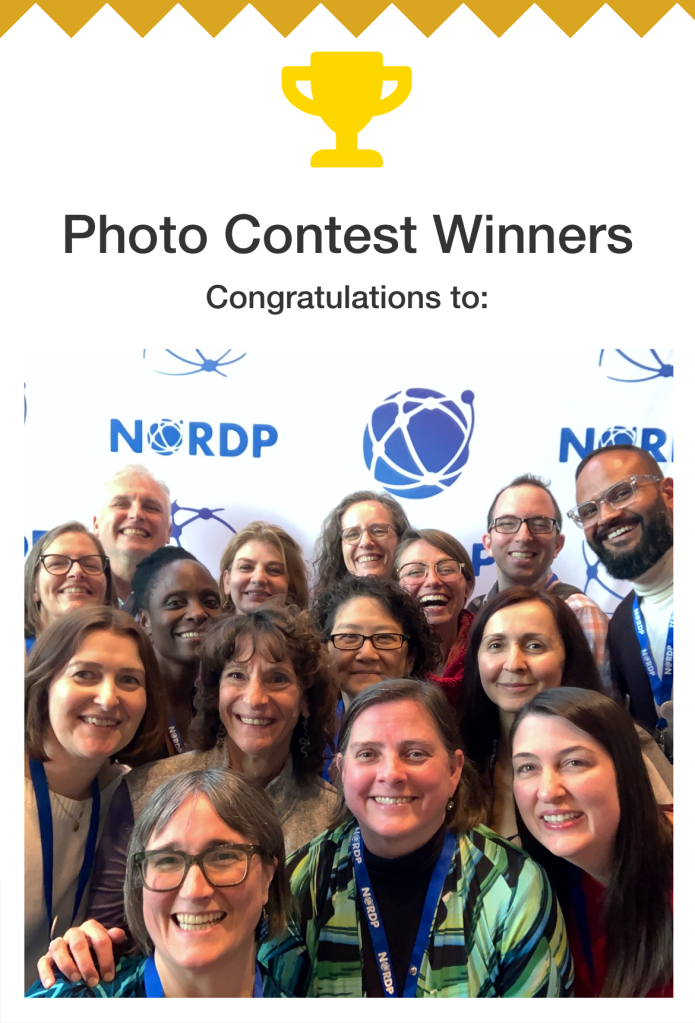
A Big Thank You to all the volunteers who have dedicated their time and effort for the Mentoring Committee (MC) this past year! The MC sponsored a mentoring volunteer appreciation dinner at the 2024 NORDP Conference in Bellevue, WA, where 17 members were able to participate. In fact, the MC group photo was this year’s photo contest winner — many thanks to Hilda McMackin for instigating the photo-opp.
At the MC Lightning Storm, eight speakers shared a wide range of mentoring experiences, highlighting lessons learned about being a mentor or a mentee from thought-provoking perspectives and contexts. For example, Samarpita Sengupta presented her personal RD journey sharing unique challenges from an immigrant’s perspective and highlighted lessons learned for mentors with immigrant mentees; Kelsey Hassevoort shared how she developed her mentor network using informational interviews. Rounding out the speakers of the MC LIghting Storm are: Monica Castañeda-Kessel.Sonya Craig, Joanna Downer, David Hopfe, Hilda McMackin, and Sarah Robertson, with Hilda, David, and Elizabeth Lathrop as the moderators.
The conference breakfast on Monday 4/29 was a great time to connect with NORDP committee members and hear about the work done by the MC committee. The MC breakfast table was packed with conference attendees eager to learn how to join the committee sessions, events, and programs, and to meet the more experienced mentoring “veterans.” The committee members rose to the occasion and showed up early, ready to share experiences and advice. The extra chairs pulled from nearby tables to accommodate everyone joining the conversation were a great testimony to the committee’s hard work and dedication to communication, openness, and pure awesomeness!
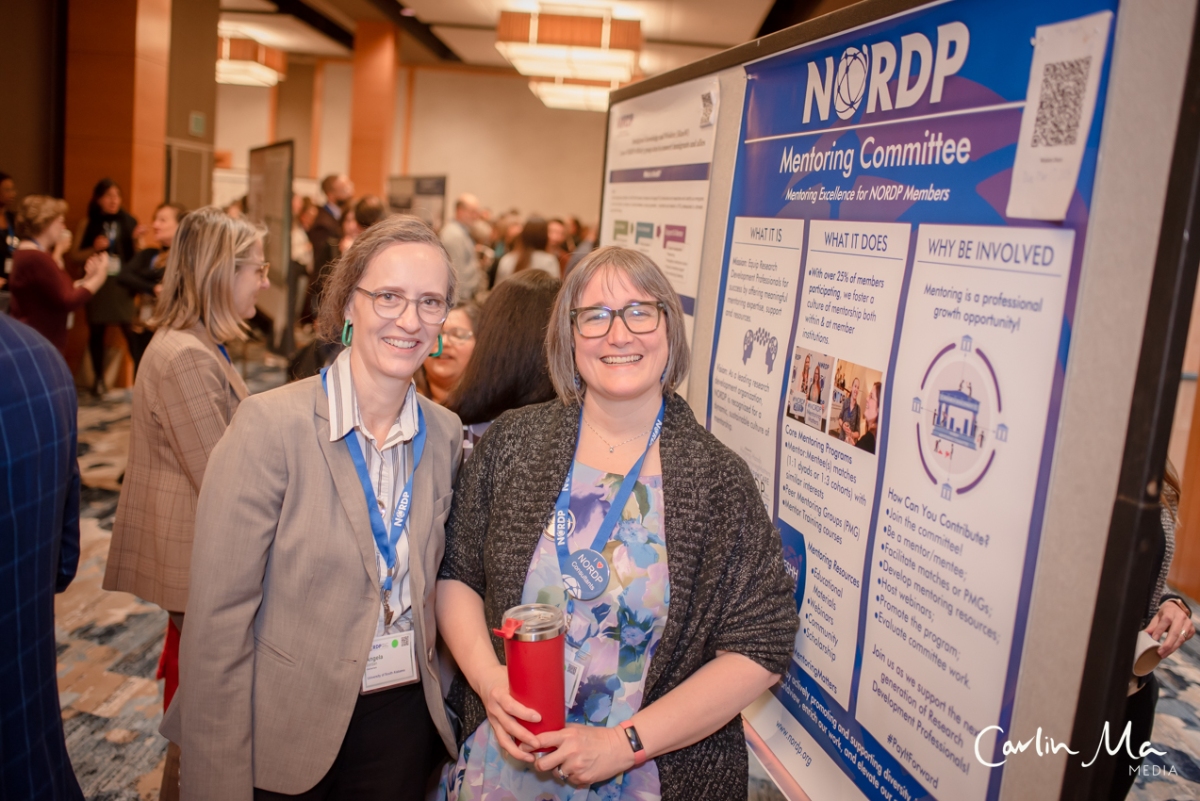
The conversation in front of the MC poster during the Tuesday Poster Session was as lively as the breakfast talk from the previous day. Supported by visuals via the MC evergreen poster, we were able to recruit at least a dozen mentoring volunteers and new mentors/mentees. A heartfelt thank you to Jan Abramson who made mentoring buttons and provided a large box of chocolate truffles. She sent them via snail mail since she was unable to attend #NORDP2024. The chocolate treats definitely helped attract the crowd’s attention and interest.
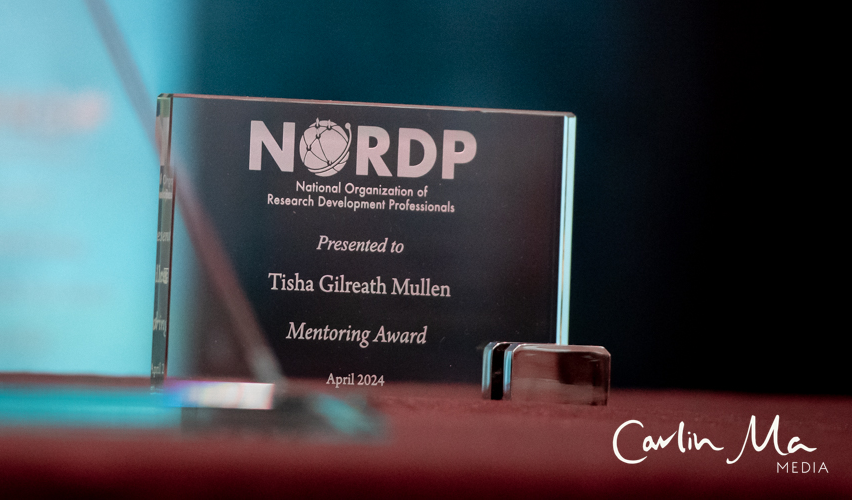
Finally, we are so excited that MC co-cair Elizabeth Lathrop was recognized with a 2024 Rising Star Award during the Awards Ceremony. [Insert picture from photographer] We are so proud of everything you have done to lift the Mentoring Committee, Elizabeth! In addition, Mentor Training Team lead Paula Carney was also awarded the Mentoring Award along with Tisha Mullen this year – Congratulations!
The MC is looking forward to a new enriching mentoring season!
Inspired? You can learn more about MC committee work by reaching out to mentorprogram@nordp.org
Contributor: Kristin Boman, University of Minnesota, Twin Cities
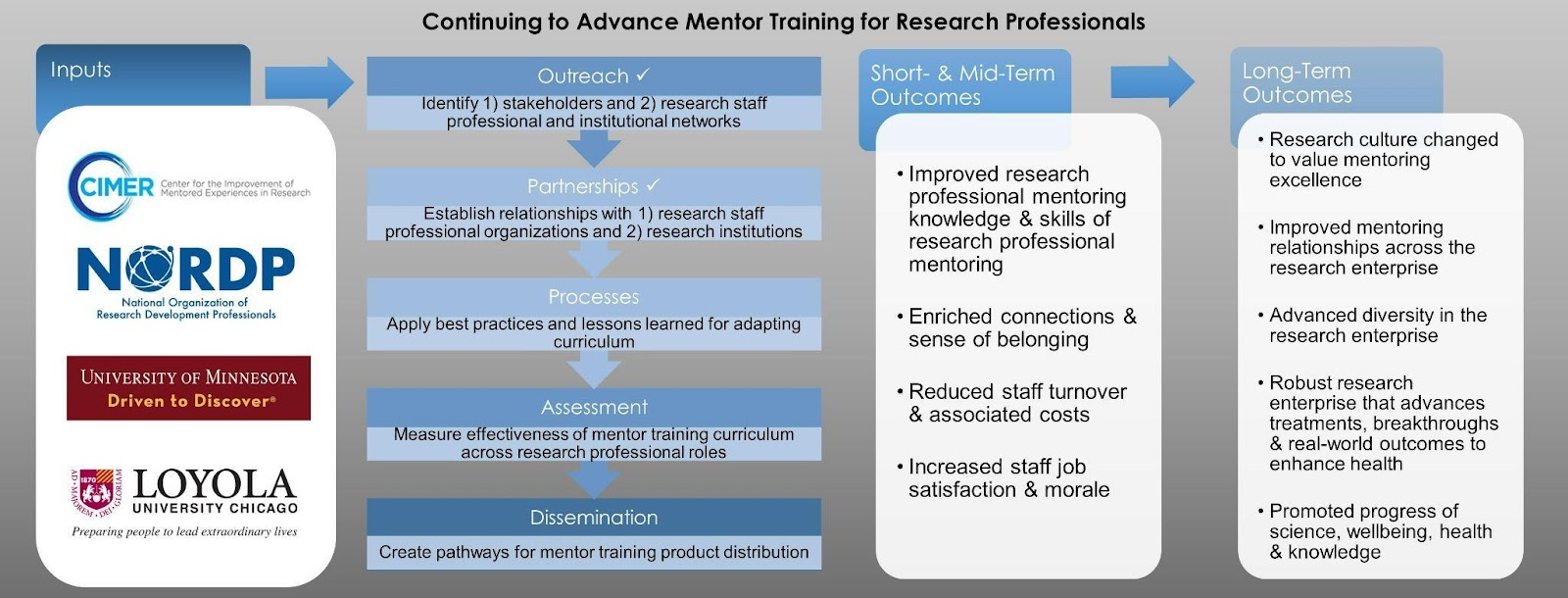
In academic settings, research mentoring and mentor training has traditionally been focused on faculty and trainees. NORDP collaborated with NIH-funded evidenced-based Center for Improvement of Mentored Experiences in Research (CIMER) to adapt the Enter Mentoring curricula for research development professionals. Since then, 100 + NORDP members (7% of members) through six cohorts have participated in mentor training for research development (RD) professionals offered by the NORDP Mentoring Committee.
The RD mentor training curricula is being adapted further for research professionals, i.e. program managers, clinical research coordinators, regulatory and compliance officers, etc. in collaboration with personnel from the University of Minnesota’s (UMN) Department of Family Medicine and Community Health and Clinical and Translational Science Institute, Loyola University Chicago and CIMER. Once the curricula adaption is completed, it will be beta tested, assessed, and disseminated (see figure below).
One of the NORDP Mentoring Committee‘s goals is to contribute to the national scholarly discussion of mentoring and bring knowledge of the state-of-the-art in the science of mentoring to NORDP. With support from NORDP Mentoring Committee, UMN, and CIMER travel awards, Kristin Boman presented a poster on staff mentor training at the 2024 Association for Clinical and Translational Science (ACTS) meeting in Las Vegas, Nevada, April 3-5, 2024. Boman co-chairs the NORDP Mentor Training Team with Dr. Paula Carney and leads the UMN Primary Care Practice Based Research Network. The poster generated interest from training and workforce development leaders at several universities; in fact, conversations have begun about potential dissemination pathways.
Several members of the NORDP Mentor Training Team have laid the groundwork for this initiative by volunteering their time and skills, especially Paula Carney, Kathy Partlow and Jan Abramson who led the initial training adaptation for RDs. The most recent cohort was highlighted in a recent blog post. Feedback from NORDP participants has also been instrumental for continual improvements to the training curricula. The next NORDP Mentor Training Workshop is anticipated to launch in early 2025.For more information on the NORDP Mentoring Committee, including how to become involved, please contact the Mentoring Committee via mentorprogram@nordp.org. You can also visit the mentoring tag on NORDP news for any program updates.
Registration for the 2024-2025 Mentoring Program is currently open on Wisdom Share for all NORDP members to sign up as a mentor, a mentee, or both. New participants need to create an account on Wisdom Share. Returning participants should follow the instructions available online from the NORDP Mentoring Committee. Deadline to apply for the 2024-2025 mentoring program closes on Friday, May 17, 2024.
In this installment of the Mentoring Reflections, we caught up with mentee-mentor pair Sandra Arriaga (Mentee) and Julie Hawk (Mentor) from the 2023-2024 cohort of the Mentoring Program to share their experiences with NORDP.
Sandra Arriaga is a Research Development Specialist with the Stanford Research Development Office and has spent the entirety of her career working in higher education. After years of teaching college composition, running academic programs, and writing proposals on the side (with a brief stint living and working in Amman, Jordan), she transitioned to the field of research development full time. Sandra has a Master’s degree in English with a concentration in Teaching English to Speakers of Other Languages (TESOL) and brings a background in education, social science, and applied linguistics to her work supporting STEM faculty from across the university on their proposals. Outside of work, Sandra enjoys traveling and yoga, and is learning to play drums.
Julie Hawk obtained her PhD in English from Georgia State University in 2012 and spent the next few years teaching at Georgia Tech and then the University of West Georgia, where she discovered that she could translate the skills from her training to a Research Development context. Since 2016, she has been working with researchers on a variety of kinds and sizes of grants. She currently works at Emory University School of Medicine in the Department of Pediatrics, where she deals mostly with large biomedical grants. However, her experience in both an emerging research institution and at an engineering powerhouse provides a wide skillset and range of disciplinary directions for grant seeking.
Q1: What influenced you to apply to be a mentor and a mentee for the 2023-2024 NORDP Mentoring Program?
SA: I am relatively new to research development, having started my current position in 2021 after a few years writing and editing proposals outside of my previous full-time role. Initially, I prioritized getting to know my immediate colleagues, supervisor, and institution while taking advantage of the many resources that NORDP offers. Once I had solid footing in my current role, I felt ready to join the NORDP’s mentoring program because I had heard wonderful things about it from my co-workers.
JH: I have been doing Research Development for several years, and last year I had a wonderful experience as a mentee in this program. Not only did the mentoring relationship provide a touchstone for learning more, but it also showed me that I was more ready to be a mentor than I thought. So I decided to pay it forward and sign up as a mentor.
Q2: What is your favorite part about your relationship?
SA: Julie offers great perspective and is just plain fun to talk to. We have a lot in common and both of us have our cats make a guest appearance more often than not. Her thoughtful advice and observations always make me feel energized after our calls, no matter what is going on for me in work and life.
JH: Sandra and I have a lot in common, including our educational backgrounds and our past teaching experience. These commonalities allow for easy analogies when we are talking through various experiences in our work lives. Sometimes I forget that I’m officially her mentor, as I certainly get as much out of the mentoring relationship as a mentee is supposed to. It truly is a bidirectional exchange.
Q3:How has participation in the Mentoring Program helped broaden your horizons about Research Development in general and/or affected your daily work in particular?
SA: Because I’ve only held one “official” RD position so far, I can sometimes lose sight of the fact that so many of us experience the same kinds of challenges and that others have dealt with them before me. Julie brings an outside point of view from within a similar professional culture, adding a voice of reason and experience which helps me reflect more deliberately. Through talking with Julie, I also learned more about her experience as an NORDP Consultant and became more interested in that type of work.
JH: Both as a mentee last year and a mentor this year, I have learned so much about the varied ways to approach RD work as well as the similarities that underlie all those variations. Working in a department as the sole RD professional, a network of colleagues is something I must intentionally cultivate. Participating in the mentoring program is one very important way that I do that, and it is extremely valuable.
Q4: What surprised you about being a mentor or a mentee?
SA: How much I needed one! It was the right time for me, and I was fortunate to be matched with the right mentor. While I have many opportunities to engage in professional development and mentoring within my organization, there’s nothing like talking to someone who “gets it” but isn’t steeped in the exact same context. It was also very beneficial to work through the MESHH Network framework with someone. Talking with Julie helped me see mentors and opportunities to find mentors where I hadn’t seen them previously.
JH: Like many others, I occasionally suffer from Imposter Syndrome, so I think I was most surprised by the fact that I actually know a lot more about RD than I realized. I was also surprised that the mentoring matching system seems to work so well. Both last year and this year, it matched me very well indeed!
Q5: What made you decide to maintain a longer-term mentoring relationship and how has it impacted you?
SA: When I reflect on my career so far, one theme that emerges is that whenever I’ve had the opportunity to learn from a mentor, I have thrived. In a previous career (teaching), I also served as a mentor after I had accumulated enough experience, and both sides of the mentoring relationship have been so valuable. Through the mentoring relationship, I have been able to appreciate how much I’ve learned and refined my own internal compass. I find mentoring especially important because I work remotely. I can intentionally build the type of connections that non-remote employees might be able to create more serendipitously.
JH: I have always benefitted from longer term mentoring relationships, whether they were formal or informal arrangements. After experiencing a great deal of benefit as a mentee in the program last year, I knew that any fears I had about not having enough time to participate were unfounded. Like the adage that one should meditate for at least 10 minutes every day unless you’re too busy, in which case you should meditate for 30 minutes, the mentoring relationship serves as a reflective experience that re-energizes my everyday work life.
Q6: Any words of wisdom or encouragement for those wanting to apply next year? Any other thoughts you would like to share?
SA: If you’re worried about having enough time, consider the “return on investment.” The way you’ll feel refreshed and re-charged after talking with your mentor will likely make managing your time easier in other aspects of your work. And by all accounts, NORDP does an excellent job with matching people. You won’t regret it!
JH: If you’ve been in RD for a while but think you aren’t advanced enough to be a mentor, that’s probably Imposter Syndrome. On the other hand, you could always start by being a mentee. Regardless of which you do (or both!), you will absolutely benefit from it.
Written by the Conference Committee Branding and Communications Working Group
NORDP has invited Dr. Marie Bernard, Rhonda Davis, and Dr. Travis York to deliver a keynote panel to kick-off the NORDP 2024 Conference on Monday, April 29, 2024. The structure of the panel will include opening remarks from each guest speaker outlining important diversity, equity, and inclusion initiatives at the National Institutes of Health (NIH), National Science Foundation (NSF), and the American Association for the Advancement of Science (AAAS).
Travis York, AAAS
“When I think about how to make meaningful change to increase access and opportunities for all people, research development professionals are well-positioned to build the capacity of institutions and organizations through thoughtful design.” — Travis York (AAAS)
Marie Bernard, NIH
“My role as the NIH Chief Officer for Scientific Workforce Diversity is to work across NIH, visioning at the 50,000-foot-level, to foster a diversity of perspectives in science.” — Marie Bernard (NIH)
Rhonda Davis, NSF
“I am excited to share how NSF thinks both about the research integrity space and about supporting researchers as they currently exist.” — Rhonda Davis (NSF)
All the speakers are looking forward to engaging with the NORDP audience. The keynote panel will feature a moderated discussion and include time for audience questions.
The invited panelists and the conference planning committee are so excited to share this conversation with #NORDP2024 attendees.
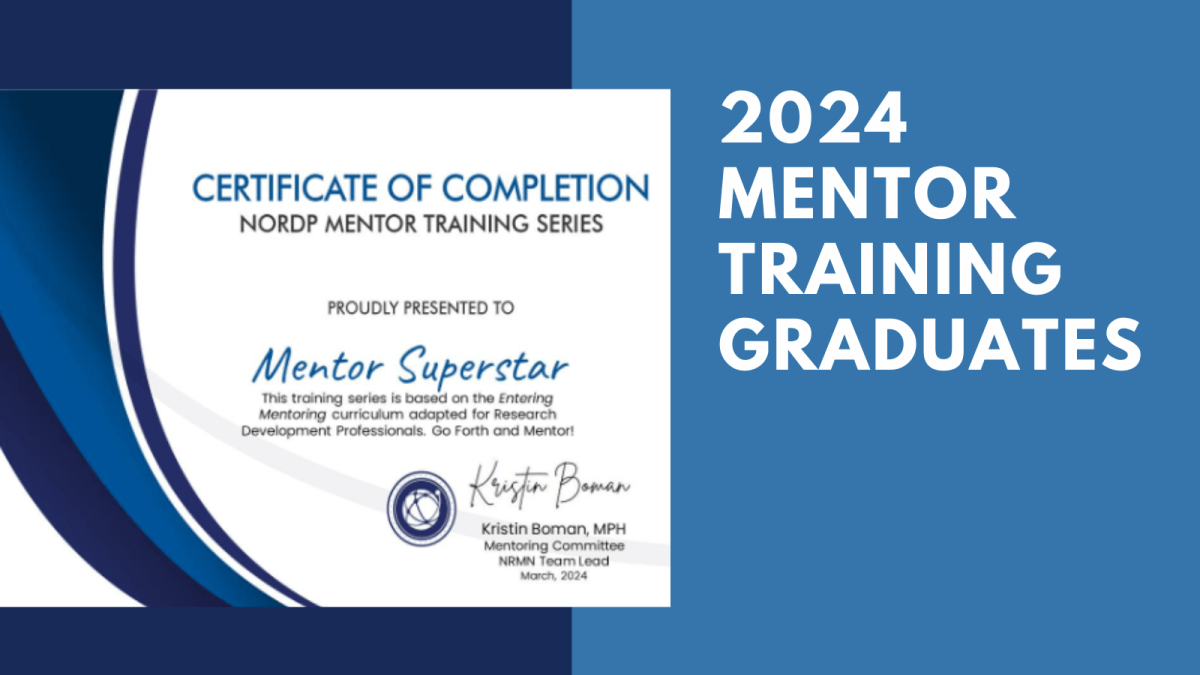
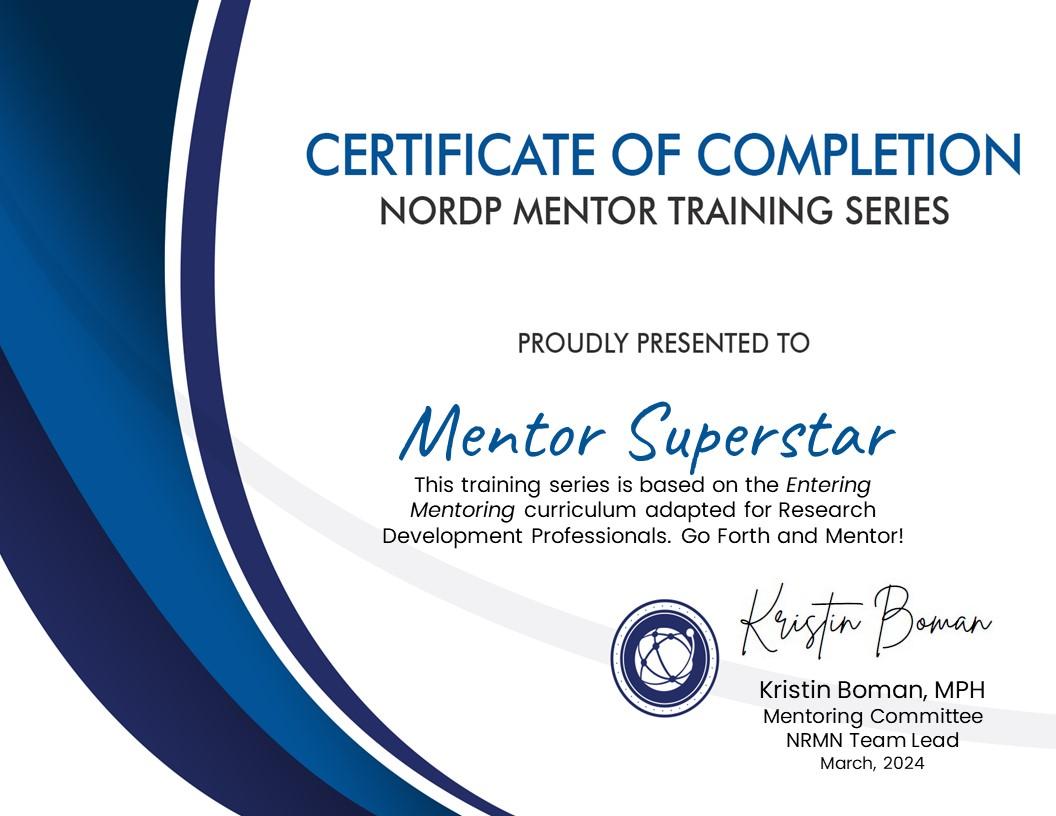
The NORDP Mentoring Committee’s Mentor Training Team held a mentor training workshop in January – March 2024. Nineteen NORDP members completed the 5-week workshop, covering the 9-module Entering Mentoring curriculum initially developed for research mentors and tailored by the NORDP Mentoring Committee for RD professionals in collaboration with the University of Wisconsin Center for Improvement of Mentored Experiences in Research (CIMER). Over 100 NORDP members have completed the Entering Mentoring Workshop and received certificates.
RD professionals explored key mentoring competencies that can benefit RD mentors and mentees that have been associated with improved career outcomes, employee engagement and retention, and more inclusive work environments. The workshop was facilitated by NORDP members Jan Abramson, Kristin Boman, Paula Carney, Rachel Goff-Albritton, Melissa Li, Kathy Partlow, and Samar Sengupta. The NORDP Mentoring Committee is committed to equipping Research Development professionals for success by offering meaningful mentoring expertise, support, and resources. If you would like to be contacted when the next Mentor Training workshop series is scheduled, please email mentorprogram@nordp.org.
Congratulations to the following 2024 NORDP Mentor Training graduates!
Sowmya Anand
University of Illinois
Vinita Bharat
Stanford University
Sherri Burda
New York University
Cate Caldwell
Black Hills State University
Caitlin Charos
University of California, Santa Cruz
Kaylynn Coates
Cleveland Clinic
Mandy Davis
Texas A&M University, Texarkana
Palemon Gonzalez
Research Development Consultant, Mexico City
Stephanie Haddad
University of California, Santa Cruz
Angela Jordan
University of South Alabama
Keri Jupka
University of Missouri, St. Louis
Prapti Mody
UT Southwestern Medical Center
Kelly Anne Moore
Emory University
Hugo Moreno
Research Development Consultant, Mexico City
Aimee Oke
Colorado State University
Daniel Riechers
University of Massachusetts, Lowell
Branden Ritter
Ohio State University
Claudia Scholz
University of Virginia
Ruth Sosnoff
University of Kansas Medical Center
Carol Thornber
University of Rhode Island
Monica Vidal
Stanford University School of Medicine
Nancy Walker
University of Missouri, Columbia
Kathryn Wrench
Lawrence Technological University
Kartik Yadav
University of California Irvine
Table: list of 2024 NORDP Mentor Training graduates and their respective organizations.
Contributors: Proposal Development Peer Mentoring Groups (PMG) Co-conveners — Sonya Craig, New York University, Grossman School of Medicine and Lindsay Ridpath, University of Arizona
The Proposal Development field is growing as proposals become more complex and as the competitiveness for obtaining research funding continues. Academic success is not achievable through the efforts of a solitary individual; the era of lone geniuses thriving in academia has passed, emphasizing the collaborative nature of contemporary academics that thrives on teamwork, be that with other investigators or with research development (RD) professionals.
To help RD professionals build a network of support, NORDP initiated the peer mentoring groups (PMGs) in 2019, out of what was then the Community of Practice Groups. As David Widmer stated for an earlier blog post about the PMGs: “We are never fully developed by a single mentor. If you think about your broader network, it’s clear that you are being mentored by multiple people.” Jan Abramson said PMGs developed “from a discussion about member needs, the importance of building a network of mentors, and making sure anyone who requests a mentor has one.” A driving factor in PMGs is NORDP members’ needs. Christina Howard, David Widmer, Jan Abramson, Kathy Partlow, Faye Farmer, Katie Shoaf, and other members of NORDP’s Mentoring Committee, are the brains behind the PMGs, orchestrating the programming that has proven to be a valuable resource for many. The Proposal Development PMG is one of six active groups.
Proposal development can be summarized as the process of advising, writing, editing, coordinating, and compiling grant applications. The RD specialist can have many roles within proposal development, including as an educator, a project manager, a writer/editor/illustrator, or an advisor and advocate. Many proposal development professionals give guidance on and coordinate writing of grant components (including budgets, letters of support, and research strategies), manage grants libraries and other institutional resources, and coordinate and manage peer or “Red Team” reviews.
The proposal/research development role has evolved over the last decade, leading to major growth in proposal development specialists in university settings. Now, innovations in generative Artificial Intelligence and graphic design have the potential to transform both proposal development and proposal evaluation, meaning that the roles of RD professionals are likely to change in the near future. Likewise, complex proposals and transformational initiatives, like ARPA-H, are transitioning grant writing from a solo experience to one requiring strategic planning from a group. Industry support in research is also increasing, as more government agencies are including industry participation in their proposals. Some examples of this are the National Science Foundation’s (NSF) Innovation Engines (NSF Engines) and Directorate for Technology, Innovation, and Partnerships (TIP) programs, and the US Economic Development Association’s (EDA) Regional Technology and Innovation Hubs (Tech Hubs). Companies like Amazon are increasingly offering research awards (Amazon Research Awards) to test solutions. Industry understands the value academic research brings and is increasingly interested in research collaborations rather than developing an internal R&D arm.
By connecting with colleagues at other universities through our Proposal Development PMG, members are able to stay abreast of how other institutions are negotiating these new developments as they arise. Our PMG has active members from all over the US, in the medical, engineering, social science, and humanities fields. Some members are in leadership roles within their institutions working in large RD offices, while on the other extreme, we have colleagues who are independent consultants who work from home. We both joined the PMG for different reasons: Sonya was working within an academic unit as the sole grant writer and wanted to grow her RD professional network; whereas Lindsay joined the PMG as a Foundation Relations professional with the goal of cultivating connections and gaining a comprehensive understanding of the research enterprise. Whatever your office size or job classification, if you have an interest in discussing proposal development best practices and challenges, we invite you to join us for an informal conversation the first Tuesday of every month at 1 pm ET. See this site within WisdomShare for more information, or direct any questions by emailing the Mentoring Committee at mentorprogram@nordp.org.









 NORDP News