A Day in the Life of Mentoring Committee Volunteers
By Mentoring Committee Marketing and Communication Team (McMc)
The NORDP Mentoring Committee (MC) held another successful annual open house on Jan 15, 2026. More than 20 prospective and current Mentoring Committee members joined to hear from experienced colleagues about the psychological benefits of mentoring and what different MC roles entail.
A lively panel discussion centered around “A Day in the Life” of a Mentoring Committee volunteer showcased eight distinct MC roles and what it meant to be a volunteer in each role.Here is a recap of the panelists’ responses:
Matt Schwartz is the senior program manager for faculty development at UMass Chan Medical School, who manages a faculty development and mentorship program for early-career faculty. He feels the Mentor Training Team (MTT) is a natural place where he can jump in and help support better mentoring for RD professionals. The MTT meets throughout the year but the main focus is in February and March, when an intense mentor training workshop is offered to the NORDP members. The training regimens (two mentor trainings per week) are offered using evidence-based practices adopted from CIMER for RD. As a volunteer, Matt learns how to facilitate and gains experience through co-facilitating with someone who is more experienced.
Jet LeBlanc, Lead Coach and Team Development Consultant at ATG, and Sujatha Koduvayur, Director, Research Development at Worcester Polytechnic Institute, are both volunteer conveners of two different Peer Mentoring Groups (PMGs)—Coaching and RD and AI in RD, respectively. They reflected on the fun they had interacting with their PMG members and noted that the time commitment is between 2 and 4 hours per month, including the 1-hour monthly online meeting with the group. PMGs are unique because they are not time-bound to a program year and NORDP members can join a PMG at any time!
Jess Brassard, Director of Research Development and Communication, serves on the Mentoring Committee Marketing and Communication (McMc) subcommittee and the broader Communication Working Group (CWG), though serving on the CWG is not required for McMc members. Jess shared that the McMc has one monthly meeting per month apart from the full Mentoring Committee meeting. During meetings, the subcommittee collaboratively drafts content for blog posts which profile mentoring activities and Mentoring Committee offerings—about one blog post per month is typical. This is a fun and easy fit for NORDP members who like writing. To join the co-working fun on the McMc, send a note to mentorprogram@nordp.org.
Vess Vassileva-Clarke, Director of Research Development at University of Michigan – Dearborn, highlighted the opportunity to serve on the Match Team. The Match Team’s efforts are focused during a short, intense period once a year, usually in April–May. The work involves serving as humans-in-the-loop for the mentoring matching program algorithm (housed in Wisdom Share) to make sure optimal matches are made. Joining the Mentoring Match team can be a short-term commitment and can be satisfying to know that you’ve helped connect people to start new relationships. To join this team and help with annual matching, attend the April or May Mentoring Committee meeting and let the group know you are interested, or send a message to mentorprogram@nordp.org!
The open house highlighted Mentoring Committee membership, activities, and events. As a reminder:
The PMGs are open at any time.
The 2026-27 mentoring year for dyads and cohorts will conclude in June. New matched dyads and cohorts for the 2026-27 mentoring year will launch in July 2026. The application portal will be open in May—look for the announcement in the NORDP Monthly newsletter.
The Mentoring Committee is looking forward to a productive 2026 with volunteers!
Written by: NORDP Mentoring Committee Communication & Marketing (McMc) Team—Vess Vessileva-Clarke, Elizabeth Lathrop, Brooke Gowl, Jessica Brassard
Applications for the 2025–2026 NORDP Mentoring Program are now open until Friday, May 16! NORDP members are invited to participate as a mentor, a mentee, or both. The NORDP Mentoring Program is a benefit available to all NORDP Members. This program enables research development (RD) professionals to network with NORDP colleagues who have volunteered to share their expertise, guidance, and support. There are two options for matching mentors and mentees in the program: the 1:1 Dyad or the 1:3 Mentoring Cohort (one mentor paired with three mentees).
Key highlights from the 2025 Mentor Recruiting Info Session (4/15).
As a growing profession, NORDP always has more mentees than available mentors.
A small but enthusiastic group of NORDP members interested in exploring the possibility of becoming mentors joined the Mentoring Committee Co-Chairs on Tuesday, April 15, for the annual Mentor Recruiting Info Session. The session began with a brief presentation on what mentoring is and a description of the role of the mentor. People with years of mentoring experience shared stories and best practices from their mentoring “careers.” Additionally, participants were introduced to the NORDP matching program details, the different mentoring “flavors” (dyads and cohorts), and common myths related to mentoring.
During the Q&A, those with experience as mentors encouraged others to become mentors! One does not have to have years of RD experience or formal mentor training in order to be an excellent mentor. Additionally, mentoring is a two-way street. As a mentor, you will likely gain as much as you give.
Mentors are provided with resources in WisdomShare to aid them in their mentoring efforts. There are also facilitators they can reach out to if they have questions or encounter situations for which they could use help. Prospective mentors were encouraged to consider a mix of mentoring experiences in dyads, cohorts, or even a dyad and a cohort in parallel.
Reflections from some of our most experienced NORDP Mentors
NORDP is a community of people who are passionate about sharing and learning with each other. When it comes to mentoring, there are many people with years of experience to share. Below are some highlights from past NORDP mentoring reflections:
Anglea: “Every mentoring relationship is unique.”
Wendi: “Continue participating in this program and serve as both mentor and mentee. The 360-degree perspective these roles provide will enhance your professional capacity and enrich your personal attributes.”
Christine: “I encourage each mentee to drive our relationship by setting goals (and allowing them to evolve), while I provide tools, resources, contacts, and advice toward achieving them.
Mayla: “Ask lots of questions.”
Toyin: “Extending grace to yourself is critical.”
Julie: “Mentoring truly is a bidirectional exchange.”
Sandra: “It was also very beneficial to work through the MESHH Network framework with someone.”
Julie: “The mentoring relationship serves as a reflective experience that re-energizes my everyday work life.”
Sofia: “Kathy opened my eyes to the possibility of leaving the bench for RD.”
Eric: “Learning how people persevere in their work through challenges and opportunities has helped me become more empathetic.”
Erica: “My mentoring relationships have contributed to my career progression and have made me a better RD professional and leader.“
Erin: “My mentor took the time to reach out to someone who knows people at my current institution and through this contact, I have expanded my network.”
Jess: “Having my mentor’s perspective helps me reflect more clearly because he sees things from an outside point of view while still having the context of our RD mission.”
David: “I feel we have crafted an important connection that will last beyond the mentoring year.”
Figure Caption: Mentoring Flavors & Benefits graphic provides useful information to help you decide how best to participate in this year’s NORDP Mentoring Program.
As applications for the 2025-2026 NORDP Mentoring Program open until Friday, May 16, we encourage all NORDP members to consider how you might benefit from participating—whether as a mentor, a mentee, or both. This valuable member benefit continues to strengthen our research development community through meaningful professional connections and knowledge sharing. Whether you choose the personalized attention of a 1:1 Dyad or the collaborative learning environment of a 1:3 Mentoring Cohort, your participation helps ensure that expertise, guidance, and support remain hallmarks of the NORDP experience. Don’t miss this opportunity to grow your network and advance your RD career!
Contributors: Mentoring Committee Marketing and Communication (McMc) Team
The summer always serves as an exciting beginning to the mentoring year. The typical cycle for the NORDP mentoring year runs from July to June for the mentoring dyad and mentoring cohort participants. The Mentoring Committee, specifically the Match Team and the Mentoring Leadership Team, work in May and June to make adjustments to the WisdomShare platform (more on that in a moment), prepare the application window, and make the matches and verify that good matches are being made.
On June 25, the Mentoring Committee sponsored the 2024 Mentor Program Orientation, introducing this year’s participants to the program and featuring one of the 2024 NORDP Mentoring Award recipients, Paula Carney. Breakouts based on participant’s role as a mentor or a mentee either in a dyad or a cohort, allowed everyone to learn more about what to expect in the year to come.
WisdomShare is a tool that NORDP has purchased to easily and effectively match mentors and mentees. The tool can match individuals or groups based on several criteria such as job level, years in the RD field, preference for dyad or cohort format, and other matching preferences. WisdomShare’s algorithm scores matches, but the Match Team and other mentoring committee volunteers still go through each dyad and cohort with an eye on the human element to make sure the best matches are made.
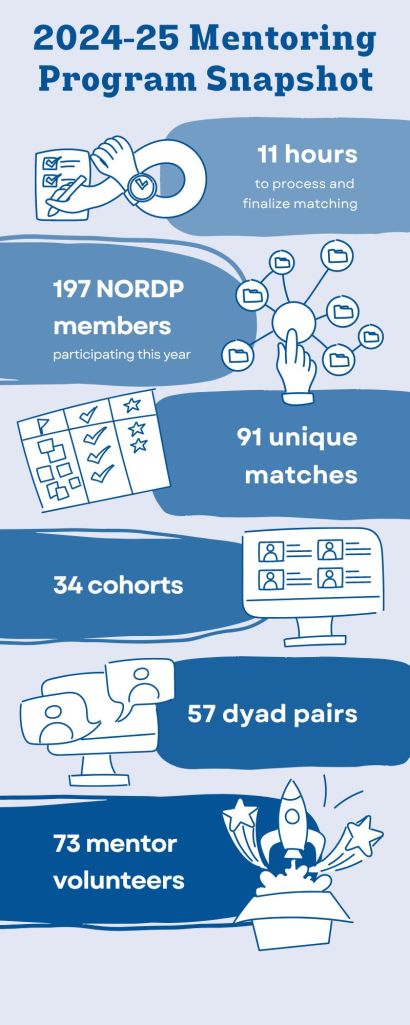
Using this year’s WisdomShare mentor- and mentee-profiles, the Match Team spent approximately 11 hours to process and finalize the matching. Overall, we have 197 NORDP members participating in this year’s Mentor Program. We matched 91 unique matches — 57 dyad pairs and 34 cohort groups, a slight increase compared to 56 dyad pairs and 31 cohort groups in 2023. The Mentoring Committee is especially excited for another year of mentoring cohorts after two successful years. Mentoring cohorts match three mentees to one mentor and they lead peer-mentoring discussions throughout the year. Many thanks to the 73 brave individuals who volunteered to be a Mentor either in a dyad or cohort this year!
Advice for new mentors and mentees (matched participants):
Use the WisdomShare “Learning” tab to help you figure out where to begin.
Log into WisdomShare for your mentor/mentee’s contact information, messaging, and for a suggested milestones list.
Go to the WisdomShare Dashboard to find active Cohort and Peer Mentoring Groups (PMGs) and to join the PMGs you are interested in.
If your mentor/mentee has not reached out to you yet, be the first to contact them! There is no right or wrong way to connect to RD peers.
Look out for future McHuddles – informal gatherings hosted by NORDP Mentoring Committee facilitators and an opportunity to share ideas, ask questions, and collectively learn from other mentees/mentors in breakout sessions.
Contact the Mentoring Committee (mentorprogram@nordp.org) if you have any questions, concerns, or suggestions.
The McMc team is always looking for mentoring dyads and cohorts to profile in a blog post. If you were part of a 2023-24 mentoring dyads and cohorts and are willing to share your experience, contact the McMc team through mentorprogram@nordp.org.
Written by: Mentoring Committee Marketing and Communication Team (McMc)
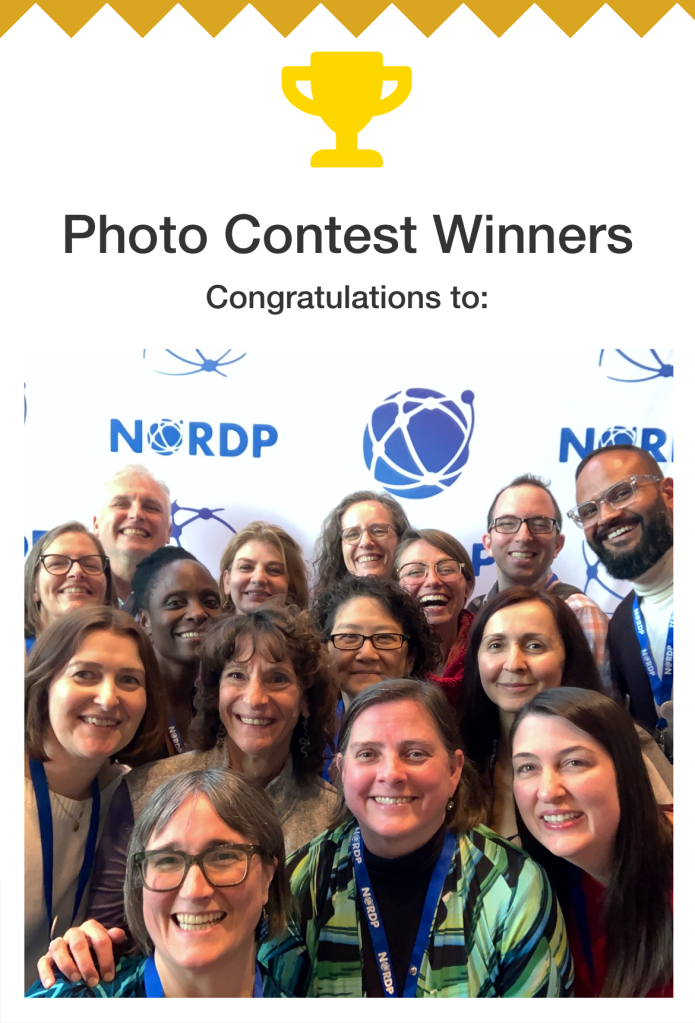
A Big Thank You to all the volunteers who have dedicated their time and effort for the Mentoring Committee (MC) this past year! The MC sponsored a mentoring volunteer appreciation dinner at the 2024 NORDP Conference in Bellevue, WA, where 17 members were able to participate. In fact, the MC group photo was this year’s photo contest winner — many thanks to Hilda McMackin for instigating the photo-opp.
At the MC Lightning Storm, eight speakers shared a wide range of mentoring experiences, highlighting lessons learned about being a mentor or a mentee from thought-provoking perspectives and contexts. For example, Samarpita Sengupta presented her personal RD journey sharing unique challenges from an immigrant’s perspective and highlighted lessons learned for mentors with immigrant mentees; Kelsey Hassevoort shared how she developed her mentor network using informational interviews. Rounding out the speakers of the MC LIghting Storm are: Monica Castañeda-Kessel.Sonya Craig, Joanna Downer, David Hopfe, Hilda McMackin, and Sarah Robertson, with Hilda, David, and Elizabeth Lathrop as the moderators.
The conference breakfast on Monday 4/29 was a great time to connect with NORDP committee members and hear about the work done by the MC committee. The MC breakfast table was packed with conference attendees eager to learn how to join the committee sessions, events, and programs, and to meet the more experienced mentoring “veterans.” The committee members rose to the occasion and showed up early, ready to share experiences and advice. The extra chairs pulled from nearby tables to accommodate everyone joining the conversation were a great testimony to the committee’s hard work and dedication to communication, openness, and pure awesomeness!
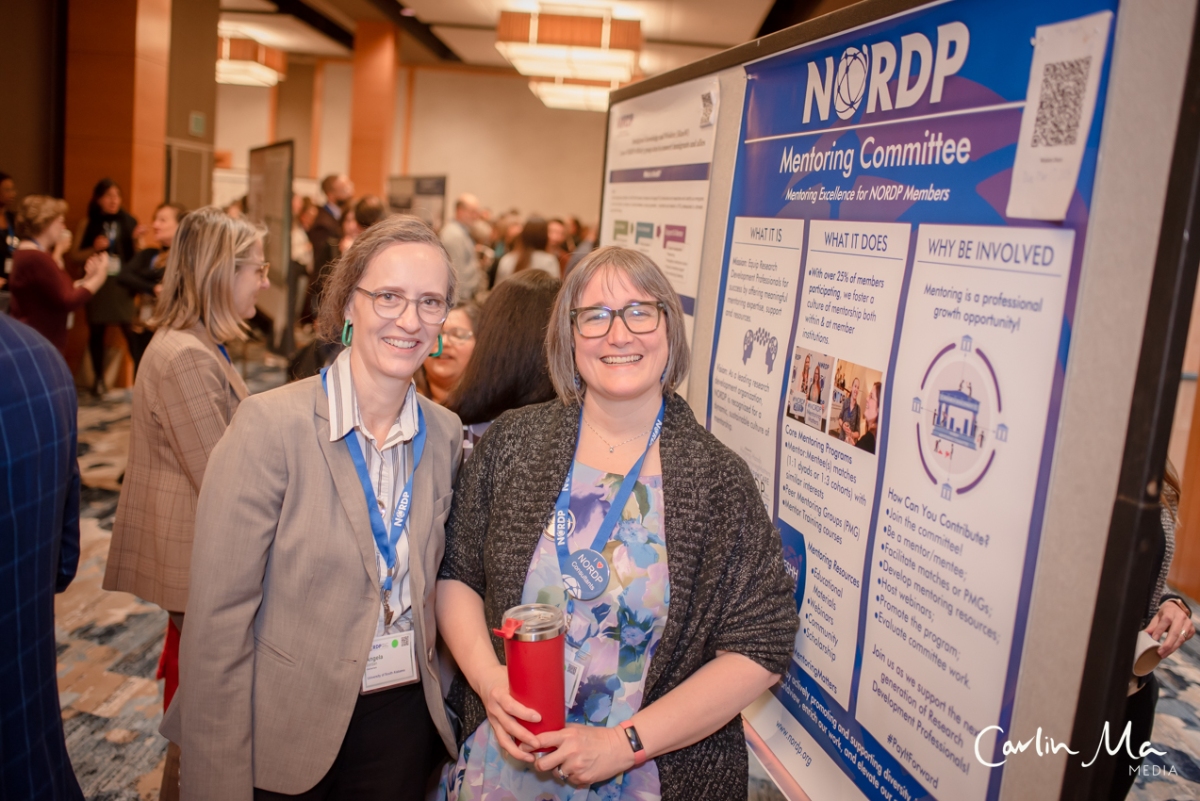
The conversation in front of the MC poster during the Tuesday Poster Session was as lively as the breakfast talk from the previous day. Supported by visuals via the MC evergreen poster, we were able to recruit at least a dozen mentoring volunteers and new mentors/mentees. A heartfelt thank you to Jan Abramson who made mentoring buttons and provided a large box of chocolate truffles. She sent them via snail mail since she was unable to attend #NORDP2024. The chocolate treats definitely helped attract the crowd’s attention and interest.
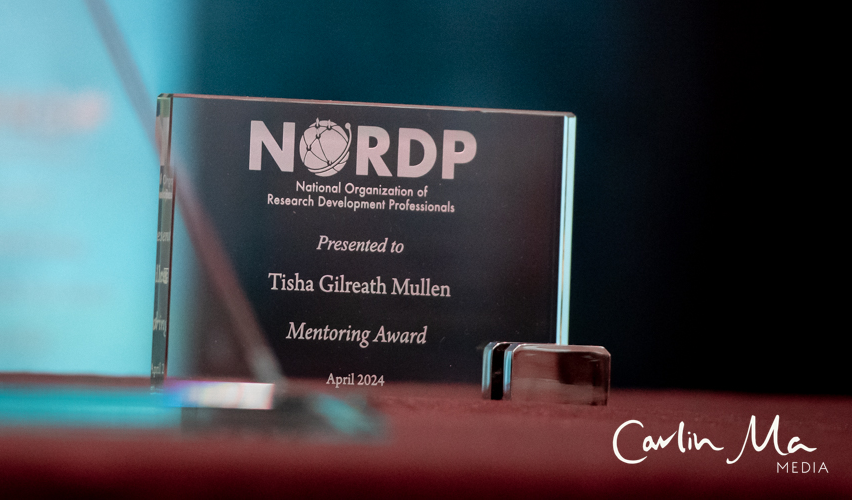
Finally, we are so excited that MC co-cair Elizabeth Lathrop was recognized with a 2024 Rising Star Award during the Awards Ceremony. [Insert picture from photographer] We are so proud of everything you have done to lift the Mentoring Committee, Elizabeth! In addition, Mentor Training Team lead Paula Carney was also awarded the Mentoring Award along with Tisha Mullen this year – Congratulations!
The MC is looking forward to a new enriching mentoring season!
Inspired? You can learn more about MC committee work by reaching out to mentorprogram@nordp.org
Contributors: Mentor Training Team Paula Carney, Loyola University Chicago and Kristen Boman, University of Minnesota, Twin Cities
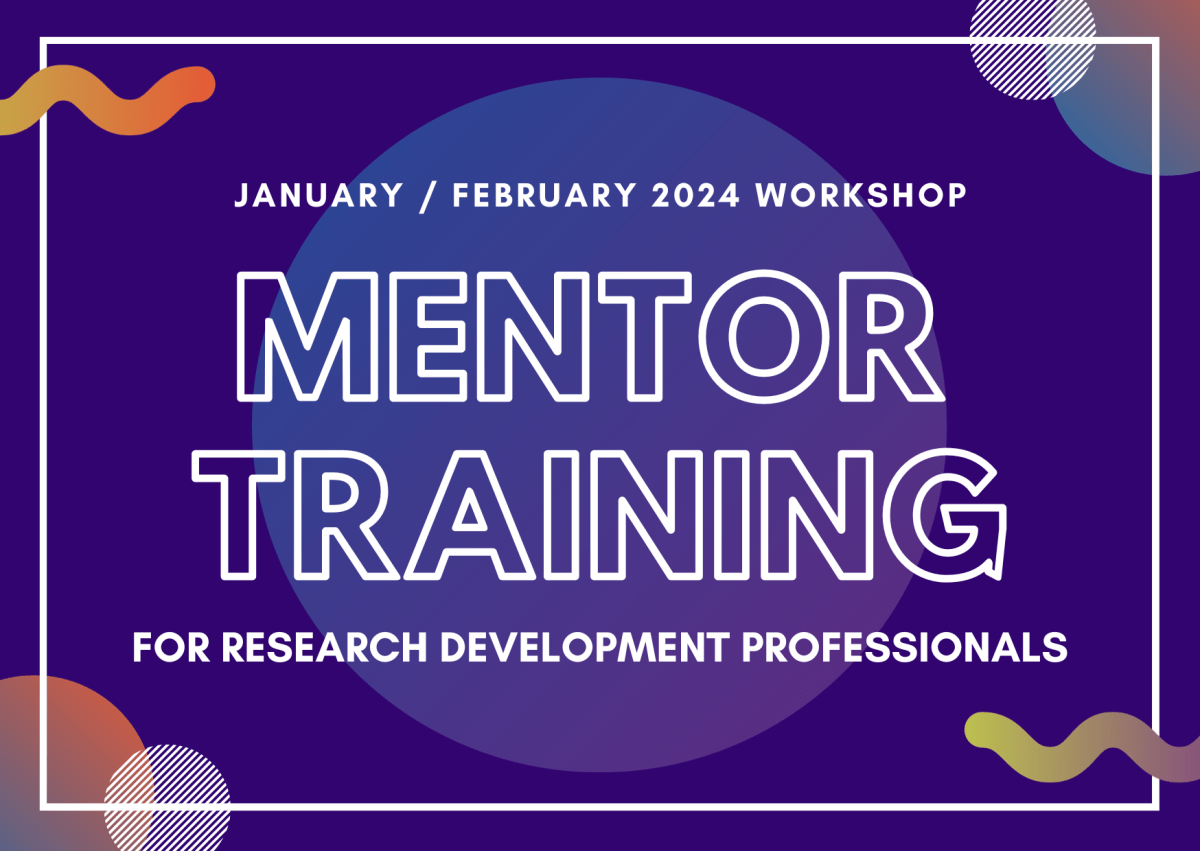
Mentor Training for Research Development Professionals – Registration forJanuary/February 2024 Workshop (UPDATE: Registration is closed and there is a waitlist)
Are you a mentor? A mentee? Do you find yourself formally or informally mentoring staff or faculty? Are you ready to explore mentoring competencies that can be utilized across the work of research development (RD)? This interactive workshop series covers the 9-module Entering Mentoring curriculum, initially developed for mentoring researchers and tailored for RD professionals.
“EXCELLENT training! The ideas presented are very applicable both to mentoring both within the research development profession and elsewhere in the research enterprise — the things I have learned and practiced in this course are incredibly valuable to me as I provide mentoring to faculty, particularly early stage investigators and junior faculty, in the area of grantsmanship.”
A recent workshop participant
Using evidence-based strategies, participants will build upon competencies crucial to the success of the mentoring relationship and expand mentor training across the research enterprise. Participants who complete the entire curriculum will receive a certificate of completion. The curriculum results from an association between the NORDP Mentoring committee and the University of Wisconsin Center for Improvement of Mentored Experiences in Research (CIMER) in collaboration with the National Research Mentoring Network (NRMN), organizations involved in developing and validating the original curriculum. RD professionals at all levels of mentoring will explore how mentoring (shown to improve career outcomes, impact employee engagement and retention, and lead to more inclusive work environments) can benefit mentors and mentees in RD.
Workshops will be presented and facilitated by the NORDP Mentoring Committee; many are certified CIMER Trained Facilitators.
Webinar Schedule:
Two (1.5-hour) sessions each week for 5 weeks (every Tuesday and Thursday) January 30 – February 29, 2024 2–3:30 pm EST/11 am–12:30 pm PST
If this workshop doesn’t fit in your schedule, share your scheduling preferences to help us plan for future Mentor Training by completing a survey of your preferences.
The National Mentoring Month is just around the corner and the NORDP Mentoring Committee has lined up exciting mentoring events and activities for all-level-of-experience mentors and mentees! Get excited and ready to:
CELEBRATE
We encourage you to observe these national and international days in a way that works for you. The Mentoring Committee has provided suggestions for how NORDP members can observe these days in January blog posts.
JANUARY 9 – I Am a Mentor Day Suggestion: send a note to your mentee(s) with an encouraging message.
JANUARY 15 – Dr. Martin Luther King Jr. Day of Service Suggestion: Seek opportunities in your local community to make an impact.
JANUARY 17 – International Mentoring Day Suggestion: Highlight a local organization that provides mentoring opportunities. Talk about the organization in a meeting, on social media, or with your family.
JANUARY 25 – Thank Your Mentor Day Suggestion: Send a note to someone you value as a mentor and highlight one piece of advice that you’ve put into action.
ENGAGE & COLLABORATE at NORDP
Participate in one or all of the events, celebrations, and learning opportunities hosted by the NORDP Mentoring Committee throughout the month and beyond:
Mentor Training for RD Professionals Workshop — Get ready to explore mentoring competencies that can be utilized across the work of research development (RD)! This interactive workshop series will cover the 9-module Entering Mentoring curriculum, initially developed by CIMER for mentoring researchers and tailored for RD professionals. Registration will open in early Jan 2024. More information to come.
Mentoring Committee Open House — Join us on January 18, 2024, 2pm ET for our monthly meeting to learn more about what the Mentoring Committee does, and find out how to get involved and join us. We will talk about the committee’s work and achievements, celebrate our volunteer members, and brainstorm new ideas for the future. Register today!
McHuddles are informal gatherings hosted by NORDP Mentoring Committee facilitators and an opportunity to share ideas, ask questions, and collectively learn from other mentees/mentors in breakout sessions. Stay tuned for the 2024 dates.
You are invited!
Mentoring Committee Open House Thursday, January 18, 2024 11am PT/12pm MT/1pm CT/2pm ET
The Committee will …
Celebrate our members and achievements
Brainstorm ideas to support NORDP members
New networks will be formed and a fun time will be had!
Peer Mentoring Group (PMG) meetings — Log in to WisdomShare and go to Dashboard to find out current PMGs and join the ones of interest to you.
DRIVE ACTION
Encourage a coworker and/or another NORDP member to join the mentoring movement — whether it’s seeking a NORDP mentor, offering mentorship, signing up for the mentor training workshop in January, or simply attending a mentoring event or a Mentoring Committee meeting.
The traditional mentoring dyad (1:1 mentor-mentee) program has been a NORDP member feature since 2012. The Cohort Mentoring Group, piloted in July 2022, consists of matching three mentees with similar interests with one shared mentor. Both the dyad and cohorts are matched based on the WisdomShare matching algorithm. This is a blended reflection of both match types.
Crystal Love, Ph.D. is a Science Grant Writer and Editor for the Biological Sciences Division at the University of Chicago. She has participated in the NORDP mentoring cohort for two years in a row.
Eric Wayne Dickey, MFA is the Director of Sponsored Programs for the Division of Extension & Engagement at Oregon State University. He’s been active on the Mentoring Committee since 2017. Eric has engaged in mentoring 1-on-1 for 16 years and has formally participated in the NORDP mentoring dyads for 6 years.
Q1: What influenced you to apply to be a mentor or a mentee for the NORDP Mentoring Program?
Eric: Mentoring is very rewarding. Each time I am paired with a new mentee, and I learn about their work and their challenges and opportunities, I am reminded of my own efforts and how much work I still need to do on myself. Even though the focus in mentoring is on the mentee, I have found it to be a mutually beneficial endeavor. I am always grateful and inspired by the mentee’s bravery in stepping forward to show that they are willing to take a chance and invest in themselves and their own well-being.
Why did you choose the cohort mentoring model?
Crystal: I chose the cohort mentoring model to expand my community of support as I get further into my career in RD. At 2.5 years in, I am still new to this field and have a lot to learn, but I’ve also experienced a wide range of proposals, funding agencies, and faculty personalities in this time. I view the mentoring cohort as a great opportunity to continue my own growth as well as offer NORDP colleagues lessons, tips, and resources I have found useful so far. The cohort model is also a great way to hear diverse perspectives on various topics and learn about how other RD offices function. Lastly, I view the cohort mentoring model as a great stepping stone to becoming a mentor myself someday.
Q2: Can you compare your experience in the dyad vs. cohort mentoring models?
Crystal: This is my third year participating in the NORDP mentoring program. My first year I participated in a 1:1 mentoring program, my second year I participated in the new cohort mentoring program, and this year I am participating in the cohort program again. My experience with 1:1 mentoring was phenomenal; I had just entered the RD field and was matched with a mentor who also had a science background and provided significant insight as to how my career could progress. I had a lot to learn this first year, and since everything was new and a bit overwhelming, it was very useful having this 1:1 time with a mentor who could help me learn the basics, dig into the details of my current projects, and help me navigate new situations. My mentor provided advice and resources with the proposals I was working on, tips on working with other staff in grants administration and RD, and guidance on how to build a network in NORDP and build expertise toward my career goals. This experience had a significant impact on my confidence and trajectory, and I am very grateful to have had this individual support as I transitioned to a career in RD.
I have since decided to participate in mentoring cohorts because I learn so much from other’s experiences and work strategies. In my experience, the 1:1 model was a bit more structured, as far as identifying goals and introspection as I developed new skills, although our discussions were also organic based on what I was experiencing at that time (proposals, takeaways from workshops or virtual conferences, etc). My first cohort was less individualized as far as goals and reflection on personal development, but the wide range of discussions were organic and rich with multiple perspectives that helped my professional growth immensely. My second (current) cohort started by identifying goals for individual growth, and now our organic conversations continue to provide invaluable guidance and resources that I incorporate into my work.
Q3: What was your favorite part about the cohort mentoring model?
Crystal: Meeting amazing individuals and just having the opportunity to connect with others in the RD field are my favorite aspects of participating in the NORDP mentoring program. The cohort offers an opportunity to learn about a wide range of grants and funding agencies I may or may not be familiar with, as well as useful strategies NORDP colleagues use to manage various tasks, and provides a regular community of support to ask questions or bounce ideas around with. I have particularly found the cohort model helpful in developing those ‘soft skills’ in RD that are shared through discussions of diverse experiences. I like that the cohort model provides a space to discuss any aspect of RD that participants are interested in and allows flexibility in the mentor/mentee relationship where everyone benefits. The 1:1 mentoring relationship can sometimes put pressure on the mentee to provide questions/topics for the conversation to fill the hour and the mentor to have all the answers, while the cohort model is a space where many can bring up topics and the mentor isn’t alone in offering advice.
Q4: How has participation in the Mentoring Program helped broaden your horizons about Research Development in general and/or affected your daily work in particular?
Eric: The sharing of professional experiences that occurs in mentoring has shown me what is possible in RD, and what RD itself can make possible. Learning how people persevere in their work through challenges and opportunities has helped me become more empathetic. I now give wider margins to the faculty and clients I serve. I now understand that almost everybody has other things going on beneath the surface, other tasks and priorities, and other obligations.
Q5: What surprised you about being a mentor or a mentee?
Eric: Throughout my career, people have often turned to me for guidance and advice. In the past, I closed myself off to that, because I was uncomfortable in my own skin. I have since learned that I am not alone. Most everybody has other things going on, and most everybody has self-doubt. Mentoring has shown me that a lot of people need support and affirmation. Mentoring has helped me feel less alone out here in this crazy world of work.
Q6: Any words of wisdom or encouragement for those wanting to apply next year? Any other thoughts you would like to share?
Eric: Taking part in the mentoring program, whether as mentee or mentor, is a profound investment in the self. You are worth it. Take the chance and apply. You and your colleagues will be glad you did.
Crystal: While the 1:1 mentoring model may fit a smaller but very important segment of new RD professionals, the cohort model is perfect for all professional levels. These small cohorts that bring together NORDP colleagues from all over the country with a wide range of experiences in a regular, comfortable, structured, and (time-limited) setting is brilliantly effective. I would encourage NORDP members at all levels to participate and share in this experience, regardless of the mentor/mentee status. RD professionals do not share the same background, experiences, or institutional support, and the beautiful strength of NORDP is that we are a community that shares, discusses, and informs with generosity and humility. RD professionals, whether part of an institutional machine or an office of one, can learn so much from each other – I’ve seen it!
Applications for the 2024-25 mentoring match cycle will open in the spring — keep an eye out for NORDP emails. Additional mentoring opportunities are available through the Peer Mentoring Groups that are open for participation throughout the year via the WisdomShare platform [LINK: https://nordpmentoring.mywisdomshare.com/]. Contact the NORDP Mentoring Committee if you have any questions [link: mentoringprogram@nordp.org].
An investment in mentoring is an investment in you!
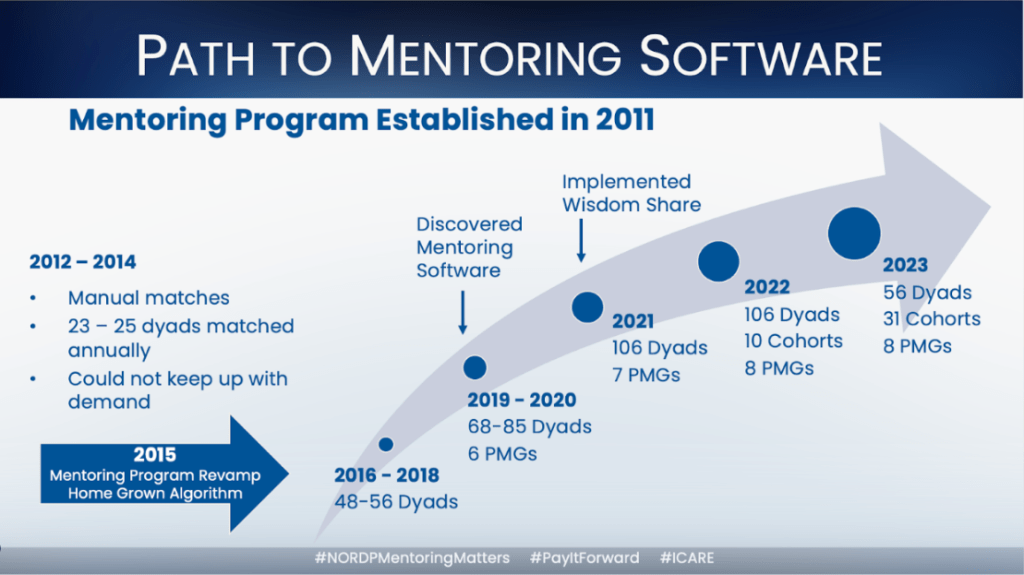
The Mentoring Committee held a Tools & Tips (TNT) information session in July on how to utilize the Wisdom Share platform to enrich your mentoring experience. In case you missed it, you can find the recording in the LMS library or the slides here. Our main goal was to answer some of the most commonly asked questions from the NORDP community about the Wisdom Share, web-based software introduced in 2021 to modernize and expedite the Mentor-Mentee matching process in order to accommodate growth of the NORDP mentoring program.
Brief history of the NORDP Mentoring Committee’s Matching Program.
Aided by the Wisdom Share algorithm, the Mentoring Committee has been able to significantly increase the number and complexity of the services we provide since its inception in 2011. A NORDP member now has access to three different types of mentoring programs:
1:1 Mentor-Mentee dyads. The match program runs from July to June annually.
1: 3 Mentor-Mentee cohorts. The match program runs from July, 2023 to June, 2024.
Eight different Peer Mentoring Groups (PMGs) led by Conveners where the discussions are member-driven. The NORDP members can elect to sign up for multiple PMGs within the Wisdom Share platform. Each PMG Convener will regularly send out meeting information.
We are currently preparing to launch our annual PMG Kickoff on Tuesday, October 10, at 1pm ET / noon CT / 11pm MT / 10am PT — mark your calendar! The registration information will be available soon through the Member Clicks email. At the PMG Kickoff, you will have an opportunity to meet this year’s PMG Conveners, get contact information, and ask questions. We want to thank all the PMG conveners for keeping us organized going forward — we look forward to seeing everyone!
As the 2022-2023 NORDP Mentoring Program year draws to a close, we want to thank everyone who participated. Whether you have participated in the more individualized 1:1 dyads or the pilot of 1:3 cohort mentoring, we hope your mentoring experience has been inspirational and supported your professional growth. In 2022, we had the largest cohort for the Mentoring Program ever: 172 participants (136 mentees; 76 mentors) matched in 106 pairs and 10 cohorts. We currently have six active peer mentoring groups, and 19 people completed the five-week mentor training program.
The NORDP conference in Crystal City, Virginia on May 8-10 afforded some of those who were able to attend with a first opportunity to connect with their NORDP mentoring partners in person! Mentoring Committee members enjoyed having a chance to talk about program options and opportunities to get involved with the committee at three conference events: the committee networking session, the poster session, and a committee breakfast table. We had a lot of positive feedback from people who have been involved in the mentoring program, and interest from people wanting to get involved for the first time. We hope everyone interested in the mentoring program this year applied in advance of the application deadline on May 22. If you missed this year’s deadline, remember that peer mentoring groups are open to new members year-round.
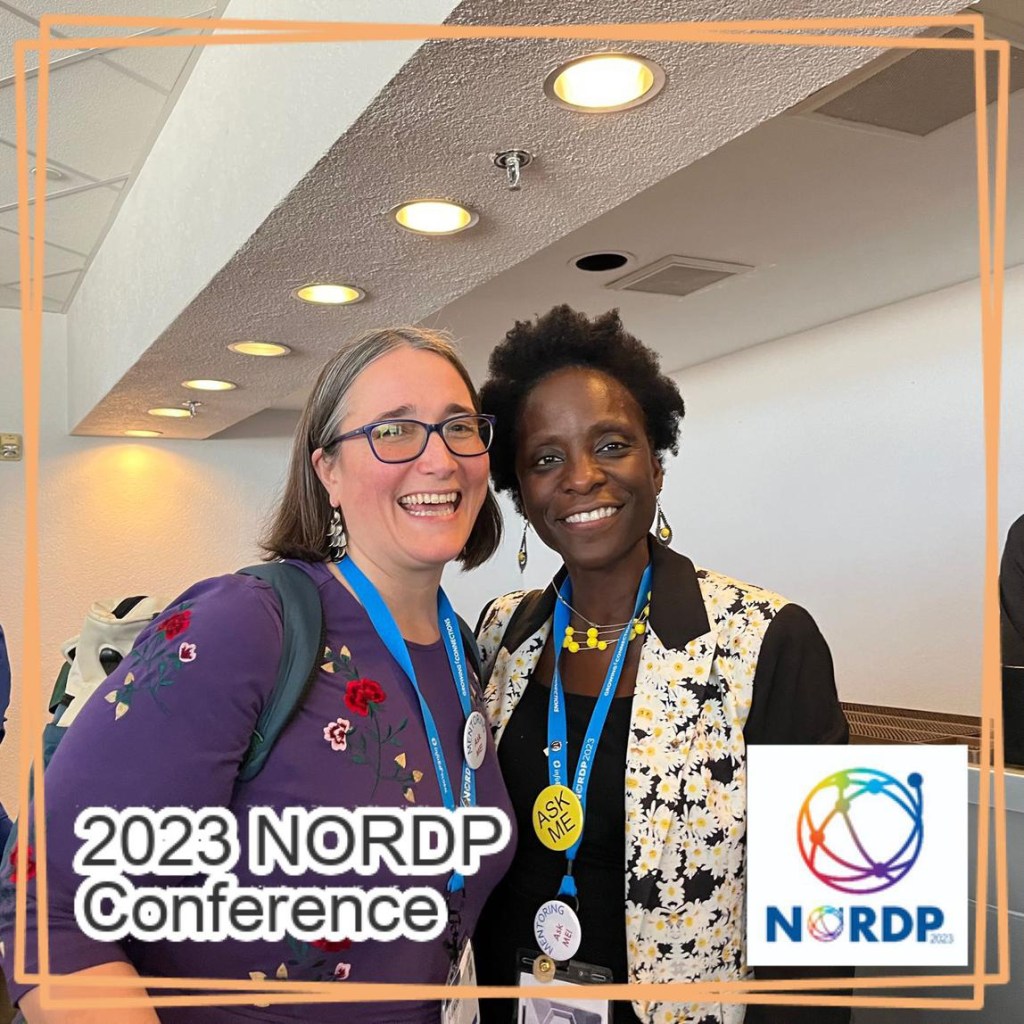
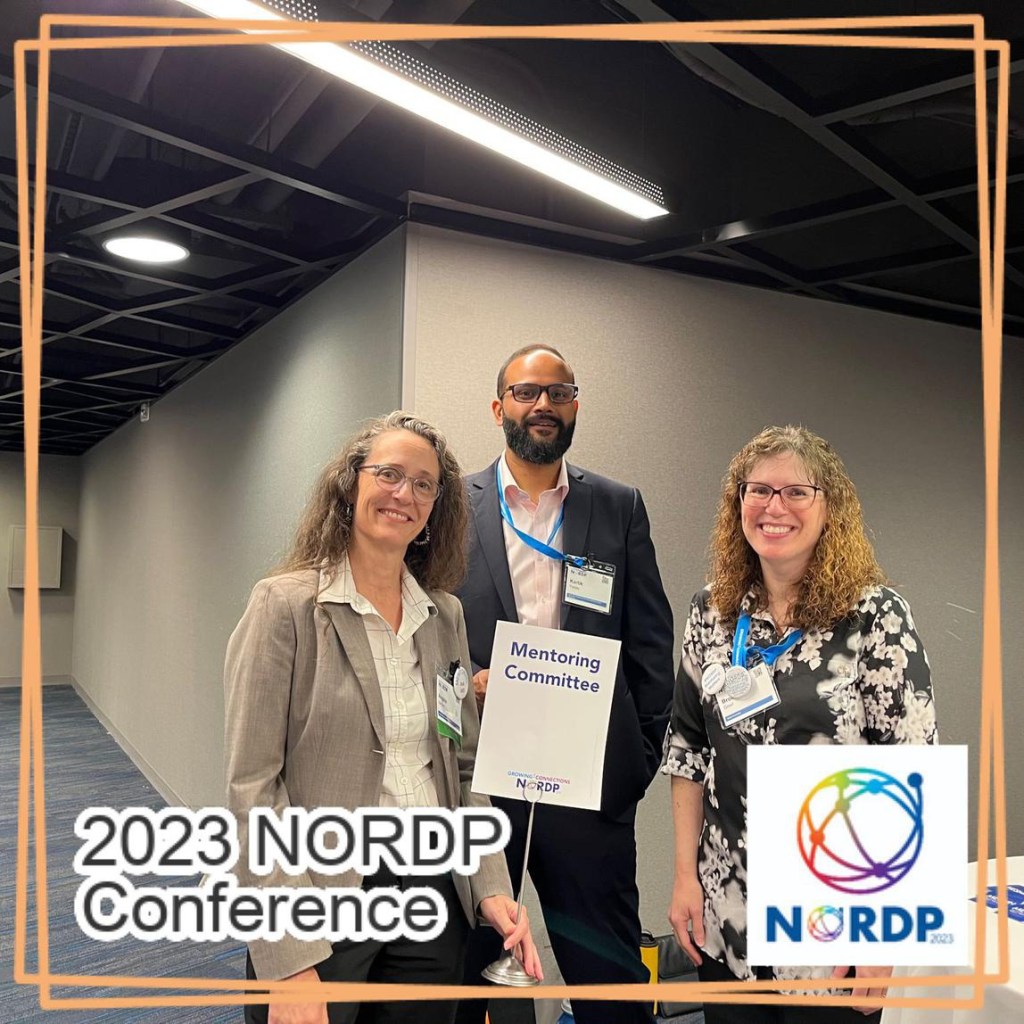
Congratulations to Hilda McMakin and Carolynn Julien, the recipients of this year’s Mentoring Awards! Mentoring Committee members (Angela Jordan, Kartik Yadav, and Brooke Gowl) hard at work during the committee networking session, 2023 NORDP Conference.
Now that the application window for our matched dyads and cohorts programs has closed, the committee is managing the matching process. We expect to share information about new matches for the 2023-24 program by mid-June.
Program participants for 2023-24 should mark their calendars for our Mentoring Program Matching Orientation, which will be held on Wednesday, June 21 from 1-2:30pm ET. The orientation introduces the mentoring programs and the support provided by the committee in the form of curated resources, facilitation, and onboarding materials. We will also be joined by Supermentor Carolynn Julien, a co-recipient of this year’s Mentoring Award along with Hilda McMackin, who will share her experience in the mentoring program.
The Mentoring Committee is also hosting the July TNT session on “Leveraging Wisdom Share Software for Mentoring” to show members how to navigate within Wisdom Share software to maximize your mentoring relationships. That session will be Tuesday, July 11 at noon ET.
On behalf of the Mentoring Committee, Angela Jordan, Elizabeth Lathrop, Hilda McMcakin, Kathy Partlow
During January, the Mentoring Committee leveraged National Mentoring Month to share information about the many ways to get involved with mentoring. As Mentoring Month comes to a close, Susan Carter and Jan Abramson, NORDP Fellows and the inaugural recipients of NORDP’s Mentoring Award, share some thoughts.
Mentoring broadens perspectives,; establishes connections, and grows relationships. It’s a way to meet new people, learn new skills, and refine your own. Mentoring opens doors, and takes you places you might never have imagined. And, it is fun!
Susan reflects, “When I look back on my career in research development, one of the best professional steps I ever took was to engage with the Mentoring Committee and to become a mentor, both formally through the NORDP Mentor Program, and informally to others in RD. The time I spend mentoring really is fun, but most importantly, I have learned much more than I ever imagined I would. One definitely gets back more than one gives, which has been a huge benefit of being involved in mentoring. There is always someone I can call on when I need a new perspective, advice, or even just a friendly voice or face on Zoom for a bit of venting. Moreover, many of my mentees have become wonderful collaborators as well as great friends: we’ve built new ideas and new programs together.”
Jan shares, “the Mentoring Committee was my first step into NORDP, and mentoring continues to be a foundation of my life. Although I have retired, my connections stay strong, and I continue to #PayItForward. My world is richer thanks to the many relationships I have formed over the years. My intent is to nurture and celebrate connections — new and established. I’m thankful for my mentors, my mentees, and those who are peer mentors. I am who I am, because you touched my life.”
The Mentoring Program is a benefit available to all NORDP members, and we encourage you to get involved. Join a Peer Mentoring Group (open year round), register to participate in the 1- on- 1 or cohort-based mentoring program (applications open annually in the spring), join the Mentoring Committee, and be open to mentoring opportunities.








 NORDP News