Find me on LinkedIn
🚀 Currently: Michigan Technological University
💼 Formerly: University of Michigan, UP Health System-Portage
🧰 Offering my time and talents to: NORDP2023 Conference (co-chair), NORDP Communications Working Group (co-chair), NORDP-GL Executive Committee, NORDP Mentoring Committee, Copper Country Ski Tigers (Level 1 coach)
Meira Orentlicher from Touro University was awarded $4,950 for the project, “Understanding the Experiences and Needs of Immigrant Faculty Researchers in their Career Development.”
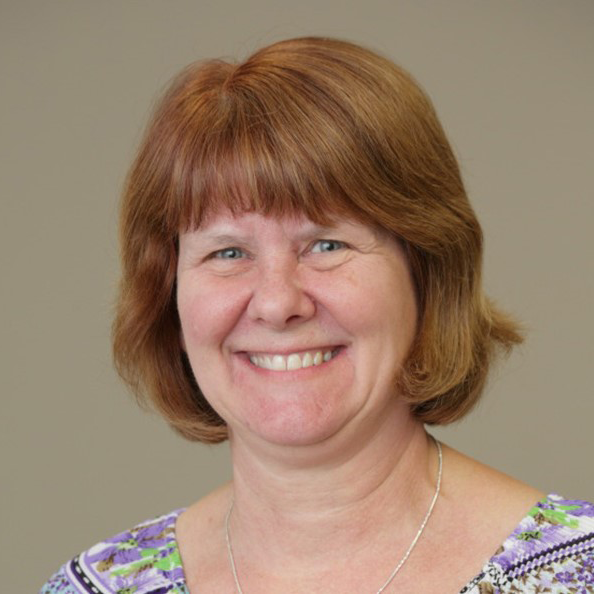
Meira Orentlicher (Touro University)
Immigrants contribute to the growth and development of the US research enterprise at many levels, as faculty, staff, and learners. This project seeks to understand the experiences, perceptions, triumphs, and challenges of immigrant faculty working at US research institutions. Orentlicher and other members of NORDP’s Immigrant Knowledge and Wisdom affinity group (Melissa Li, University of Michigan; Gagan Bajaj, University of Vermont; Samarpita Sengupta, UT Southwestern Medical Center) will conduct in-depth interviews with first-generation immigrant faculty researchers. Using the results of those interviews, they will develop the foundation for tools and actionable strategies for research development professionals to use in supporting immigrant researchers.
Susan Carter (Santa Fe Institute) and Nathan Meier (University of Nebraska-Lincoln) were awarded $4,976 for the project “Professional Development in Research Development: A Landscape Analysis.”
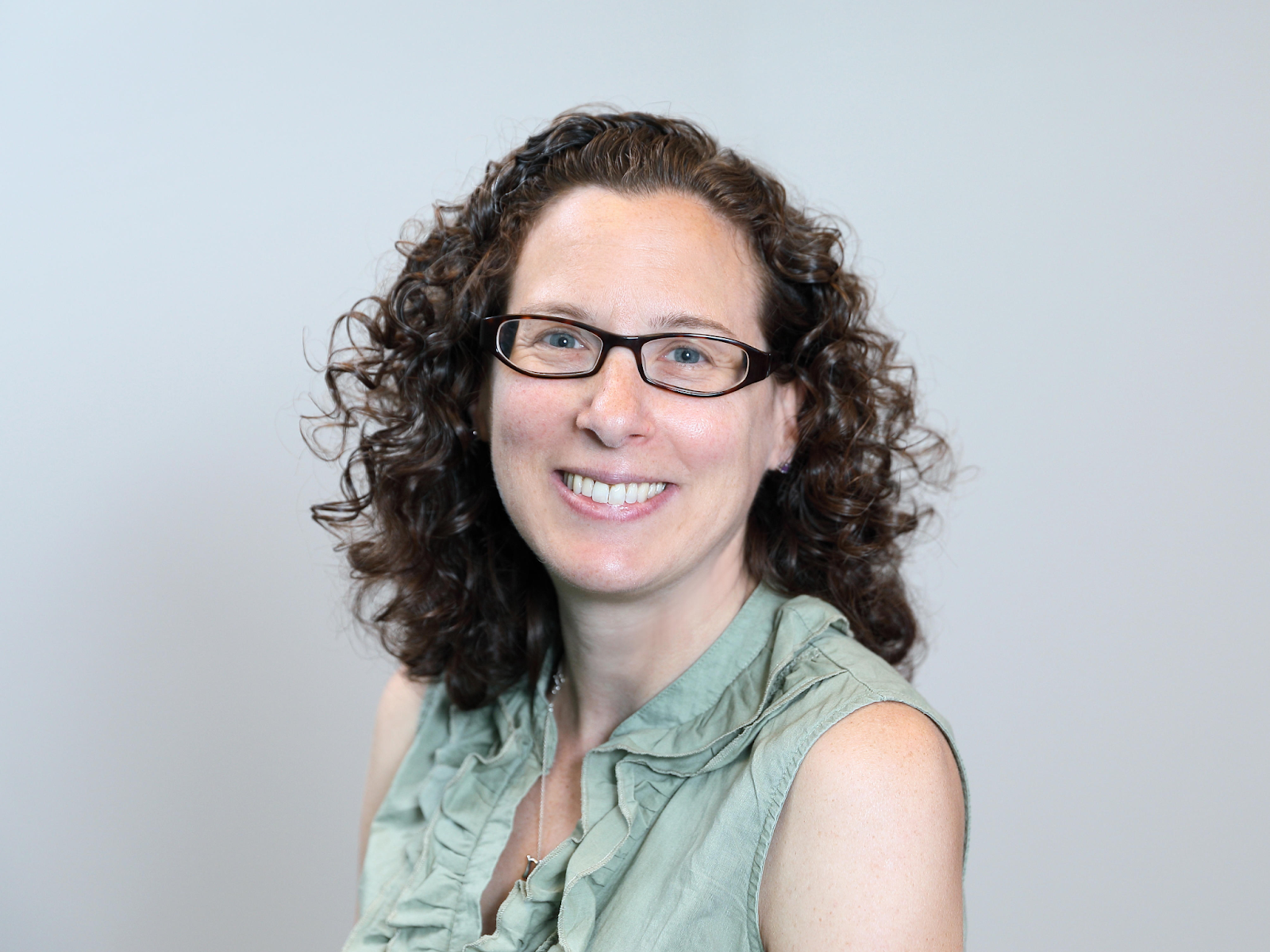
Susan Carter (Santa Fe Institute)Nathan Meier (University of Nebraska Lincoln)
There is no comprehensive, intentional system of professional development programming to support the research development (RD) workforce. This gap complicates the recruitment, development, and retention of talent in RD. This project seeks to establish a systematic understanding of professional development opportunities available to RD practitioners through an online survey. The survey will collect information about extant RD-focused professional development programming. Survey items also will capture respondents’ perceptions about barriers to access or participation in professional development programming in RD, help identify holes in that content, and surface promising approaches from allied fields. Results will provide a baseline against which unmet professional development needs of RD professionals can be identified and offer empirical direction for future attention and investment.
Charlene Emerson from the University of Missouri – Columbia was awarded $3,750 for the project “Responsibilities and Motivations of Research Support Staff: An Institutional Case Study.”
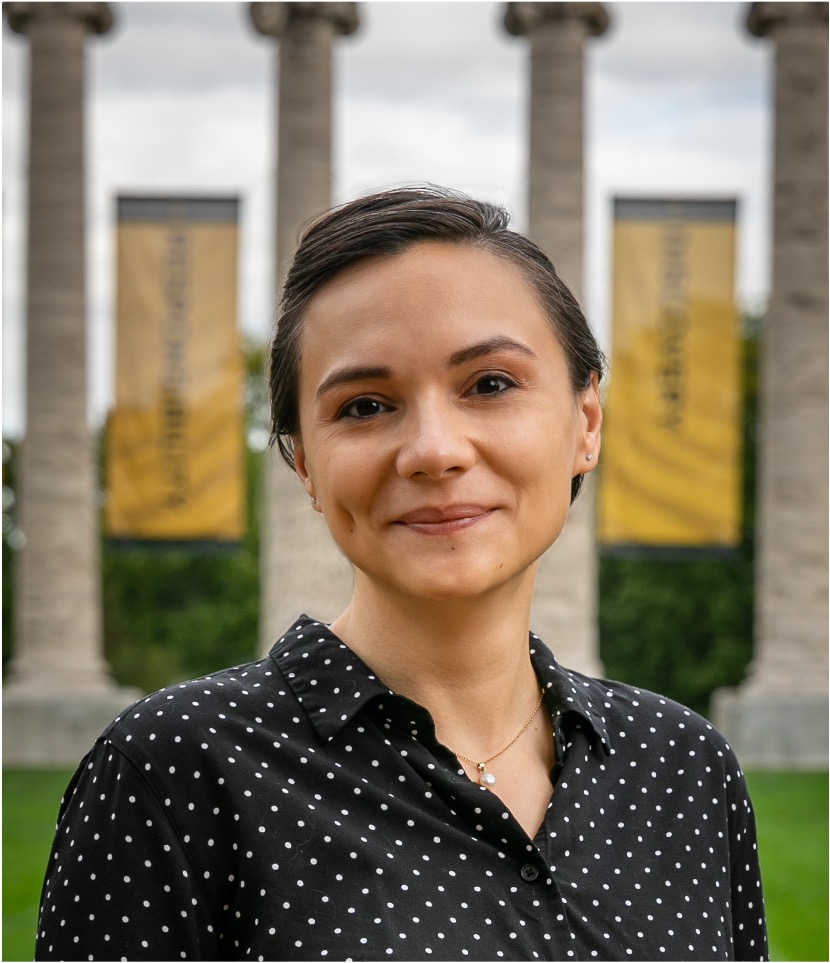
Charlene Emerson (University of Missouri)
As universities continue to invest in research development (RD), they will likely experience challenges integrating existing infrastructure with emerging RD practices, as well as with recruiting and retaining skilled research support staff. Emerson and team will use a survey-based approach to characterize RD and research administration (RA) task distribution at an R1 institution and identify variables that can be used to optimize research support operations. In addition to collecting data to understand the distribution of RD and RA responsibilities across positions and units, the team will also collect information on staff experiences, job satisfaction, and career motivations. The cross-disciplinary team includes human resources professionals, so that results can be used to inform institutional practices for structuring research support offices and for recruiting and retaining research support staff.
Congratulations to Meira, Susan, Nathan, and Charlene!
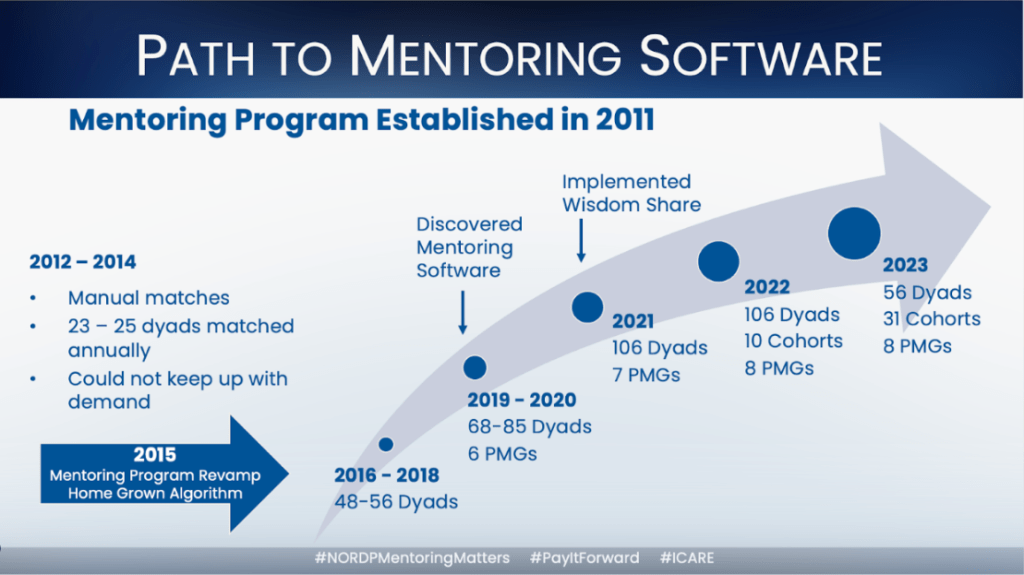
The Mentoring Committee held a Tools & Tips (TNT) information session in July on how to utilize the Wisdom Share platform to enrich your mentoring experience. In case you missed it, you can find the recording in the LMS library or the slides here. Our main goal was to answer some of the most commonly asked questions from the NORDP community about the Wisdom Share, web-based software introduced in 2021 to modernize and expedite the Mentor-Mentee matching process in order to accommodate growth of the NORDP mentoring program.
Brief history of the NORDP Mentoring Committee’s Matching Program.
Aided by the Wisdom Share algorithm, the Mentoring Committee has been able to significantly increase the number and complexity of the services we provide since its inception in 2011. A NORDP member now has access to three different types of mentoring programs:
1:1 Mentor-Mentee dyads. The match program runs from July to June annually.
1: 3 Mentor-Mentee cohorts. The match program runs from July, 2023 to June, 2024.
Eight different Peer Mentoring Groups (PMGs) led by Conveners where the discussions are member-driven. The NORDP members can elect to sign up for multiple PMGs within the Wisdom Share platform. Each PMG Convener will regularly send out meeting information.
We are currently preparing to launch our annual PMG Kickoff on Tuesday, October 10, at 1pm ET / noon CT / 11pm MT / 10am PT — mark your calendar! The registration information will be available soon through the Member Clicks email. At the PMG Kickoff, you will have an opportunity to meet this year’s PMG Conveners, get contact information, and ask questions. We want to thank all the PMG conveners for keeping us organized going forward — we look forward to seeing everyone!
First awarded in 2022, the NORDP Mentoring Award recognizes an individual NORDP member’s unique ability to provide an engaging, supportive, and inclusive environment for professional and/or personal growth through mentorship in the research development community. This award is bestowed with the acknowledgment that effective mentoring occurs through formal and informal channels and may vary in style and substance.
Who: Carolynn Julien
Where: Fairleigh Dickinson University
Number of years in research development: 34 years
Length of NORDP membership: 10 years
What does this mentoring award mean to you?
Let me just start by saying, I was surprised to get the award. I was totally thrown off. I was fidgeting with something and I heard my name being called. If there was anything that I would want to be recognized for, it would be mentoring. It is just the best honor ever! It solidifies who I am and my efforts. It was just perfect!
What has your mentoring journey within NORDP looked like?
I believe it was 2013 when I found out about the NORDP mentoring program, and I was matched with a wonderful mentor, Linda Mason from the University of Oklahoma. It was a wonderful experience. I even got a NORDP travel award to meet her in Austin. She was my introduction to NORDP, and it was just the most amazing connection that I had with her. She came up to where I live in New York once and we got to spend time together while she was on vacation. I recently found out that she passed away and I was just so heartbroken. Linda was amazing and really helped me to grow as a professional.
Generally, I think I remained on the outskirts of NORDP. I was kind of a lurker. I wasn’t fully engaged until I decided to join the mentoring committee. Serving on the committee solidified my commitment to NORDP and it was an opportunity for me to not only engage but to give back.
What initially drew you to mentoring?
I always say, “Mentoring is who I am and what I do.” I have mentored in so many capacities, professionally and personally. I am in an organization where I mentor high school girls. I have mentored people in a group that I created across the City University of New York, where I mentored many individuals across the RD spectrum. Mentoring was the focus of my dissertation. So, yes, it’s my “walk.”
How did you take the first step in the “walk” of mentoring?
My parents always taught me that I’m on this earth to give back. And that has always been a part of me. My upbringing taught me to give back and to figure out how I can give back. Mentoring allows me to have those personal relationships to give back.
What does being a good mentor mean to you?
It means that I show up fully and I provide a space where I will help a mentee grow both personally and professionally. It means that I will be a good listener and that I am looking to understand not only what is spoken but what is also unspoken. It means that I am going to be a cheerleader, and that I am going to be a friend; It means that I am going to be an educator; It means that I am going to be a student; It means that I’m going to be whatever the role is that my mentee needs. The mentee decides and I provide.
You have lived in the spirit of mentoring your entire life. Is there a lesson you have learned along the way that has helped you become a better mentor?
The lesson I have learned is that mentoring relationships have no finite timeline. I think that’s something I struggle with a little bit when it comes to the NORDP program because it’s a one-year commitment. I don’t believe that mentoring relationships have a timeline. The mentoring relationships that I have are ongoing. There are people who I worked with 20 years ago and if they need me, I will be there. They know how to find me and if it’s a year from now, 10 years from now, 20 years from now — I will be there.
What have you found most challenging about being a mentor?
I think one of the challenges in a mentoring relationship is creating intimacy. The best relationship investments are where both the mentor and the mentee can fully show up. That’s a challenge, but it’s a challenge that I love. Because I like taking the time to get to know the mentee, and it takes time. It takes care, patience, and a willingness to accept who this person is.
What advice do you have for others within NORDP who wish to follow in your footsteps?
I’m going to borrow from Nike…Just do it! It’s scary at first. I can remember when the camera came on for the first time and there was a person in another Zoom box. In my mind, I am saying to myself, “I had this mentor training and I should have the right thing to say.” But I have found the best success through listening to my heart. Your heart will guide you. You’ll know what to say and what to do. And it really starts with intention. If your intentions are to help an individual with the agreed upon goals, and you fully show up and listen, your intentions will guide you.
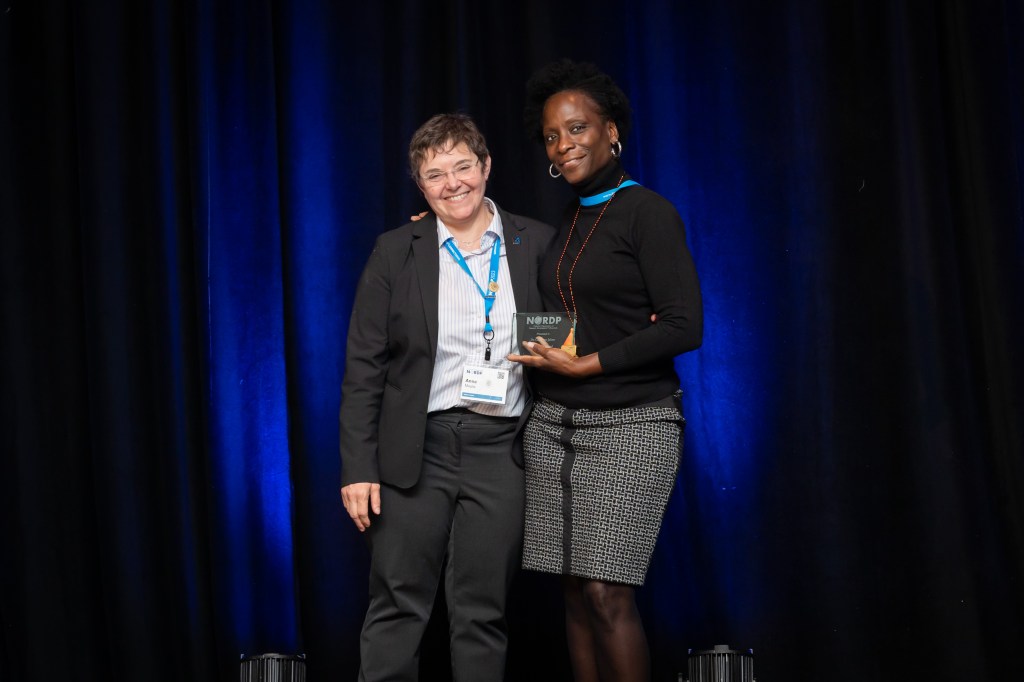
NORDP president Anne Maglia (left) presenting the 2023 Mentoring Award to recipient Carolynn Julien (right).
The afternoon of Wednesday, November 1 (“PreCON”), will be dedicated to representatives of funding agencies and organizations–offering attendees the opportunity to hear about new programs and funding priorities, and ask questions about how best to support your researchers. Two presentations will run concurrently, and most will be recorded for viewing post-event.
Compiled by Daniel Campbell, Member Services Committee
Career Stories are a partnership of NORDP LEAD, the Professional Development Committee, and the Member Services Committee. These informal “fireside chats” highlight the professional trajectories of NORDP members by showcasing the multiple ways that members end up in research development as well as the variety of paths available for career growth and advancement.
NORDP Charter Fellow and Emeritus Member, Jan Abramson, was part of the group that worked to create this series of conversations. Jan adds, “Career Stories is always a highlight of my month. We have a great team of volunteers who make this event happen, and it is always fun to connect through conversation with NORDP members. Career Stories is a great way to start volunteering or sharing your personal path with NORDP colleagues.”
These 30-minute listen and learn sessions along with participant Q&A, began in January 2021 with Karen Fletcher, Director of Grants Resources & Services at Appalachian State University, and have continued monthly since then.
Gagan Bajaj, PhD, Grant Proposal Developer at the University of Vermont notes,“I joined the team at Career Stories in September 2021, bang in the middle of the pandemic—I was craving human connection, and boy, did the series deliver! Career Stories is my monthly dose of inspiration, and I am so grateful for all the wonderful people I have met through this forum.”
Career Stories from this year are listed below with a bit of background bio on the featured members. All Career Stories have been recorded and are accessible by NORDP members through the NORDP LMS.
January – Sammy Rodriguez Flecha (Washington State University)
Sammy Rodriguez Flecha, PhD is currently the director of the Washington State University’s Team Mentoring Program, a network serving underserved undergraduate students pursuing degrees in science, technology, engineering, math (STEM) and health fields. Prior to this new role, he served as interim director for the WSU Office of Research Advancement & Partnerships. His research development and administration career has spanned over 10 years. His PhD is in educational psychology and his Master’s degree is in English literature. He’s been a member of NORDP’s Nominating Committee, a mentor for NORDP’s mentoring program and participated in the inaugural cohort of NORDP LEAD.
February – Jaime Rubin (Columbia University)
Dr. Jaime Rubin is currently the Vice Chair for Investigator Development in the Department of Medicine at Columbia University. She has held senior level positions at Columbia University Medical Center, including Acting Associate Dean for Graduate Affairs, was the founding Director of the Office of Graduate Affairs, and served as the Acting Associate Vice President/Acting Associate Dean for Research Administration – and was one of the founders of the Office of Research Administration. Dr. Rubin completed her PhD at the Ontario Cancer Institute, University of Toronto. She is currently a Fulbright Scholar awardee with the Republic of Kosovo’s Ministry of Education, Science, Technology and Innovation. Her responsibilities include working on projects to increase extramurally-funded research with international partners.
March - Elizabeth Lathrop (University of Maryland)
Elizabeth Lathrop works as a Proposal Development Specialist for the A. James Clark School of Engineering at the University of Maryland. She provides critical support to the Clark School's capacity for complex, multidisciplinary research initiatives in response to targeted funding opportunities. Elizabeth is a Professional Track Faculty with degrees in sciences and was the Associate Director of Programs for a DOE EFRC: Energy Frontier Research Center - Science of Precision Multifunctional Nanostructures for Electrical Energy Storage.  Elizabeth is currently a co-chair of the Mentoring Committee, and participates in the iKnoW, (immigrant Knowledge and Wisdom) Affinity Group.
April - Jason Charland (University of Maine)
Jason Charland serves as Senior Advisor to the President and Executive Director of Research Development at the University of Maine. He oversees research development service provision to faculty and researchers across the University of Maine System, which comprises five primarily undergraduate institutions, a regional comprehensive university, a law school, and an R1 research university distributed across a rural state. He is also responsible for implementing university-wide extramural funding strategies for federal, state, and foundation funding and executing strategic research initiatives.
May - Elizabeth Festa (Rice University)
Elizabeth Festa is a Research Development Specialist in the Office of Research Development at Rice University. She received her Ph.D. from Vanderbilt University and her B.A. from the University of Notre Dame. She is an IRB affiliate at Baylor College of Medicine and a past screener for the Fulbright-National Geographic Fellowship. Before transitioning into RD, Elizabeth was Associate Director of the Program in Writing in Communication at Rice, and the Associate Director of the Center for Academic and Professional Communication. Elizabeth holds leadership positions in NORDP’s Strategic Alliances Committee and Member Services Committee.
June - Camille Coley (University of San Francisco)
Camille Coley, JD, CRA is the inaugural Associate Vice Provost for Sponsored Programs and External Partnerships at the University of San Francisco.  She has worked in research administration and research development for more than 20 years including at the American Museum of Natural History (in New York City, NY), Florida Atlantic University (FAU), and Southeast National Marine Renewable Energy Center and the Center for Biomedical and Marine Biotechnology at FAU. She is a certified Research Administrator as well as a Certified Mediator. Camille shares her experience and expertise through the NORDP PEERD program and is a consultant for NORDP’s Pilot Project for Historically Black Colleges and Universities.
July – Eric Wayne Dickey (Oregon State University)
Eric holds an Honors Bachelor of Arts in English and a Master of Fine Arts in Creative Writing, both from Oregon State University (OSU), and is a certified Project Management Professional by the Project Management Institute. He is also a published poet, children's author, and translator of German Poetry, and his work can be found online and in print. In July 2022, Eric began a new role as the first ever Director of Sponsored Programs for OSU’s Division of Extension and Engagement. He has 20 years of experience in research development and proposal and project management and has worked for OSU’s College of Forestry and College of Liberal Arts, for Oregon Sea Grant, and at Western Oregon University where he established its inaugural Sponsored Projects Office. For NORDP, Eric currently serves on the Member Services Committee and is a co-representative for the Pacific Region. He is also on the Mentoring Committee and has recently agreed to serve on the Conference Committee.
August - Jessica Venable (Thorn Run Partners)
Jessica Venable, PhD is known for her work in higher education policy and reform, particularly as it pertains to how underserved and underrepresented individuals, institutions and groups are represented in, and benefit from, the Federal funding landscaper. In her career, she worked in RD at Virginia Commonwealth University, and at NASA Langley Research Center and NASA Headquarters. She has also served as a grant reviewer for numerous federal agencies, and prior to joining Thorn Run Partners served as Vice President at McAllister & Quinn.
Elizabeth Festa noted, “As a person who transitioned to RD mid-career, the experience of being interviewed for Career Stories was a validating one. The field of RD is still emerging and the opportunity to draw upon a wide variety of experiences and skills to impact the profession, as opposed to following a clearly defined path, has ultimately been rewarding. Career Stories made me recognize the value in my unique path, and those of my NORDP colleagues.”
If you are interested participating as a conversation facilitator, technical host or sharing your own story please contact Gagan Bajaj at gagan.bajaj@med.uvm.edu.
As the 2022-2023 NORDP Mentoring Program year draws to a close, we want to thank everyone who participated. Whether you have participated in the more individualized 1:1 dyads or the pilot of 1:3 cohort mentoring, we hope your mentoring experience has been inspirational and supported your professional growth. In 2022, we had the largest cohort for the Mentoring Program ever: 172 participants (136 mentees; 76 mentors) matched in 106 pairs and 10 cohorts. We currently have six active peer mentoring groups, and 19 people completed the five-week mentor training program.
The NORDP conference in Crystal City, Virginia on May 8-10 afforded some of those who were able to attend with a first opportunity to connect with their NORDP mentoring partners in person! Mentoring Committee members enjoyed having a chance to talk about program options and opportunities to get involved with the committee at three conference events: the committee networking session, the poster session, and a committee breakfast table. We had a lot of positive feedback from people who have been involved in the mentoring program, and interest from people wanting to get involved for the first time. We hope everyone interested in the mentoring program this year applied in advance of the application deadline on May 22. If you missed this year’s deadline, remember that peer mentoring groups are open to new members year-round.
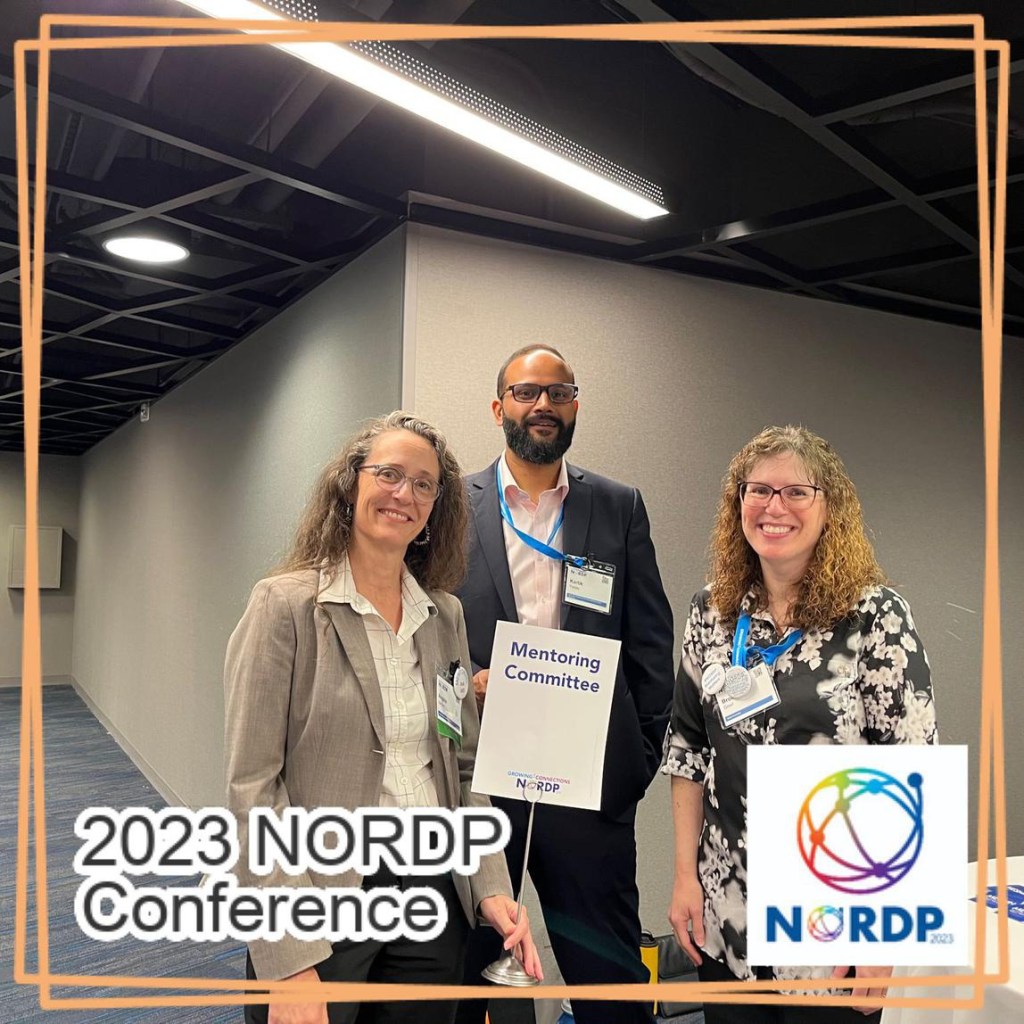
Congratulations to Hilda McMakin and Carolynn Julien, the recipients of this year’s Mentoring Awards! Mentoring Committee members (Angela Jordan, Kartik Yadav, and Brooke Gowl) hard at work during the committee networking session, 2023 NORDP Conference.
Now that the application window for our matched dyads and cohorts programs has closed, the committee is managing the matching process. We expect to share information about new matches for the 2023-24 program by mid-June.
Program participants for 2023-24 should mark their calendars for our Mentoring Program Matching Orientation, which will be held on Wednesday, June 21 from 1-2:30pm ET. The orientation introduces the mentoring programs and the support provided by the committee in the form of curated resources, facilitation, and onboarding materials. We will also be joined by Supermentor Carolynn Julien, a co-recipient of this year’s Mentoring Award along with Hilda McMackin, who will share her experience in the mentoring program.
The Mentoring Committee is also hosting the July TNT session on “Leveraging Wisdom Share Software for Mentoring” to show members how to navigate within Wisdom Share software to maximize your mentoring relationships. That session will be Tuesday, July 11 at noon ET.
On behalf of the Mentoring Committee, Angela Jordan, Elizabeth Lathrop, Hilda McMcakin, Kathy Partlow
The yearly NORDP Mentoring Program offers a structured mentoring experience for NORDP members. This month, we catch up with a current mentor-mentee pair as they share their reflections on their mentoring journey.
Brooke Gowl is currently serving as Research Development Associate at Duke University, Durham, NC. She has been in research development for over 13 years. Her PhD is in Neuroscience. She is a member of NORDP’s Mentoring Committee and formerly served on the Member Services Committee. She is also a mentor and mentee in NORDP’s mentoring program. She serves as a mentor for Kartik Yadav currently in NORDP’s mentoring program.
Kartik Yadav is the Director of Research Development and Administration at the University of California Irvine (UCI) Sue & Bill Gross School of Nursing. He has researched vulnerable populations in Los Angeles and India for over a decade. In his current RD role, he mentors junior faculty and Ph.D. students in developing and designing complex research grants for prestigious and competitive funding agencies and in the scientific development and operational, regulatory (IRB), and financial aspects of research grants to ensure their successful completion. Regarding the Research Administration role, he has led both Pre‐and Post-Award grants, ranging from simple to incredibly complex. In addition, he has collaborated with other partner institutions, both national and international (India, Botswana, Europe), to develop grants and provide training and support for developing programs. He is a mentee of Brooke in the NORDP’s mentoring program.
Q1: What influenced you to apply to be a mentor and a mentee for the 2022-2023 NORDP Mentoring Program?
Brooke: I have been a NORDP mentor every mentoring program year since 2019. My participation in the program has been a pleasure, and I knew that I wanted to participate again for the 2022-2023 year and plan to sign up for the 2023-2024 program year. I originally applied to be a part of the mentoring program to be a mentee and a mentor so that while I received knowledge from someone, I was also giving support to someone else.
Kartik: Although I have been conducting research and developing grants with PIs for over a decade, I recently stepped into a more formal role for the school. I felt the need to learn more, and the NORDP mentorship program was the best option!
Q2: What is your favorite part about your relationship?
Brooke: I have really enjoyed getting to know Kartik. I look forward to our monthly Zoom calls. I enjoy talking with him about what is happening in his life and giving advice as needed. My favorite part of our relationship is that while Kartik is learning from me, I am learning from him.
Kartik: I just love it! It provides me a safe space to ask any question, discuss and learn all about Research Development from Brooke’s vast experience. Besides our monthly Zoom meeting, Brooke was always available to answer my questions.
Q3:How has participation in the Mentoring Program helped broaden your horizons about Research Development in general and/or affected your daily work in particular?
Brooke: The mentoring program has helped me to improve my mentoring skills. My participation has given me the opportunity to learn about Kartik’s work responsibilities, his institution, where he lives, etc. and the opportunity to provide him some suggestions and advice based on my past experiences, discussing what worked and what didn’t.
Kartik: It has been an excellent success for my professional development, and with Brooke’s support, I created an internal/external proposal review process at my institution. In general, I got many insights from the world of Research Development!
Q4: What surprised you about being a mentor or a mentee?
Brooke: I have been surprised by how much mentoring is a two-way street. Kartik and I both benefit from the relationship by learning from each other.
Kartik: The extraordinary guidance from Brooke in availing all the available resources and networking across the NORDP platform.
Q5: Any words of wisdom or encouragement for those wanting to apply next year? Any other thoughts you would like to share?
Brooke: I encourage my NORDP colleagues to be mentees and mentors, but I especially encourage them to be mentors! There is always a demand for mentors, and if you do not think you are quite yet ready to be a mentor, NORDP has an excellent Mentor Training course! NORDP also provides excellent support to both mentors and mentees through a wealth of tools in Wisdom Share and through virtual get togethers called McHuddles. We also have facilitators that can help answer questions and provide support to mentee pairs. In addition to being a mentor and mentee, I also serve as a facilitator on the Mentoring Committee. I encourage all NORDP members to get involved in mentoring and other NORDP initiatives.
Kartik: If you are new to RD or want to move to RD or have been in RD, I would strongly recommend joining this program. It gives you a great perspective of the RD world at various, different levels and provides a strong network of experts volunteering their time towards your professional development.
The application for the 2023-2024 NORDP Mentoring Program is currently open until Monday, May 22. You can participate as a mentor, a mentee (or both), or participate in a Peer Mentoring Group (PMG - which you can join anytime via Wisdom Share). To participate, the first step is to apply for the Mentoring Program and complete your mentor and/or mentee profile. This short video provides a step-by-step overview of the application process. (Note: For current users in Wisdom Share, separate instructions were sent for how to participate in the 2023-2024 Mentoring Program.)
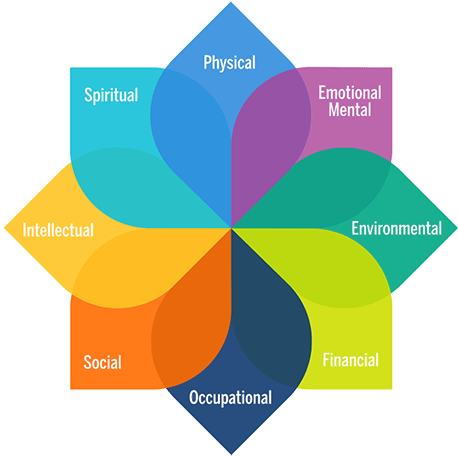
Mentoring is a valuable relationship that can have a significant impact on one’s life, both personally and professionally. Recognizing and addressing mentees’ wellness is a critical component of mentoring. As shown in the figure below, well-being spans multiple dimensions, including emotional, mental, physical, social, intellectual, spiritual, financial, etc. A few of them are discussed as follows.
Credit: University of Michigan
Emotional wellness: Emotional wellness refers to an individual’s ability to manage their emotions in a healthy way. In a mentoring relationship, it’s important to create a psychologically safe space where the mentee feels comfortable sharing their feelings and concerns. The mentor can provide emotional support, offer guidance on managing stress and anxiety, and help the mentee develop healthy coping mechanisms.
Mental wellness: Mental wellness is about maintaining a healthy state of mind. In a mentoring relationship, the mentor can encourage the mentee to practice mindfulness, help them identify any negative thought patterns, and provide guidance on setting goals and developing a growth mindset.
Physical wellness: Physical wellness refers to maintaining a healthy body through regular exercise, proper nutrition, and adequate rest. The mentor can encourage the mentee to prioritize physical wellness, share tips on healthy habits, and offer guidance on finding a work-life balance.
Social wellness: Social wellness involves having meaningful relationships and a strong support system. The mentor can encourage the mentee to build positive relationships, offer guidance on effective communication and conflict resolution, and help the mentee identify and navigate any social challenges.
Intellectual wellness: Intellectual wellness refers to an individual’s ability to engage in creative and stimulating mental activities. In a mentoring relationship, the mentor can encourage the mentee to pursue their intellectual interests, offer guidance on developing critical thinking skills, and provide resources for continued learning.
Overall, prioritizing the mentee’s wellness in all these areas can lead to a more fulfilling mentoring relationship and the mentee’s success.
NORDP 2023 Keynote Speaker, Dr. Christine Yifeng Chen
From a young age, Christine Yifeng Chen had an affinity for the outdoors. Growing up in upstate New York, she spent many afternoons amusing herself in the local woods observing plants, rocks, and passing wildlife. When the sun was down or the weather was poor, she watched nature documentaries on public television and read books about historical expeditions and voyages, captivated by stories of field scientists working in far-flung places. Despite her enthusiasm, she never considered that outdoor field research was something she could ever do herself. After all, she had no camping or hiking experience, and hardly traveled outside of her hometown, as the costs of such activities were prohibitive.
That all changed when she “won the lottery,” as Chen puts it, by gaining admittance to Princeton University for her undergraduate studies with a full tuition financial aid package. Scanning the catalog of course offerings, she noticed that the earth science department offered classes with field trips, all expenses paid. Soon enough, in her first semester, she found herself in California, gazing at snow-capped mountains, climbing up sand dunes, and walking amongst ancient pine trees for the very first time. This formative experience set the stage for Chen’s future in field geology. “It was a complete culture shock,” Chen says. “Suddenly, I had access to all these resources at this school, to do all the things I’d always read about or seen on TV. It was nothing short of life changing.”
Chen understands first-hand the impact that access to social and material resources can have on one’s career. She will deliver the 2023 NORDP Conference opening keynote address, entitled “Racial disparities in research funding.” In her remarks, she will highlight results from a recent study she led showing systematic racial disparities in funding rates at the National Science Foundation (NSF). Using publicly available data, Chen and her colleagues showed that from 1999 to 2019, proposals by white researchers at NSF were funded at rates higher than most other non-white groups, and that these trends held regardless of scientific discipline and proposal type. Since similar patterns have been observed at the National institutes of Health, NASA, and other philanthropic funding organizations, they are likely widespread throughout the research funding ecosystem.
Despite countless of initiatives at colleges and universities to diversify the professoriate, data on faculty demographics indicate that higher education institutions appear to have little to show for it. Chen believes that the long-standing funding disparities have played a significant role in stymieing diversity goals: “Eliminating inequalities in STEM and academia will require a reorganization of what causes inequality in the first place: unequal access to social prestige and material resources.”
As a geologist and geochemist by training, Chen is very familiar with the lack of diversity amongst faculty. The geosciences are the least diverse field of all STEM disciplines in terms of race and ethnicity; less than 10% of geoscience PhD recipients are people of color, and little has changed in the last 40 years. And unlike other STEM disciplines, Asians are underrepresented amongst geoscience PhD recipients.
That statistic, along with the rise in anti-Asian sentiments during the pandemic, spurred Chen and two of her colleagues to start an affinity group, Asian Americans and Pacific Islanders in Geosciences (AAPIiG), to build community for AAPIs in the discipline. It was through one of the early virtual AAPIiG community gatherings that Chen first learned from a senior academic about the “open secret” that Asian researchers have the lowest proposal success rates at the NSF. The rest is history.
Chen is eager to engage with the NORDP community about these widespread funding disparities and what we can do about them, both as individuals as well as a collective organization. She hopes that we might consider the funding data at our own institutions from both public and private funders with a critical eye. Chen also hopes that NORDP can mobilize a coordination action in response to these trends, given our unique vantage point as being embedded in the research community at multiple levels and sectors. “NORDP is ideally positioned to guide and catalyze action around this issue. If not you, who else?”
Chen is now at a national lab where she continues her geological and geochemistry research.
Help us welcome her to the NORDP stage in May.
Follow @NORDP_official on Twitter for all the latest #NORDP2023 updates.
NORDP fosters a culture of inclusive excellence by actively promoting and supporting diversity, inclusion, and equity in all its forms to expand our worldview, enrich our work, and elevate our profession.
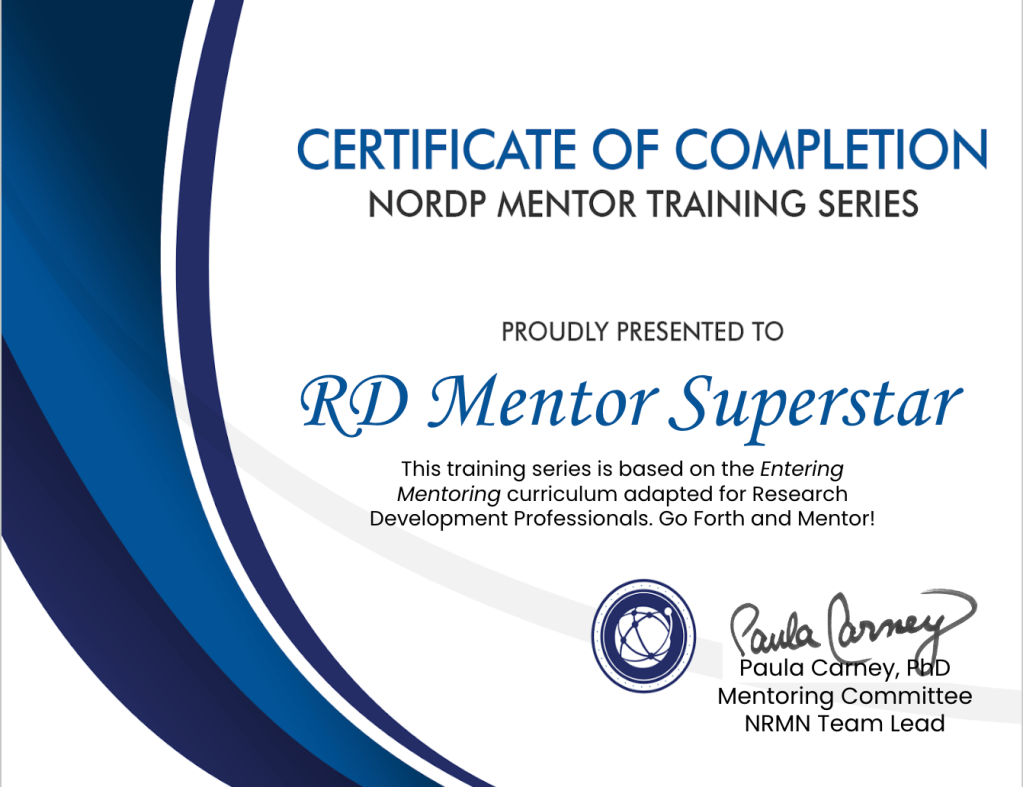
The NORDP Mentoring Committee’s Mentor Training Team held a mentor training workshop in January – March 2023. Nineteen NORDP members completed the 5-week workshop, covering the 9-module Entering Mentoring curriculum initially developed for research mentors and tailored by the NORDP Mentoring Committee for RD professionals in collaboration with the University of Wisconsin Center for Improvement of Mentored Experiences in Research (CIMER). RD professionals explored key mentoring competencies that can benefit RD mentors and mentees that have been associated with improved career outcomes, employee engagement and retention, and more inclusive work environments. The workshop was facilitated by NORDP members Toni Blair, Kristin Boman, Paula Carney, Rachel Goff-Albritton, and Melissa Li. The NORDP Mentoring Committee is committed to equipping Research Development professionals for success by offering meaningful mentoring expertise, support, and resources. The next Mentor Training Workshop is being planned and will be announced soon. If you would like to be contacted when the next workshop series is scheduled, please complete this form.
Congratulations to the following 2023 NORDP Mentor Training graduates!
Sheri
Anderson
North Dakota State University
Sarah
Atkinson
Michigan Tech
Anna
Babkhanyan
University of Hawaii
Danielle
Barefoot
University of Arizona
Tiffany
Brutus
James Madison University
Elizabeth
Carroll
Texas Tech University
Kathy
Dreyer
University of North Texas
Debbie
Frank
Washington University in St. Louis
Sharon
Franks
UC San Diego
Carolynn
Julien
Fairleigh Dickinson University
Monica
Kessel
Utah State
Liz
Lance
Syracuse University (Falk College)
Crystal
Love
Indiana University
Jennifer
Lyon Gardner
The University of Texas at Austin
Ali
Pearks
University of Colorado Denver
Matthew
Schwartz
UMass Chan Medical School
Vess
Vassileva-Clarke
University of Michigan
Quyen
Wickham
Arizona State University
Viktoriya
Zhuravleva
Columbia University
List of graduates from the 2023 Mentor Training and their home institutions.





 NORDP News