A New Year’s Resolution for Mentors: Register for CIMER Mentor Training for RD Professionals

by: Paula Carney

Mentor Training for Research Development Professionals – Registration Open for January/February 2023 Workshop Series;

Are you a mentor? A mentee? Do you find yourself formally or informally mentoring staff or faculty? Are you ready to explore mentoring competencies that can be utilized across the work of research development (RD)? This interactive webinar series covers the 9-module Entering Mentoring curriculum, initially developed for mentoring researchers and tailored for RD professionals. A recent webinar series attendee commented:

“EXCELLENT training! The ideas presented are very applicable both to mentoring both within the research development profession and elsewhere in the research enterprise — the things I have learned and practiced in this course are incredibly valuable to me as I provide mentoring to faculty, particularly early stage investigators and junior faculty, in the area of grantsmanship.”

recent participant

Using evidence-based strategies, participants will build upon competencies crucial to the success of the mentoring relationship and expand mentor training across the research enterprise. Participants who complete the entire curriculum will receive a certificate of completion. The curriculum results from an association between the NORDP Mentoring committee and the University of Wisconsin Center for Improvement of Mentored Experiences in Research (CIMER) in collaboration with the National Research Mentoring Network (NRMN), organizations involved in developing and validating the original curriculum. RD professionals at all levels of mentoring will explore how mentoring (shown to improve career outcomes, impact employee engagement and retention, and lead to more inclusive work environments) can benefit mentors and mentees in RD.

This webinar series will be presented and facilitated by the NORDP Mentoring Committee. There are six certified CIMER Trained Facilitators, and two Trained Facilitators on the Mentoring Committee.

Webinar Schedule:

Two sessions are scheduled each week: Interactive Workshop Sessions will be held on 5 Tuesdays (January 31–February 28, 2023; (2-hours) 2–4 pm EST/11 am–1 pm PST) with an application and reflection session on Thursdays (February 2–March 2, 2023; (1-hour) 2–3 pm EST/11 am–1 pm PST.

Register TODAY for the webinar series (30 participant limit). Please register to receive login information for all workshop sessions.

Registration: National Organization of Research Development Professionals (memberclicks.net)Mentor Training for Research Development Professionals

If this series doesn’t fit in your schedule, share your scheduling preferences to help us plan for future Mentor Training by completing a survey of your preferences.

Questions? Contact us at mentorprogram@nordp.org.

January is National Mentoring Month

Written by the NORDP Mentoring Committee

The Mentoring Committee invites every NORDP member to celebrate National Mentoring Month January 1 – 31. Originally developed as a campaign to expand quality mentoring opportunities for youth, the month-designation can be a catalyst to remember the mentors and mentees who have supported you along your path.

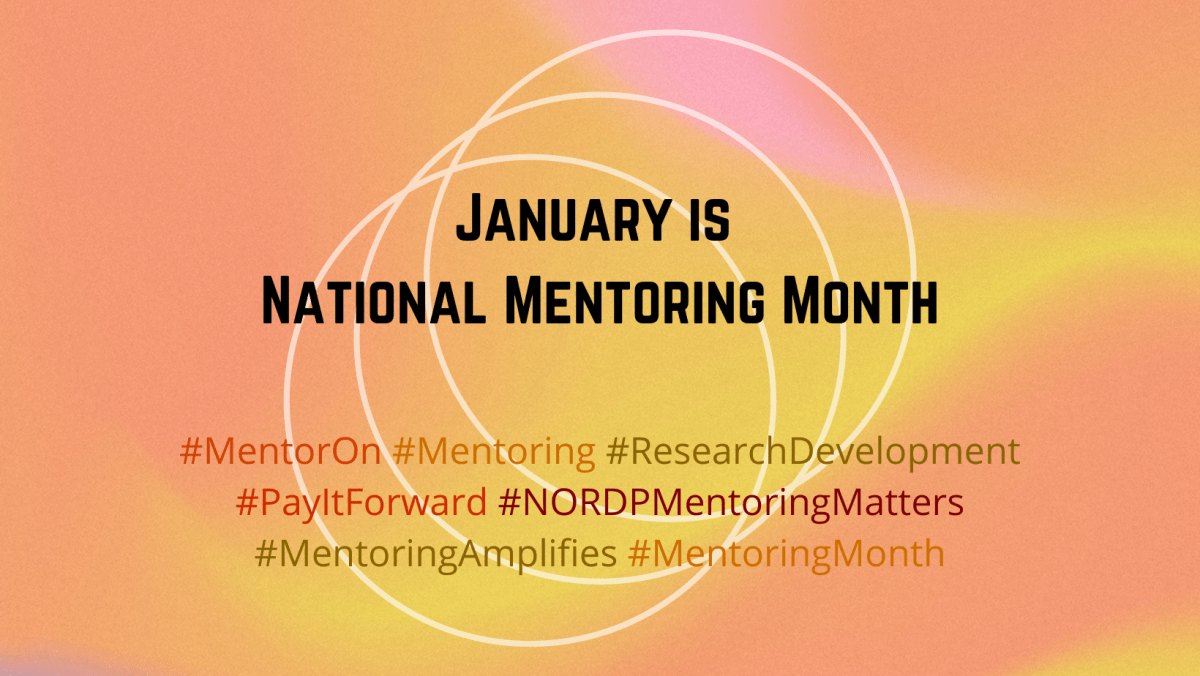
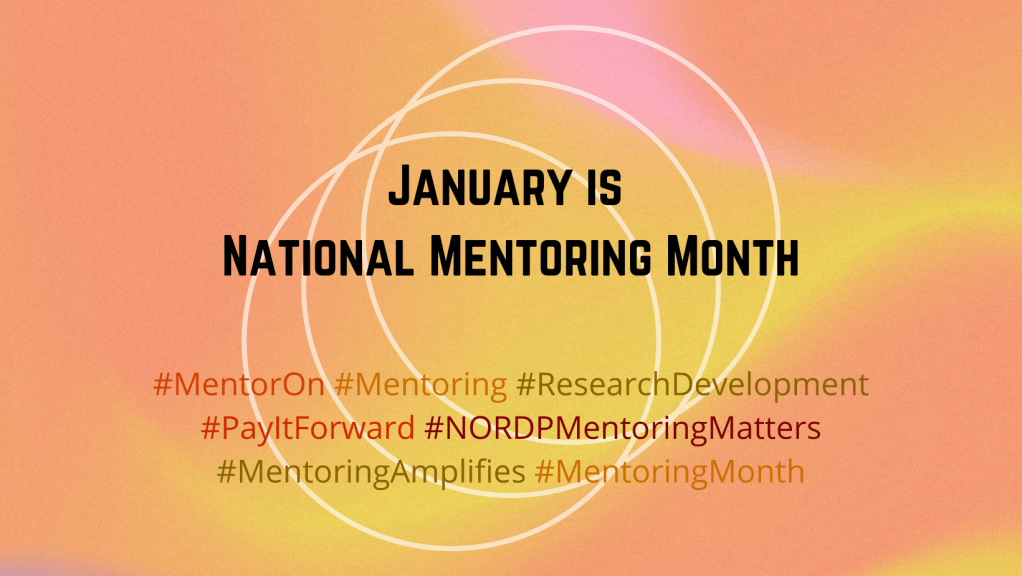
This images has a gradient background of yellows, soft pink and orange. A text heading says, "January is National Mentoring Month." There are hashtags near the bottom of the image meant to inspire readers to use and follow on social media. The hashtags include: #MentorOn, #Mentoring, #ResearchDevelopment, #PayItForward, #NORDPMentoringMatters, #MentoringAmplifies, and #MentoringMonth.

National Mentoring Month, in addition to the early summer months, is a time of year where engagement from NORDP members interested in becoming a mentor increases. This year, with the support of the mentoring community, we are encouraging you to go beyond digital engagement and become involved in real life. Mentoring relationships are at their best when connections are made, sustained, and invested in.

Watch social media and engage in conversation on mentoring (using #NORDPMentoringMatters and #MentoringMonth), take time to listen to a podcast or two (The Science of Mentorship from the National Academies of Sciences, Engineering, and Medicine is a great listen), or explore the NORDP Wisdom Share Learning Library (register here if you don’t have an account in Wisdom Share). Here are some dates to make note of:

January 7 — I am a Mentor Day — own it!

January 17 — International Mentoring Day — #MentoringAmplifies support around the world

January 21 — Thank Your Mentor Day — share your story to inspire

Also explore some offerings from the National Research Mentoring Network (NRMN).

The National Research Mentoring Network (NRMN) is an NIH grant-funded initiative whose entire purpose is to diversify the STEM workforce by providing researchers across all career stages in the biomedical, behavioral, clinical, and social sciences field with evidence-based mentorship and professional development programming that emphasizes the benefits and challenges of diversity, inclusivity, and culture. Their program achieves that through mentorship, networking, and professional development through their online networking platform, MyNRMN, which has over 21,000 mentors and mentees.

How to Leverage the NRMN Network Webinar Series (Monthly Series) – Jan. 17 at 11am CST. Register here: https://unthsc.zoom.us/webinar/register/WN_z3ZWYl8TRSyyHPosIoIc9w

The NORDP Mentoring Program is a benefit available to all NORDP Members. The Mentoring Committee strives to provide resources and support for all NORDP Members interested in mentorship. To do this, the committee leverages national partnership and engages in a variety of scholarly activities. Members supporting members as mentors, mentees, or as part of a peer mentoring or learning group, making NORDP and the profession of research development a stronger community!

Applications will open in the spring for the 1:1 or the Cohort Mentoring Program. Peer Mentoring Groups are also available to join any time, and we invite you to start 2023 by joining and exploring opportunities within the Mentoring Committee. For more information, email the Mentoring Committee and a member of the Leadership Team will respond!

Happy New Year!

Reflections: Cohort Mentoring Group

The 2022-23 Mentoring Program started in July, with a new pilot cohort mentoring program. The Cohort Mentoring Group consists of matching three mentees with similar interests with one shared mentor based on the WisdomShare matching algorithm. The Mentoring Committee caught up with a mentoring cohort and in this post, mentor Kate Bullard and her mentees, Kelsey Haasevoort, Josh Tychonievich, Hayley Bohall share their reflections. 

Dr. Kate Bullard, who serves as the mentor in the cohort, is a Senior Research Program Development Officer in the Office of the Vice Provost for Research at Lehigh University. She manages limited submissions, internal seed funding and research development for the University. Additionally, she works with the Vice Provost on strategic initiatives to improve the research environment at the University. 

Dr. Kelsey Hassevoort is a research development manager and leader of the Community-Academic Partnerships Core in the Interdisciplinary Health Sciences Institute at the University of Illinois Urbana-Champaign. She facilitates new research initiatives and supports community-academic partnerships in health. She also works with Illinois Extension and other campus partners to develop and coordinate collaborations between undergraduate and graduate scholars and community organizations.

Hayley Bohall is the Assistant Director of Research Development within Knowledge Enterprise at Arizona State University.  Research Development (RD) works with research faculty, staff, and leaders to improve funding success and grow the research enterprise. RD seeks to empower and embolden every faculty, staff, and student member of ASU to increase their competitive edge in support of the expanding quality and quantity of the research enterprise. Hayley’s primary responsibility is to support and manage limited submissions, internal grant competitions, and nominations to various federal and non-federal agencies. She interacts with faculty and staff across disciplines to provide research development support and provides solutions to issues associated with sponsored projects. 

Josh Tychonievich is Research Development Program Director at the Institute for Scholarship in the Liberal Arts at the University of Notre Dame. Josh provides research development and project management support for the arts, humanities, and social sciences, with a primary focus on helping faculty in the College of Arts and Letters develop, fund, and realize their research agendas.

Q1: What influenced you to apply to be a mentor and a mentee for the 2022-23 NORDP Mentoring Program? Why did you choose the cohort mentoring model?

A: Mentor Kate: I hoped that I could share some of what I’ve learned over the years. I came to research development after doing other things so I hoped that some of that life experience could be useful. The cohort model wasn’t one I explicitly chose but I am enjoying it! 

A: Mentee Kelsey: I have participated in the NORDP mentoring program as a mentee for the last two years, but made the decision this year that I was ready to step into a mentor role. However, I was still looking for some support in the mentoring space so when I saw the cohort model, I thought it would be a perfect fit!

Q2: Have you participated in a 1:1 mentoring model before? How has this experience been different or similar?

A: Mentor Kate: I have participated in 1:1 mentoring before and in many ways it is similar. It is a chance for the mentee to take stock of where they are professionally and think through their goals. Obviously with a group there is less time for each mentee but there is also the chance to learn from each other. 

A: Mentee Josh: I convene the Communications Peer Mentoring Group for NORDP, but aside from that, this cohort is my first mentoring experience. I find that I benefit not only from the advice of the designated mentor but also from the perspectives of my fellow mentees.

Q3: What was your favorite part about this cohort mentoring model? 

A: Mentor Kate: It takes the pressure off of me! Seriously I’ve learned from the mentees in the cohort and they are absolutely learning from each other. It is a really good support group. 

A: Mentee Hayley: Multiple perspectives. One of the primary purposes of a mentoring program is to hear and learn from someone else’s experiences. In this cohort model, not only am I learning from and encouraged by my mentor but also my fellow mentees, who each bring their unique RD background.

Q4: How has participation in the Mentoring Program helped broaden your horizons about Research Development in general and/or affected your daily work in particular? 

A: Mentor Kate: I am more intentional about mentoring my direct report and encouraging her to seek out additional mentors.

A: Mentee Kelsey: Participating in the mentoring program has really broadened my network with NORDP and helped me think about how I want to navigate my career. Now that I’ve experienced being a mentor and a mentee, it’s clear that the learning goes both ways. One thing I love about the cohort mentoring model is that you get to learn not only from your mentor, but from your fellow mentees! Having those additional perspectives allows for a much richer conversation and I find I leave each meeting with actionable advice that informs the way I work.

Q5: What surprised you about being a mentor or a mentee?  

A: Mentor Kate: For me the preparation it takes for each meeting. I absolutely enjoy them but I also have to make sure to block a bit of time to prepare for each one. In part this is because I want to ensure each member of the cohort gets time and space in the hour a month. 

A: Mentee Josh: I’ve been pleasantly surprised by how beneficial the mentoring program has been. I’ve already made good use of the suggestions offered by my mentor and fellow mentees. They’ve made me a more effective RD professional. I look forward to our meetings each month!

Q6: Any words of wisdom or encouragement for those wanting to apply next year? Any other thoughts you would like to share?  

A: Mentor Kate: As a mentor or mentee you will definitely benefit! It really is not a huge amount of time per month and it pays dividends well beyond the investment.

A: Mentee Hayley: Don’t hesitate to apply. The cohort model takes some of the pressure off the mentee and has allowed me to enjoy the time we spend together, and I look forward to our meetings. In these first few months, I have already seen my RD career from a new perspective.  


The 2022-23 NORDP Mentoring Program is now in full swing! Applications for the 2023-24 cycle will open in the spring, keep an eye out for emails from the NORDP listserv. Additional mentoring opportunities are available through the Peer Mentoring Groups that are open for participation throughout the year via the WisdomShare platform.

Investment in mentoring is an investment in you. As the new year approaches, we encourage everyone to resolve to invest in themselves next year!

Effective Mentoring Roles: Coach and Sponsor/Champion

by Kristin Boman, MPH & Paula Carney, PhD

The NORDP Mentoring Program continues to be an important member benefit, first matching Mentor-Mentee pairs in 2011, and growing to support the professional development of NORDP member Mentors and Mentees through effective programs, resources and tools. Mentors support a collaborative relationship designed to engage the Mentee in personal and professional growth and development. This practice helps acquire essential competencies needed for career success. One important component of the mentoring relationship identifies a mentor network that can serve Mentees. A second component identifies roles Mentors can fill as part of the relationship. Specifically, Mentors may serve as Coaches, and/or Sponsors/Champion at different times in a research development professional’s mentored career development. 

The NORDP Mentoring Committee designed the My MESHH Network (Mentorship, Expertise, Support, HelpingHands) which is part of the Mentor Program Onboarding Packet. Mentors and Mentees report that the tool is especially useful, and enables the Mentee to identify a mentor network as well as mentor roles that can serve the Mentee’s professional development. My MESHH Network is designed to be a dynamic tool that can help a Mentee identify and connect existing and prospective relationships to meet evolving professional goals, including the roles that may be needed to support the mentoring relationship.

A Mentee can identify the role(s) needed from a Mentor. For example, a career guidance Mentor may use coaching skills so the Mentee can identify values to inform career direction. A Mentee may then seek out a Mentor who can serve as a Sponsor for professional development related to these values. 

Although the NORDP Mentoring Program is designed for Mentors and Mentees who are at different institutions, the tools and mentoring roles could also be used in mentoring programs within an institution or in situations when a supervisor also has a mentoring role.  

Definitions of Coach and Sponsor/Champion roles as well as scenarios of how each role may contribute to the mentoring relationship follow:

COACH

Definition: Coaching is a method that enables the Mentee to develop and succeed in their jobs and lives. One definition of coaching is “…partnering with clients in a thought-provoking and creative process that inspires them to maximize their personal and professional potential”. Two main tools used in coaching are asking powerful questions and exploring values, so the Mentee identifies goals and strengths, overcomes limiting beliefs, emotions, and obstacles, and improves well-being, life satisfaction and performance.

Example Scenario: A Mentee expresses interest in changing their career – from grant writing within a PI-led small research institute to a broader office of research role. They accept a school-level research administration position with an opportunity to build research development services within the school. The hiring manager soon left and so did the research development opportunity; the Mentee is now unhappy in the role. As their Mentor, asking powerful questions (open-ended questions that send Mentees in search of discovery, such as “Look ahead one year; standing there, what decisions would you make today?”) and supporting the Mentee’s identification of values (What is important to you? What do you want?) are two coaching skills that can support the Mentee’s journey.  

SPONSOR/CHAMPION

Definition: A Mentor can sponsor a Mentee by putting them in the “right place at the right time” for a specific opportunity by serving as an advocate and using their network and influence. A Mentor can also champion a Mentee for broader career advancement in an organization or profession.

Example Scenario: A Research Development Professional identifies that they want to develop expertise in the Science of Team Science (SciTS) and seek a professional role that provides an opportunity to attain a leadership role in this area. The primary Mentor and Mentee together identify a NORDP member for their My MESHH Network who can be an advocate and guide and who also has a voice at the SciTS table to serve in the Sponsor/Champion role. The Mentor, who is active in SciTS organizations, introduces the Mentee to members in the organization’s special interest group to champion their involvement. Several years later, the Mentor identifies a team science position and serves as a Sponsor for the Mentee as they apply for the job opportunity.

SUMMARY

Awareness of approaches that support Mentor/Mentee interactions can lead to meaningful relationships. Learn more about the NORDP Mentor Program and its resources here

REFERENCES/RESOURCES

Hewlett, S.A. (2014, January 21). Are you ready for a sponsor? Harvard Business Review. https://hbr.org/2014/01/are-you-ready-for-a-sponsor

ICF. (2021). ICF, the gold standard in coaching: Read about ICF. https://coaching federation.org/about 

Yacobucci, M. (2021, June 22). How to be a strong sponsor and advocate for faculty. National Center for Faculty Development [webinar]. https://www.facultydiversity.org/webinars/facultysponsor

NORDP Book Club is Forming

A NORDP Book Club is forming with enthusiastic readers and thought-provoking books. The concept of a book club started to solidify at the NORDP 2017 Conference on Twitter. Conference-goers, specifically those attending the Leadership Without Authority session with Brian Ten Eyck and Shay Stautz, collected some titles to begin reading after the conference.

A virtual book club has begun to take shape. Anyone can join at any time. The majority of the book discussions will take place online. The NORDP Book Club, like any book club, will have many options, based on your preferences:

  • Read with the group’s pace and engage in group discussions about insights and actions you might take in your work.
  • Read with the group, but keep insights to yourself.
  • Read at your own pace, using the book list as inspiration for your next read.

Facilitation

The book club will be facilitated based on the preferences of the group. A few options have been created to offer as starting points. We can add and delete from this list of options as we move forward with the book club:

  • Goodreads Group: This is nice because it offers an easy way to make a book list, link to user’s desired book format (even audiobook and public libraries), and have discussion. It requires that all participants have a Goodreads account. (https://www.goodreads.com/group/show/219569-nordp-book-club)
  • Slack Channel: Maybe more people are on Slack than on Goodreads? Readers can have discussion and side convos pretty easily. Of course, if you’re not on Slack, this would also be another sign-up. I have it currently integrated with an Airtable database to keep a running list of books. (https://nordpbookclub.slack.com/signup)
  • NORDP Book Club Circle in the members area of the NORDP website. This could easily be done, too. The downside of this option is that there may be people who are not NORDP members that want to participate.

Booklist

A booklist has been created on Goodreads.  It can also be found by clicking on “bookshelf” from the NORDP Book Club Goodreads page. Anyone can add books to this list. There are tags (called “shelves”) that can be used to show which books are “to-read,” “read,” and “currently-reading.” This list automatically updates a #booklist channel on the NORDP Book Club Slack.

Groundrules

There have been several suggestions for format, frequency, and facilitation. These have been shared in Slack. Generally, though, we are looking at a monthly discussion of a title chosen by the group. To participate in the discussion, you won’t need to have read the book. All books should be generally applicable to research development, higher education, or professional development.

As the NORDP Book Club develops, we’ll post updates on the NORDP Blog. Please send any feedback and ideas to Jessica Brassard (jnbrassa@mtu.edu).