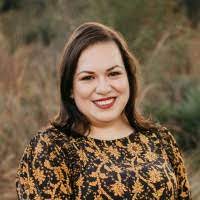
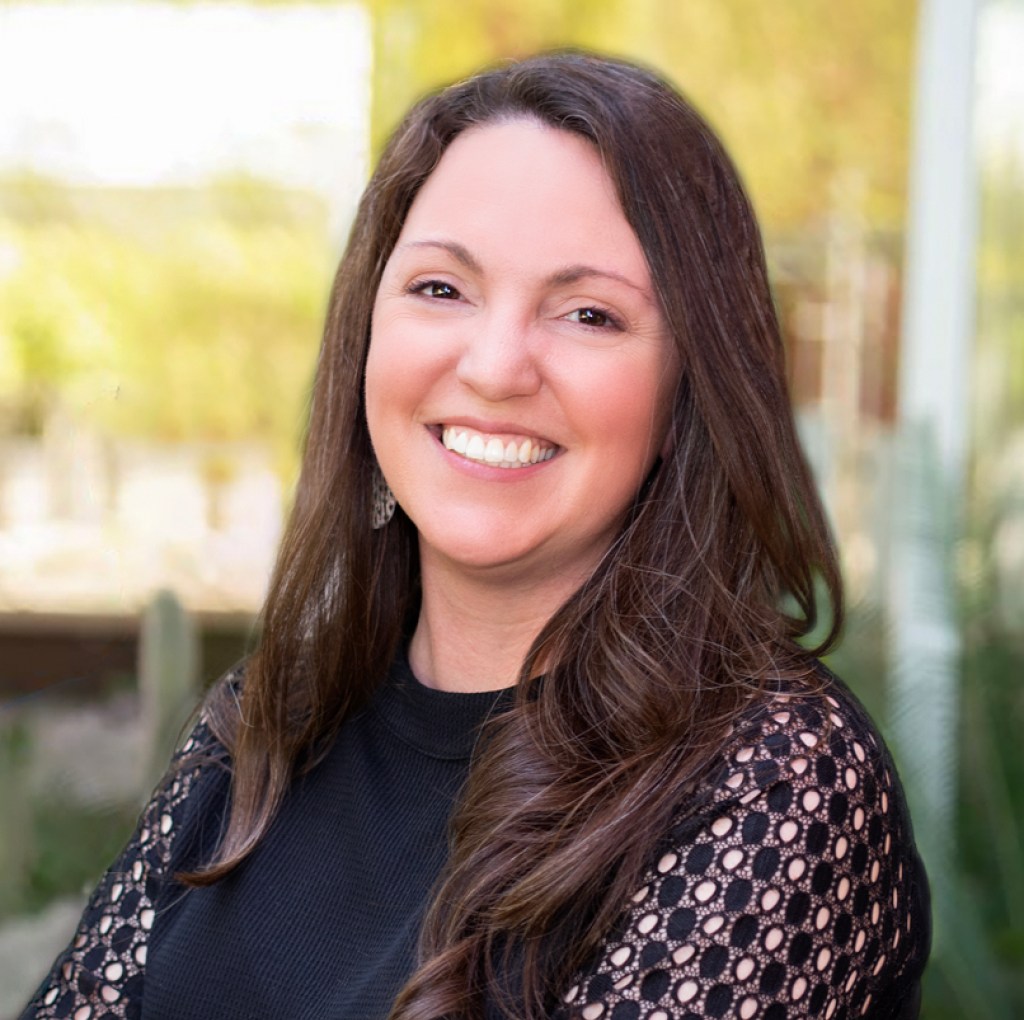
The November 2023 Career Stories featured Katie Lindl, Deputy Director, Program Development Support Office, Lawrence Livermore National Laboratory (LLNL).
Katie Lindl, PhD
Dr. Katie Lindl has been at Lawrence Livermore National Laboratory (LLNL) for 5+ years working in the Program Development Support Office (also known as the “proposals” group or PDSO), first as a proposal manager and for the past year and a half as the group’s deputy director. She has a bachelor’s degree in molecular biology from Princeton and completed a PhD in neuroscience at the University of Pennsylvania. Together with the PDSO director, she heads a group of 12 people.
Calling this an accidental career, Dr. Lindl found her first job as a grant writer at a neuroscience start-up in Menlo Park through her rowing team, a sport she picked up during graduate school. Following her stint at this start-up, Katie took a break from research development and began work as a Pilates instructor and studio manager, hoping to have time for creative writing while also dabbling in freelance work in scientific editing. Once again chance pulled her back into research development when one of her Pilates clients found out about her science and science writing background and recruited her into the PDSO at LLNL. Currently, her day-day job includes proposal management and editing, training and mentoring, approving and assigning work that comes into the PDSO, and interacting with PIs and leadership at the Lab.
The diversity of work proposed across the lab keeps Dr. Lindl’s job interesting and exactly matches the breadth of work she had hoped to find when she finished graduate school, as she adds “During my time in graduate school, I realized that I’d rather help others communicate and improve their science than do my own research.” She is inspired by writing proposals for big science, having a very appreciative group of PIs, participating in training and growing her skills, as well as investing in and growing the careers of others. Two of her biggest sources of inspiration are her dad, a scientist, and her curiosity about people and the world around her.
Even though Dr. Lindl’s work is very rewarding, she knows research development work can be overwhelming at times and that people in our field of work tend to want to “take it all on.” Hence, her tip to the NORDP community is to learn to say no when needed.
Dr. Lindl continues to row regularly on a competitive masters team in Sacramento, CA; hike year-round with her overgrown puppy, Koda; ski in the winter; and teach Pilates, while splitting her time between her ranch in Livermore, CA in the San Francisco Bay Area and her place in Truckee near Tahoe in the Sierra Nevada. Her full-time remote work option at LLNL has allowed this lifestyle, for which she is grateful.
When asked if she had learned anything from her time in rowing that has helped her in her career in research development, Dr. Lindl noted that, yes, she learned that “You can’t win the race by yourself, but you can lose the race by yourself.” She has loved the connections she has made through NORDP and feels she has benefitted from learning the ways others do their RD work at their institutions and has shared these insights with her team at LLNL.
Dr. Lindl would love to answer any questions you have for her, so please feel free to email her at lindl2@llnl.gov. To listen to her full interview by the career/kindle team, please click on this link (you must log in as a NORDP member to access): MC LMS – NORDP LEAD presents: “Career Stories” – Katie Lindl – November 8, 2023
Who: Dr. Susan Ferrari, Assistant Dean and Director of Corporate, Foundation, and Government Relations
Where: Grinnell College
Number of Years Working in RD: 10 years
Length of NORDP Membership: 10 years
Entering the field
Susan, who leads an office with a team of three, was hired into a grants office in 2013 for a research administration role. At a small institution, she’s worn many hats related to RD, corporate and foundation relations, and faculty development. Susan earned her PhD in biomedical sciences but credits her general nerdiness, including many years of Quiz Bowl competition, for providing a broad foundation of knowledge that enables her to work across disciplines.
Throughout her career, Susan has championed faculty outreach and support, and she’s coordinated with other units to lead initiatives in these areas. Another common thread through her career is bringing people together, especially to support humanists and challenges related to those disciplines.
The value of her NORDP membership became apparent when Susan realized how NORDP could support her in developing programing for faculty. She was especially inspired by members working in the liberal arts space, including Claudia Scholz (formerly of Trinity College and Spellman College, now at the University of Virginia School of Data Science) and Kendra Mingo (formerly of Willamette University, now at UC San Diego).
Susan has been part of what is now a movement towards RD within liberal arts college research administration circles. Supporting faculty who teach many courses and who may not need to write books or win grants to earn tenure creates an all-carrots, no-sticks environment, presenting unique challenges and opportunities.
Research Development work
Susan calls her work in RD ‘cradle to grave’; it includes everything from hands-on work with faculty and proposal preparation, both research and curricular grants, community-involved efforts, and communications. She works with everyone from artists to scientists.
Susan had been working with Communications on efforts to share information about faculty research (including improving internal communication about new faculty members’ research and teaching agendas), which grew into initiatives to rebuild community after the pandemic. Recently, she established a faculty writing group program, now in its second round, a huge success with 55 participants out of approximately 200 faculty!
During the pandemic, Susan conducted a study with 46 faculty interviews on research culture at Grinnell to assess needs and guide future efforts. This work identified key issues, such as loneliness and lack of community around research, interest in more discussion of the research process (not just products), and areas where particular demographics or disciplines were not being well-served by current institutional structures. Conducting the project and sharing the results across campus helped Susan build closer relationships with faculty members and inspired other partners to work with Susan’s team to address the issues identified in the study—for example, the Grinnell College Libraries has launched a weekly faculty-staff research series.
Susan’s study also helped her make an institutional case for the value of faculty research. In liberal arts colleges, research activity is generally valued for its benefit to the curriculum and student experience. However, Susan’s research indicates that further benefits exist. These include supporting faculty retention and well-being and providing faculty a sense of autonomy. Her research also indicates that these benefits are especially strong for minoritized individuals. Further, her work showed the benefits that faculty members derive from their research communities beyond the College. This work demonstrates that RD supports faculty and communities broadly and is much more than dollars at the door.
Susan’s history with NORDP
Susan joined NORDP in 2013 and became more active in 2018, inspired by great work from members in the liberal arts space. Prior to becoming a board member, she engaged most with the PUI affinity group and the creative arts, social sciences and humanities (CASSH) group.
Susan has also been involved with the NORD grant committee since receiving a grant in 2020 that supported a study of faculty members at liberal arts colleges who direct institutional grants that blend pedagogy and research.
Susan went to her first conference in Providence (2019) as well as online conferences and gatherings, and she’s presented both in person and virtually on faculty programs at NORDP events.
Motivation to run for the NORDP Board
Susan notes that it’s a challenging time to be in humanistic or qualitative social science fields because of a retreat from those fields by some of their traditional funders. She sees RD as part of what can address that challenge, so she promotes RD within her professional circles, including in her role as past president (2020-2022) of Colleges of Liberal Arts Sponsored Programs (CLASP), which supports grants professionals at over 300 primarily undergraduate institutions.
A large part of Susan’s motivation to run for the Board was driven by her desire to expand what people think about when they think of RD and by her enthusiasm around the cultivation of an RD community of practice at smaller institutions and for smaller efforts. This community of practice includes more diverse schools, minority-serving institutions, and emerging research institutions. It’s important to Susan that perspectives from those within this community are respected and honored, and she emphasizes that we can all learn from each other. The productive exchange of ideas and learning has been exemplified by the CASSH group.
What Susan is most excited about as a new NORDP Board member
Susan is excited to get to work with people that she’s seen shaping NORDP in recent years. She’s excited about our new management company. She’s ready to tackle challenges related to declining funding and enrollments in the humanities and the near- and long-term impact of the SCOTUS decision. She acknowledges challenges but embraces them with enthusiasm.
Susan remembers going to her first NORDP conference and knowing that she ‘found her people’. That was topped when she went to her second conference and first-time-participant friends from CLASP and other liberal arts colleagues told her that they found their people. Embracing connection, Susan is looking forward to continuing to bring more into the fold.
Written by: Jan Abramson and the Mentoring Committee Leadership (Elizabeth Lathrop, Hilda McMackin, Angela Jordan, Kathy Partlow)
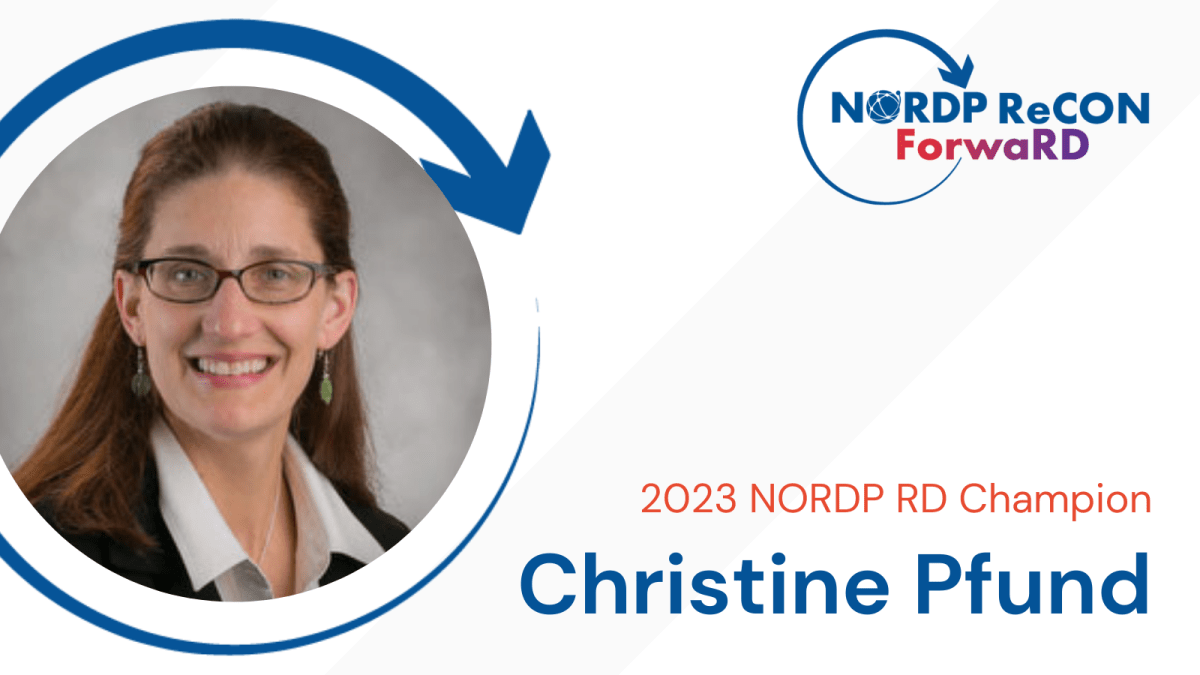
Congratulations to Dr. Christine Pfund—the honored recipient of the 2023 NORDP Research Development Champion! The award was established in 2020 to recognize RD Champions who are distinguished by their advocacy for the critical support of research development (RD) and/or wider efforts to advance the research enterprise. Dr. Pfund, of the Center for the Improvement of Mentored Experiences in Research (CIMER), has long been a champion for research development and the work of RD professionals.
Christine Pfund
Dr. Pfund is a distinguished senior scientist with the Wisconsin Center for Education Research and the Institute for Clinical and Translational Research at the University of Wisconsin-Madison. Her work centers on advancing the science and practice of mentorship with a particular focus on culturally responsive mentorship education interventions. Through her work, she has developed, implemented, documented, and studied the training of research mentors across science, technology, engineering, mathematics and medicine (STEMM). Dr. Pfund holds multiple roles as the Director, the Center for the Improvement of Mentored Experiences in Research (CIMER), the Principal Investigator for the Coordination Center, National Research Mentoring Network (NRMN), and Director of Mentorship Initiatives, Institute for Clinical & Translational Research. She was a member of the National Academies committee that published the consensus report and online guide The Science of Effective Mentorship in STEMM.
In 2018, members of the NORDP Mentoring Committee had the opportunity to participate in CIMER’s mentor training. Inspired by their experience, they determined that CIMER resources and best practices would positively benefit NORDP and its membership. This led to the development of the first CIMER curriculum for RD professionals, Mentoring for Research Development Professionals, published by CIMER as part of the Entering Mentoring curriculum series. The process of adapting the evidence-based curriculum took over three years, and hundreds of NORDP Mentoring Committee volunteer hours. Dr. Pfund and CIMER were strong advocates for RD throughout the process, recognizing the impact of the work and the mentorship RD professionals engage in. Encouraged by her unwavering support, NORDP members are engaging in the national conversation around mentorship and can participate in creating a shared language of mentorship.
NORDP members are invited to participate in mentor training offered by the Mentoring Committee. The 5-week webinar series begins 1/30/2024. Registration will open in early January 2024, and is limited to 30 NORDP members.
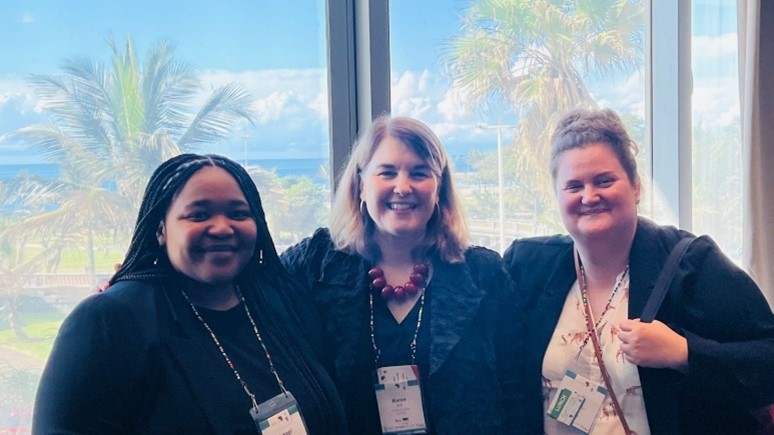
Tshepi Khahlu (University of Cape Town) joined Karen Eck (Old Dominion University) and Emily Kotay (University of Arizona) to present on “Managing University-Industry Collaboration” at INORMS 2023 in Durban, South Africa.
One of the oldest committees within NORDP, the Strategic Alliances Committee (SAC) is a driving force behind the growth and development of research development professionals. We invite you to explore this group that builds strong organizational relationships across all facets of the research enterprise.
SAC volunteers promote and enhance interactions between NORDP and external entities, which include professional organizations within the research enterprise, government and private agencies, and international groups. The committee’s mission is to “build and support relationships that drive membership growth, foster professional development, and strengthen advocacy and stakeholder relations.”
In the process, SAC positions NORDP as an engaged and respected professional organization with avenues for membership growth. To do so, we take a dual perspective that recognizes the importance of both outward and inward-facing actions.
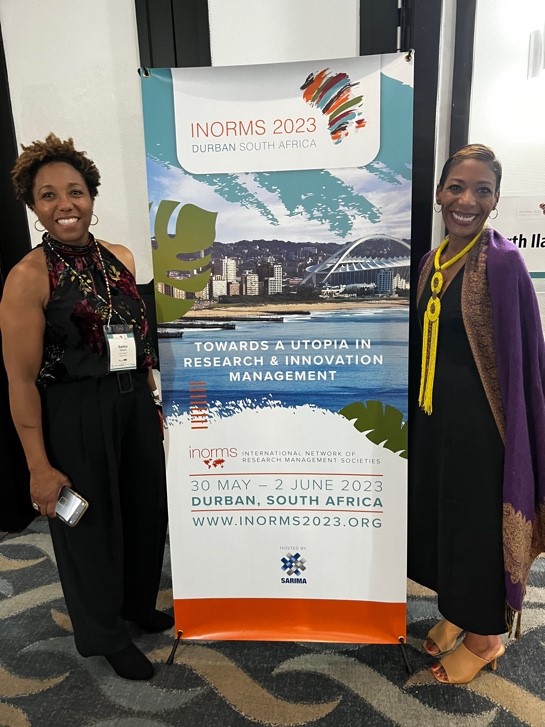
Jessica Venable, Thorn Run Partners (Washington, DC), met Saskia Walcott, Walcott Communications (Bristol, England), at the 2023 INORMS conference in Durban. They now collaborate to attract more women of color to RD, particularly targeting professionals in England, the US, and South Africa.
NORDP → WORLD: SAC disseminates NORDP members’ expertise to benefit the global research enterprise. In doing so, we assist in promoting the organization across the world, and advocate for a collective voice for research development excellence.
WORLD → NORDP: SAC brings valuable insights and information back to NORDP and its members. We help NORDP strategies align with the ever-evolving landscape of RD, ensuring that our organization remains at the forefront of the global research enterprise. This work also helps RD professionals at all levels have a bird’s-eye view of the field, contributing to their professional growth.
What We Do: Notable accomplishments in support of research development include:
Establishing funding for the Center for Advancing Research Impact in Society (ARIS) Fellows in 2022
Leveraging a partnership with the Association of Public and Land-Grant Universities (APLU) to secure funding for research development growth at Historically Black Colleges and Universities in 2021
Actively participating in EU-US Science and Technology and European Commission Horizon 2020 meetings
Developing guidance documents to promote strategic outreach, such as the NORDP Rules of Engagement with Federal Employees in 2013
Advocating for NORDP’s bid to host the 2027 International Network of Research Management Societies (INORMS) conference
SAC Liaisons: Liaisons are are specifically tasked with advocating for research development to external organizations and associations, in turn providing an invaluable service to NORDP members by gathering and sharing useful information as part of a broad, strategic outreach program. Visit SAC’s Liaisons webpage to see a list of existing liaisons.
The role of each liaison depends on the target organization and NORDP leadership goals as well as the skills and experience that an individual liaison brings to the position. Liaison duties and roles are assigned by SAC and approved by the Board on a case-by-case basis. Typical duties for liaisons include:
Serving as a point of contact between NORDP and the targeted organization or key subgroups.
Monitoring developments and activities at the targeted organization and sharing that information with NORDP’s membership through reports shared through NORDP’s various communication channels.
Increasing the visibility of RD generally, and NORDP specifically, among these targeted organizations; for example, by delivering relevant webinars, presenting at conferences, and contributing to thought pieces. email, webinars, conferences, discussions, posters, and presentations.
With NORDP Board approval, some liaisons interact with their target organization’s leadership to determine how NORDP’s mission can complement mutual interests such as: promoting alternative career paths within academia, increasing national and international research collaborations, building multidisciplinary research teams among diverse groups of individuals, and advocating for the global research enterprise.
Liaisons serve a minimum of three years, are asked to participate in a 30-minute monthly meeting with other liaisons, and encouraged to set goals with the Liaison Manager. Individuals with at least two years of NORDP membership may apply (although some liaison positions have additional requirements) . Liaison applications are reviewed by the SAC chairs and approved by the Board of NORDP. Upon acceptance, liaisons are provided with useful resources to begin their new roles. SAC considers individual requests to add new liaison organizations based on NORDP’s goals and evolving needs of NORDP members.
International Working Group (IWG): Many RD professionals work on international research funding opportunities and benefit from professional development opportunities to consult with experts in this area. Within SAC, the International Working Group meets monthly to discuss international research issues, such as NIH’s new policy regarding reporting requirements for international collaborators. The IWG actively promotes NORDP within the International Network of Research Management Societies (INORMS), work that attracts new members from across the world, strengthens relationships with others in the field, and delivers global RD perspectives, relationships, and best practices to US-based RD professionals.
How to Get Involved: Join SAC to become part of a dynamic team that is passionate about RD and:
Advocate for the field of research development
Catalyze activities that advance the profession
Serve as a liaison between NORDP and external organizations
Elevate your professional profile
Contribute to strategic thinking and intelligence gathering
Join us in shaping the future of research development at NORDP! For more information and to get involved, contact one of the SAC Committee Chairs: Karen Eck at keck@odu.edu, Gretchen Kiser at gretchen.kiser@ucsf.edu, or Sharon Pound at spound@utk.edu.
It’s difficult to believe that it is already time for holiday planning, but here we are!
Please save the date for our upcoming Holiday Soiree on Thursday, November 30 from 3:30-5PM Eastern. There will be general merriment and games, so make some time to celebrate the season with your NORDP colleagues and friends. More details and registration info will be forthcoming.
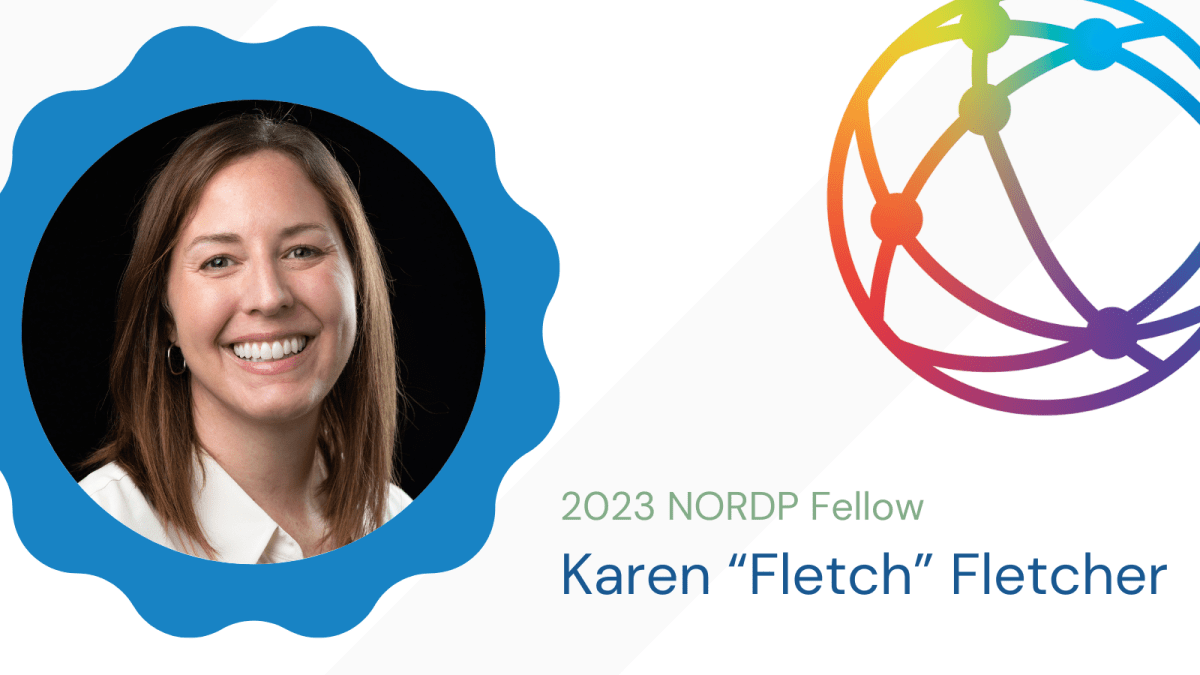
The NORDP Fellow Award recognizes the long-term accomplishments of members who have made sustained contributions to NORDP and worked tirelessly to advance research development as a profession and/or as a field. Status as a NORDP Fellow is the highest professional distinction the organization may bestow on a member.
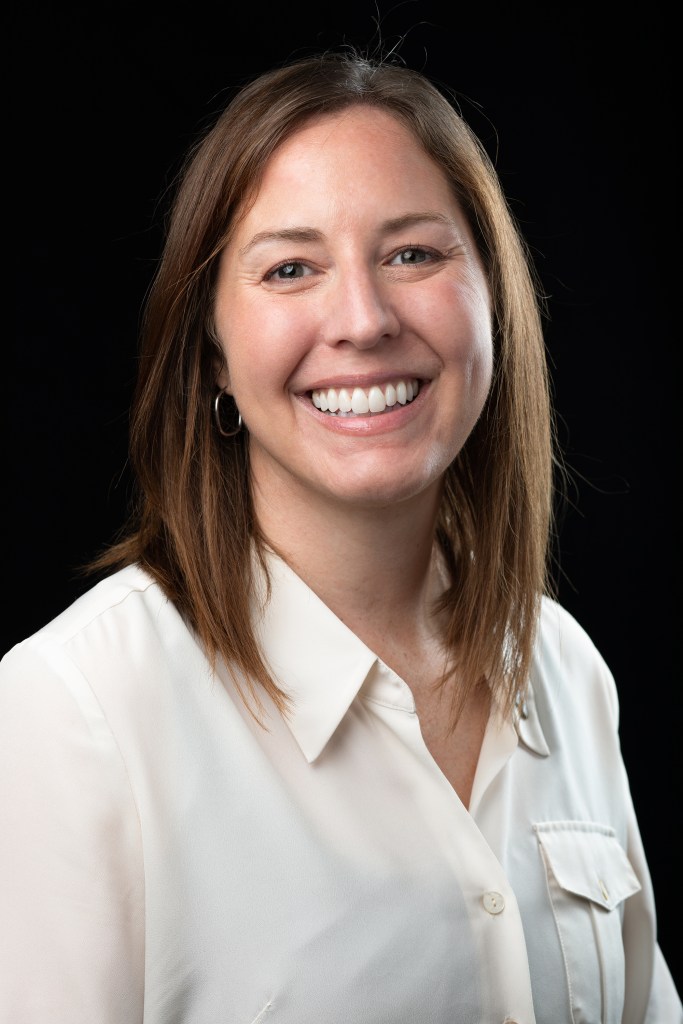
Who: Karen Fletcher, Director of Grants Resources & Services
Where: Appalachian State University
Number of years in research development: 13
Length of NORDP membership: 11
What is leadership to you?
Leadership is empowering the people around you. Both in a professional and personal capacity. I think the role of a leader is to encourage people to do their best and want to do their best.
What has your journey within NORDP looked like so far?
Initially, I joined the mentoring committee and then became co-chair of that committee. When I had an opportunity to run for the board, I jumped at it. I got involved with the conference planning committee, the communication working group, the member services committee, the nominating committee, the sponsorship committee, and the finance committee; I just wanted to be part of anything I could! I figured the more I learned, the more valuable I could be – in NORDP and in my every day job. While on the NORDP Board of Directors, I became secretary, then served the three-year term of vice president, president, and immediate past president. Since leaving the board, I am co-chair of the New Opportunities for Research Development (NORD) committee. I believe in the mission of NORDP and I believe in our community, so I want to give back.
Throughout your time in NORDP, which experiences stand out to you? What led you to take on leadership roles within the organization?
The support of NORDP members and the varied opportunities available in NORDP stand out to me. As I learned more about NORDP, I was constantly asking, “what skills are needed and how can I contribute?” When leadership opportunities presented themselves, I took a leap of faith that I could learn once in that role, and I was fortunate to have support from other incredible members.
What initiatives are you most proud of from your time as a NORDP volunteer?
So much has happened! The growth of NORDP – when our membership surpassed 1000 during the time I was President – was really exciting. I am very proud of the work we did around NORDP’s first strategic plan and how this has helped shape NORDP into the organization it is today. Most recently, it would be my work in NORD; creating a system for publishing NORDP supported articles and working to establish the editorial board for the Research Development Review: The NORDP Journal is something I am very proud we could make happen.
How has your involvement in NORDP impacted your career in research development?
It is interwoven into everything. Being part of committees helped me move forward and learn new skills. Zoom is actually a great example of that. We used Zoom so much in NORDP among members from all over that when Covid hit and Zoom became the default meeting mechanism at my university, there really was no learning curve, it was already so normal to me!
One of the biggest ways in which my career has been impacted is that after attending my first NORDP conference, I reached out to a member I met and asked if I could come and visit their university to learn how they were growing their research development office. After adopting some of those practices I learned from her and a few years later, I had the opportunity to interview and was hired into that position to carry on her work when she left it; I continue to visit other research development programs of members and learn so much from them – I wouldn’t be in the position I am today without the shared insight and experience of NORDP members.
What are you most excited about when you think about the future of research development as a field?
The growth of NORDP. We have so many new members and new job opportunities, the field is exploding, and we have such a positive impact on faculty and the evolving landscape of research development. I am so excited to see where research development is going next.
Karen was interviewed by Kirsten Abel, Faculty Recognition Director at Iowa State University.
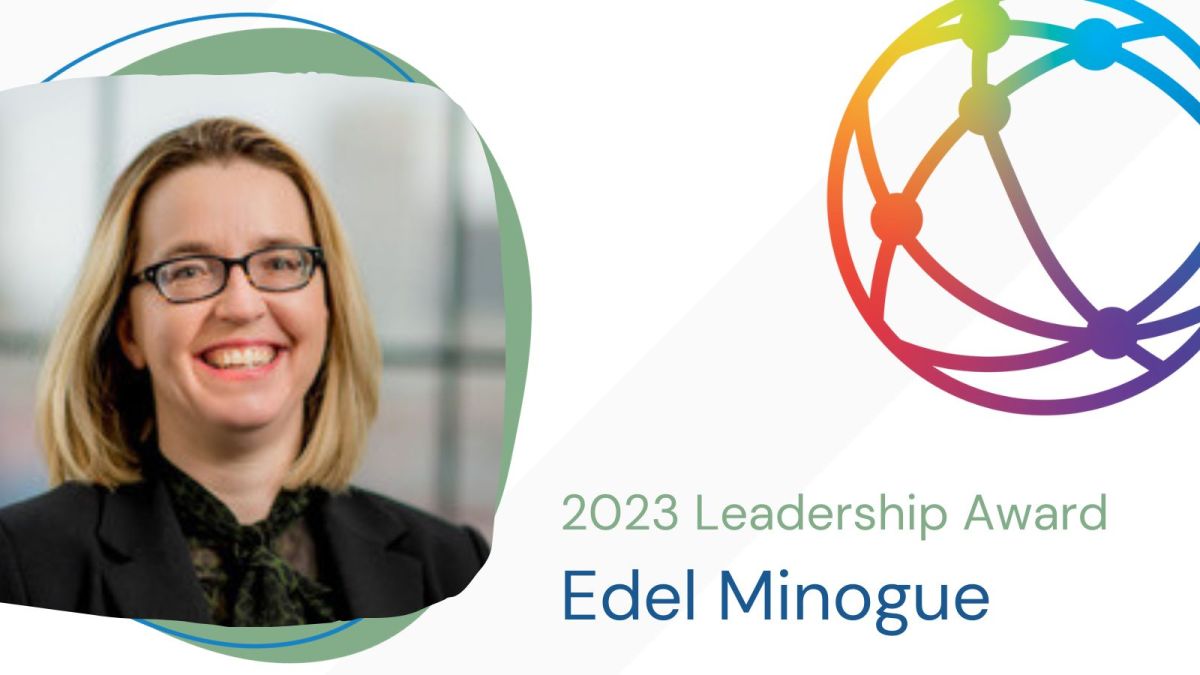
Who: Edel Minogue, Senior Director of Research Strategy and Development
Where: Brown University
Number of years in research development: 8
Length of NORDP membership: 8
What does leadership mean to you?
Leadership is a dynamic skill; you have to adapt and evolve based on the needs of your team and the environment at the time. I don’t see leadership as a single skill you have in your toolbox but a collection of skills that you mold and shape based on the circumstances.
How did you learn or develop your style of leadership?
It is not ‘developed’ but developing. Those around me have influenced me, and continue to influence me. I have always had very strong female leads- from my Ph.D. advisor, postdoc advisor, my current supervisor, Dr. Jill Pipher, Vice President for Research, and the person who hired me here at Brown, Dr. Amy Carroll. She could see that even though I had no prior experience in research development per se, I had those translatable skills to be successful both in the field and as a leader. With all these role models, I could choose from a buffet of leadership styles to find what would work for me personally.
How does your membership in NORDP develop your leadership style?
I have always tried to have my own personal advisory board, and some of these folks were on there in the early years. It is important to have sounding boards outside of your immediate environment, but at the same time, those who understand your work area and your needs and challenges. NORDP has been instrumental in creating that network. It’s been invaluable to know that I had those people in my corner and that I could call them if I needed their expertise. I really like to inspire and motivate others to grow in their professional career, and I have learned from my mentors.
What relationships have you built as a result of NORDP, and how have these relationships influenced your work?
Anne Windham (now the Associate Dean of Faculty at Brown) introduced me to NORDP and introduced me to many of those who started and created this organization and really pioneered the idea that this was a unique career field that has previously been overlooked. They pushed me to be more active in NORDP and I was. I just rotated off the NORDP NE Advisory Committee, I am the NORDP liaison to the European Commission and serve on various committees, which has really enhanced my knowledge and scope. The network of folks I see on a regular basis now spans the globe, and that is because of NORDP.
What do you wish you would have known when you began your leadership journey within NORDP?
Between working at Los Alamos National Lab and leading a startup with a critical need to be protective over intellectual property and patents, I came from a world that was very secretive and confidential. Then I came over to NORDP! A place where everybody shared everything, and I remember saying, “Don’t they realize they are giving away all their secrets?”. But I realized we all have a common goal – to enable the best research in the nation, irrespective of where it comes from. This open exchange of ideas and information was definitely something it took me time to learn and become comfortable with. It took me a while to put my thumb on it.
What have you found most rewarding, and most challenging, about leading within NORDP? In your CAREER?
The Northeast is a tremendous region, really engaged and active in NORDP. We have done a lot of listening, especially during COVID, to identify and respond to people’s needs, and I do that within my own team. NORDP is a ‘community of leaders’ – for everyone. Even if you don’t have that title today, you probably will one day, and it is cultivating those skills and relationships and elevating others that is especially rewarding.
What advice do you have for others within NORDP who are looking to develop as leaders?
Push yourself out of your comfort zone, join committees, and become involved. Even if you don’t have much expertise in a certain area, but you have an interest, there will be others who will support you along the way; that’s what is so great about NORDP. Use the NORDP community to create your own personal advisory boards and make those connections.
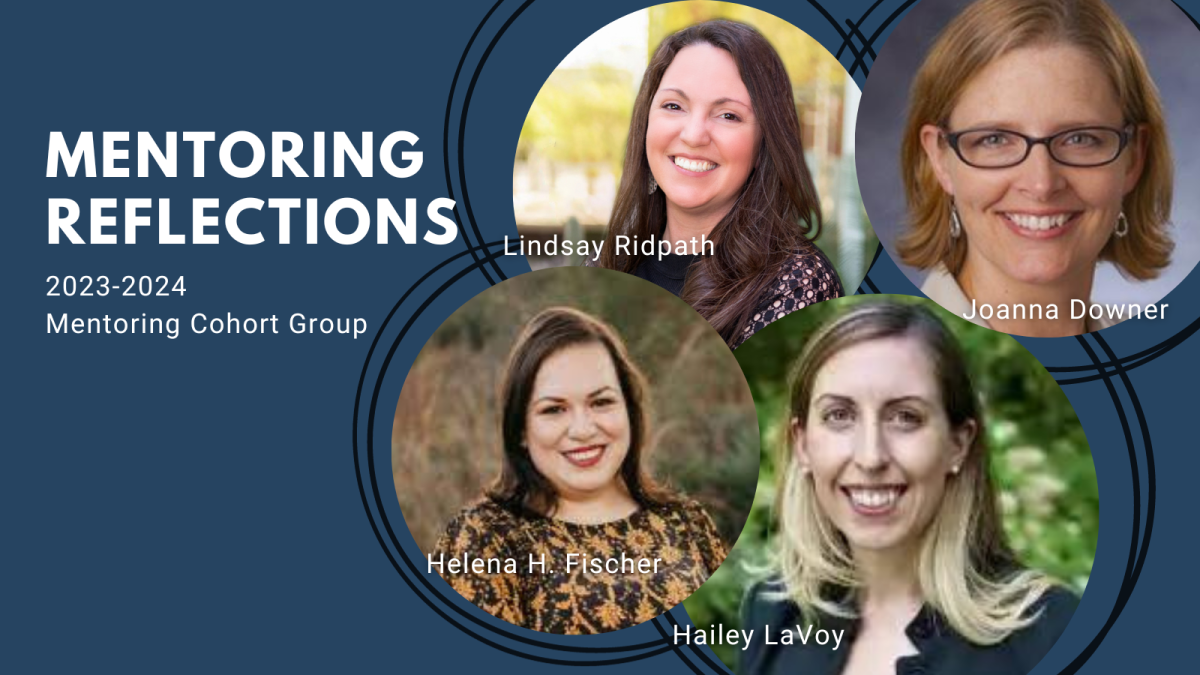
The traditional mentoring dyad (1:1 mentor-mentee) program has been a NORDP member feature since 2012. The Cohort Mentoring Group, piloted in July 2022, consists of matching three mentees with similar interests with one shared mentor. Both the dyad and cohorts are matched based on the WisdomShare matching algorithm. This is a blended reflection of both match types.
Crystal Love, Ph.D. is a Science Grant Writer and Editor for the Biological Sciences Division at the University of Chicago. She has participated in the NORDP mentoring cohort for two years in a row.
Eric Wayne Dickey, MFA is the Director of Sponsored Programs for the Division of Extension & Engagement at Oregon State University. He’s been active on the Mentoring Committee since 2017. Eric has engaged in mentoring 1-on-1 for 16 years and has formally participated in the NORDP mentoring dyads for 6 years.
Q1: What influenced you to apply to be a mentor or a mentee for the NORDP Mentoring Program?
Eric: Mentoring is very rewarding. Each time I am paired with a new mentee, and I learn about their work and their challenges and opportunities, I am reminded of my own efforts and how much work I still need to do on myself. Even though the focus in mentoring is on the mentee, I have found it to be a mutually beneficial endeavor. I am always grateful and inspired by the mentee’s bravery in stepping forward to show that they are willing to take a chance and invest in themselves and their own well-being.
Why did you choose the cohort mentoring model?
Crystal: I chose the cohort mentoring model to expand my community of support as I get further into my career in RD. At 2.5 years in, I am still new to this field and have a lot to learn, but I’ve also experienced a wide range of proposals, funding agencies, and faculty personalities in this time. I view the mentoring cohort as a great opportunity to continue my own growth as well as offer NORDP colleagues lessons, tips, and resources I have found useful so far. The cohort model is also a great way to hear diverse perspectives on various topics and learn about how other RD offices function. Lastly, I view the cohort mentoring model as a great stepping stone to becoming a mentor myself someday.
Q2: Can you compare your experience in the dyad vs. cohort mentoring models?
Crystal: This is my third year participating in the NORDP mentoring program. My first year I participated in a 1:1 mentoring program, my second year I participated in the new cohort mentoring program, and this year I am participating in the cohort program again. My experience with 1:1 mentoring was phenomenal; I had just entered the RD field and was matched with a mentor who also had a science background and provided significant insight as to how my career could progress. I had a lot to learn this first year, and since everything was new and a bit overwhelming, it was very useful having this 1:1 time with a mentor who could help me learn the basics, dig into the details of my current projects, and help me navigate new situations. My mentor provided advice and resources with the proposals I was working on, tips on working with other staff in grants administration and RD, and guidance on how to build a network in NORDP and build expertise toward my career goals. This experience had a significant impact on my confidence and trajectory, and I am very grateful to have had this individual support as I transitioned to a career in RD.
I have since decided to participate in mentoring cohorts because I learn so much from other’s experiences and work strategies. In my experience, the 1:1 model was a bit more structured, as far as identifying goals and introspection as I developed new skills, although our discussions were also organic based on what I was experiencing at that time (proposals, takeaways from workshops or virtual conferences, etc). My first cohort was less individualized as far as goals and reflection on personal development, but the wide range of discussions were organic and rich with multiple perspectives that helped my professional growth immensely. My second (current) cohort started by identifying goals for individual growth, and now our organic conversations continue to provide invaluable guidance and resources that I incorporate into my work.
Q3: What was your favorite part about the cohort mentoring model?
Crystal: Meeting amazing individuals and just having the opportunity to connect with others in the RD field are my favorite aspects of participating in the NORDP mentoring program. The cohort offers an opportunity to learn about a wide range of grants and funding agencies I may or may not be familiar with, as well as useful strategies NORDP colleagues use to manage various tasks, and provides a regular community of support to ask questions or bounce ideas around with. I have particularly found the cohort model helpful in developing those ‘soft skills’ in RD that are shared through discussions of diverse experiences. I like that the cohort model provides a space to discuss any aspect of RD that participants are interested in and allows flexibility in the mentor/mentee relationship where everyone benefits. The 1:1 mentoring relationship can sometimes put pressure on the mentee to provide questions/topics for the conversation to fill the hour and the mentor to have all the answers, while the cohort model is a space where many can bring up topics and the mentor isn’t alone in offering advice.
Q4: How has participation in the Mentoring Program helped broaden your horizons about Research Development in general and/or affected your daily work in particular?
Eric: The sharing of professional experiences that occurs in mentoring has shown me what is possible in RD, and what RD itself can make possible. Learning how people persevere in their work through challenges and opportunities has helped me become more empathetic. I now give wider margins to the faculty and clients I serve. I now understand that almost everybody has other things going on beneath the surface, other tasks and priorities, and other obligations.
Q5: What surprised you about being a mentor or a mentee?
Eric: Throughout my career, people have often turned to me for guidance and advice. In the past, I closed myself off to that, because I was uncomfortable in my own skin. I have since learned that I am not alone. Most everybody has other things going on, and most everybody has self-doubt. Mentoring has shown me that a lot of people need support and affirmation. Mentoring has helped me feel less alone out here in this crazy world of work.
Q6: Any words of wisdom or encouragement for those wanting to apply next year? Any other thoughts you would like to share?
Eric: Taking part in the mentoring program, whether as mentee or mentor, is a profound investment in the self. You are worth it. Take the chance and apply. You and your colleagues will be glad you did.
Crystal: While the 1:1 mentoring model may fit a smaller but very important segment of new RD professionals, the cohort model is perfect for all professional levels. These small cohorts that bring together NORDP colleagues from all over the country with a wide range of experiences in a regular, comfortable, structured, and (time-limited) setting is brilliantly effective. I would encourage NORDP members at all levels to participate and share in this experience, regardless of the mentor/mentee status. RD professionals do not share the same background, experiences, or institutional support, and the beautiful strength of NORDP is that we are a community that shares, discusses, and informs with generosity and humility. RD professionals, whether part of an institutional machine or an office of one, can learn so much from each other – I’ve seen it!
Applications for the 2024-25 mentoring match cycle will open in the spring — keep an eye out for NORDP emails. Additional mentoring opportunities are available through the Peer Mentoring Groups that are open for participation throughout the year via the WisdomShare platform [LINK: https://nordpmentoring.mywisdomshare.com/]. Contact the NORDP Mentoring Committee if you have any questions [link: mentoringprogram@nordp.org].
An investment in mentoring is an investment in you!
I have been in NACRO for over 10 years. Having a background as a chemical engineer, I worked for Dow Chemical for 17 years. A large part of my job was bringing in sponsored research with academia so that Dow would have much needed expertise and capability. Therefore, I was initially on the other side of the table. Once I began working in research development, working in/with corporate relations was a natural fit for me.
What is your role within your organization?
I am Director for Research in the Grainger College of Engineering at the University of Illinois Urbana-Champaign. My office falls under the Office of the Associate Dean for Research. In addition to supporting the launching of large, multi-investigator, multi-organization efforts, I have a significant faculty development mission. I have developed a number of programs for early career investigators including a program for new faculty to help them in starting their research at University of Illinois and a workshop series dedicated to assisting faculty with their NSF CAREER proposals. I have also developed/facilitated workshops on interacting with program officers and workshops on leading graduate students as well as faculty peers. As part of seeding large, multi-investigator centers and institutes, I oversee the Strategic Research Initiative at Grainger Engineering, which offers funding to help build teams and obtain preliminary data for large, multi-million-dollar proposals. I am also a certified coach – coaching faculty and staff in career and leadership development. I recently initiated “5 for 5” group coaching where five professors meet with me for five weeks.
How can NORDP’s alliance with NACRO help us at the member level?
We have an alliance between NORDP and NACRO, and one of the things we’ve been thinking about is how this alliance can increase member-to-member interaction across these organizations. Right now, we are exploring collaborations between NORDP, NACRO, and federal agencies. Our current project is emerging in conversation with the NSF TIP (Technology, Innovation, and Partnership) program. NORDP and NACRO are exploring the possibility of partnering to conduct a landscape analysis of needs and capabilities (such as workforce development and commercialization opportunities) in different regional innovation ecosystems. We hope to facilitate collaborations between universities and corporations that are mutually beneficial. This project is well-suited to support the NSF ENGINES program, which focuses on catalyzing regional innovation ecosystems – especially those that may be in early development and have had limited interaction with federal agencies.
You recently presented on this project at the NACRO 2023 meeting. How was your talk received?
This year’s NACRO 2023 meeting was held in Portland, Oregon. I presented on a panel with fellow NORDP and NACRO member Rachel Dresbeck, Senior Director of Research Development at Oregon Health and Science University, and NACRO member, Kim Jacobs, Assistant Dean of Development in the College of Engineering at Florida A&M and Florida State. A quick poll of the audience of about 50 showed that almost all were potentially interested in this project. Our vision for the landscape analyses are quite broad and may include technical/research capabilities, entrepreneurship, tech transfer, DEIB, local government needs, nonprofits/NGOs, community engagement, incubator services, etc.
How might NORDP members be involved in this project?
This project will necessarily draw upon many untapped partnerships and will have teams performing landscape analyses in different areas of the country that are co-led by NORDP and NACRO members. NORDP and NACRO members can also just be members of the teams. The highly successful NORDP Consultant program has been an inspiration and a model as we plan for this grassroots effort. We are also drawing upon Strategic Doing to develop our framework. As you may know from workshops at previous NORDP conferences, Strategic Doing facilitates collaborations to address complex challenges. NORDP members Rachel Dresbeck, and Jeff Agnoli, Director of Education, Funding, and Research Development in the Office of Research at Ohio State (who is also a Strategic Doing Fellow) are involved in this effort. The NORDP membership will be instrumental in requesting support for their regions and partnering with us in these efforts. NSF TIP may also wish to prioritize certain areas. While we are still in the planning phase of this effort, it is clear that the kernels of activity and energy from this effort will also result in new collaborations and team building.
Based on your experiences as an engineer in industry, an RD professional, and a NACRO member, how can research development offices and offices of corporate relations work together more effectively?
I want to emphasize the importance of networking between RD offices and offices of corporate relations. While each office has its own mission, there is a benefit for corporate relations being included as a part of the team in proposals to federal funders, and vice versa. Since corporate partnerships and funding are an essential part of the academic research ecosystem, corporate relations, and research development should be working closely together on a regular basis. This will result in new opportunities as well as more compelling proposals for funders. Instead of waiting until a particular proposal needs corporations, these teams can engage at a much earlier stage to determine how they can work together for future proposals – before the solicitation comes out. Programs that the institution has submitted to in the past may be a good place to start.
Meira Orentlicher from Touro University was awarded $4,950 for the project, “Understanding the Experiences and Needs of Immigrant Faculty Researchers in their Career Development.”
Meira Orentlicher (Touro University)
Immigrants contribute to the growth and development of the US research enterprise at many levels, as faculty, staff, and learners. This project seeks to understand the experiences, perceptions, triumphs, and challenges of immigrant faculty working at US research institutions. Orentlicher and other members of NORDP’s Immigrant Knowledge and Wisdom affinity group (Melissa Li, University of Michigan; Gagan Bajaj, University of Vermont; Samarpita Sengupta, UT Southwestern Medical Center) will conduct in-depth interviews with first-generation immigrant faculty researchers. Using the results of those interviews, they will develop the foundation for tools and actionable strategies for research development professionals to use in supporting immigrant researchers.
Susan Carter (Santa Fe Institute) and Nathan Meier (University of Nebraska-Lincoln) were awarded $4,976 for the project “Professional Development in Research Development: A Landscape Analysis.”
Susan Carter (Santa Fe Institute)Nathan Meier (University of Nebraska Lincoln)
There is no comprehensive, intentional system of professional development programming to support the research development (RD) workforce. This gap complicates the recruitment, development, and retention of talent in RD. This project seeks to establish a systematic understanding of professional development opportunities available to RD practitioners through an online survey. The survey will collect information about extant RD-focused professional development programming. Survey items also will capture respondents’ perceptions about barriers to access or participation in professional development programming in RD, help identify holes in that content, and surface promising approaches from allied fields. Results will provide a baseline against which unmet professional development needs of RD professionals can be identified and offer empirical direction for future attention and investment.
Charlene Emerson from the University of Missouri – Columbia was awarded $3,750 for the project “Responsibilities and Motivations of Research Support Staff: An Institutional Case Study.”
Charlene Emerson (University of Missouri)
As universities continue to invest in research development (RD), they will likely experience challenges integrating existing infrastructure with emerging RD practices, as well as with recruiting and retaining skilled research support staff. Emerson and team will use a survey-based approach to characterize RD and research administration (RA) task distribution at an R1 institution and identify variables that can be used to optimize research support operations. In addition to collecting data to understand the distribution of RD and RA responsibilities across positions and units, the team will also collect information on staff experiences, job satisfaction, and career motivations. The cross-disciplinary team includes human resources professionals, so that results can be used to inform institutional practices for structuring research support offices and for recruiting and retaining research support staff.
Congratulations to Meira, Susan, Nathan, and Charlene!