NORDP 2019 Conference Notes: Employing Tactical and Strategic Approaches to Help Faculty Maximize Broader Impacts

Slides: Employing Tactical and Strategic Approaches to Help Faculty Maximize Broader Impacts

Presenters:

  • Danielle Mazzeo, American Museum of Natural History
  • Nathan Meier, University of Alabama at Birmingham
  • Tisha Mullen, University of Nebraska-Lincoln
  • Stephanie Hensel, University of Michigan School of Education

Thanks to our session scribe, Paige Belisle, Harvard University!

This presentation explored how different institutions address Broader Impacts requirements during the proposal development process. The National Science Foundation defines Broader Impacts as activities associated with sponsored research that will benefit our society and world. Other Federal agencies require similar components that will have impact outside of traditional academia. Meeting Broader Impacts requirements can be accomplished through the research/project itself; through activities directly related to the research/project; or through activities complementary to the research/project.

Case Study: American Museum of Natural History, New York City

This portion of the presentation focused on how the museum uses intra-institutional connections to maximize Broader Impacts activities. The museum aims to create & support interdisciplinary partnerships; leverage other departmental efforts to support new Broader Impact activities; and develop Broader Impact activities that are replicable and scalable. This is carried out by establishing links between its library and archives, cyberinfrastructure, graduate students, research projects, youth programs, and exhibitions, all of which also serve the museum’s central mission.

Case Study: University of Michigan School of Education

This section of the presentation discussed a university center which addresses Broader Impacts. The University of Michigan School of Education’s Center for Education Design, Evaluation, and Research (CEDER) “advances equity and excellence in education by providing access to high quality design, evaluation, and research services through collaborations with university, school, and community partners.” CEDER helps faculty during the proposal development, project implementation, and research dissemination stages by offering design, evaluation, and research development services. Through consultations, CEDER helps faculty consider how to approach Broader Impacts activities in K-12 classrooms.

Case Study: University of Nebraska-Lincoln

This portion of the presentation explored how the University of Nebraska-Lincoln uses a matrix approach for Broader Impacts support by providing something for nearly everyone in the community: Pre-K to seniors, formal and informal activities, and local to global impact. Their group emphasizes that there are no cookie-cutter approaches that guarantee Broader Impacts success. The presentation discussed the importance of leveraging existing partnerships and infrastructure. It  argued that a faculty member doesn’t need to reinvent themselves to successfully implement Broader Impacts activities; rather, they should focus on how their existing connections, passions, and projects might be expanded to meet the requirements.

What did you hear at this presentation that surprised you?

I did not realize that the American Museum of Natural History in New York functions as a PhD-granting research institution, and it was very interesting to hear their unique perspective on Broader Impacts.

What resources did you discover at this presentation? 

E-resources from the presentation can be found here: http://bit.ly/2ZvBtqz

The presenters mentioned that the National Alliance for Broader Impacts (NABI) offers many additional resources: https://broaderimpacts.net

What were the most interesting questions asked by an audience member, and what was the presenters’ responses?

Question: What if PIs want to focus only on training graduate students for their Broader Impacts?

Answer: While this is a very important aspect, it is typically not adequate to only focus on training graduate students in the Broader Impacts section. Generally, the proposal will need to have other Broader Impacts activities as well.

Question: How do you encourage faculty to visit a curriculum development office (or other relevant Broader Impacts resource) early in the proposal development process?

Answer: A helpful website can be a good first step in advertising your services. You can also create a “roadshow” presentation to bring to existing meetings, especially for schools and departments that may need extra help.

Question: What are the most common critiques regarding Broader Impacts in unsuccessful proposals?

Answer: A comment the presenters have frequently seen is that the Broader Impacts were interpreted by the reviewers as too broad or ambitious in scope. Proposal writers should focus on the quality of their Broader Impacts activities rather than the quantity of activities they are proposing. Goals should be concrete and attainable, not aspirational. Broader Impacts partnerships should be authentic.

NORDP NE Summer Meeting

NORDP NE held their Summer Meeting on Thursday, July 25th at Worcester Polytechnic Institute in Worcester, MA. A big shout out and thank you to our hosts at WPI, especially Antje Harnisch, who served on the planning committee and presented at the meeting. Over fifty RD professionals from around Region 1 attended, accompanied by visitors from Region 2. The agenda from the meeting is below, along with a couple of select slide decks. Thanks to all who attended!

TIME SUBJECT/TOPIC PRESENTER/LOCATION
8:45 – 9:15 Registration/ Continental Breakfast Odeum A, Campus Center
9:15 – 9:30 Welcome Amy Gantt, NORDP NE Chair and Jeralyn Haraldsen, NORDP NE Chair-Elect and NORDP Member Services Committee
9:30 – 10:30 Welcome and Panel Discussion: WPI’s Institutional Engagement Model Institutional Engagement
10:45 – 11:45 Lightning Talks: Project Management in Research Development Facilitated by Anne Maglia, UMass Lowell

– Anne Maglia: Work Breakdown Structures
– Jacob Levin, MIT: Wrike Project Management Software
– Peg AtKisson, ATG Consulting: What We Learned When We Hired a Professional Project Manager
– Mary Green, UMass Amherst: Proposal Workflow Schedules
– Loren Walker, UMass Amherst: A Simple Plan
– Kate Duggan, Brown University: RD Knowledge Repository – What Have We Been Up To?

11:45 – 12:45 Lunch
12:45 – 1:15 NORDP NE News and Updates – Amy Gantt, NORDP NE Chair
– Kathy Cataneo, NORDP Board Member
– Jeralyn Haraldsen, NORDP NE Chair Elect and NORDP Member Services Committee
1:15 – 2:15 Jim Kurose, NSF Assistant Director, Directorate of Computer and Information Science (CISE) National Science Foundation Programmatics and Activities
2:30 – 3:30 Discussion & Brainstorming: Research Intelligence, faculty profiles, and information management Facilitated by Mark Milutinovich, University of New Hampshire, and Loren Walker, UMass Amherst
3:30 – 4:30 Activity & Discussion: Areas of Strength at NORDP NE Institutions Facilitated by Amy Gantt, Tufts University, and Jeralyn Haraldsen, University of Vermont
4:30 Reception Onsite at WPI with cash bar

Two New Board Members Appointed

The Board is pleased to announce the appointment of two new Board members:

  • Kimberly Littlefield, of The University of North Carolina at Greensboro, representing the Regional/MSI institutions, and
  • Nathan Meier, of University of Nebraska-Lincoln, representing the overall membership.

These members were appointed pursuant to the bylaws, Article IV, Section F  and 1) filled a seat that was vacant due to a resignation from the Board, and 2) increased the Board to an odd-number of members, in order to avoid a tied-vote situation, by filling the Board Regional/MSI designated seat.

We are excited to begin our strategic planning process with a full Board and look forward to keeping you informed. Keep an eye out for the upcoming Board cameos of your two new Board members.

We would also like to, again, thank former Board members Jan Abramson, Jeff Agnoli, Kellie Dyslin, and Karen Eck for their Board service.

Cheers,

Karen “Fletch” Fletcher

Karen Fletcher
Director, Grants Resources & Services
Office of Research | Appalachian State University
John E. Thomas Hall | ASU Box 32174 | Boone, NC  28608

President 2019-2020
National Organization of Research Development Professionals (NORDP)
www.nordp.org

It’s Here! NORDP Resource Creates Inroads into RD Careers: NROAD to RD

Why formal RD training?

Research Development (RD) is a career of strategists, planners and figure-it-outers. Most of us “fell into” the role and realized later that what we do is RD. We’ve figured out and honed our skills along the way.

However, the field is growing (if the first-ever sold-out NORDP conference is any indication!), and so a considerable need exists to shorten and ease that learning curve. Similarly, people looking at RD as a potential career may feel unsure about how to get started, or how to “test the waters” given the variability across RD offices.

With this in mind, NORDP launched a working group in June 2018 under the Strategic Alliances Committee to create a resource to help RD offices develop training programs relevant to their own needs. Indeed, the “NROAD to RD” training program framework is based on the idea that some RD-relevant skills and knowledge can be taught – and it offers a menu of options from which to choose.

The NROAD to RD, or the NORDP Resource for Organizing and ADapting a Training Program toward Developing an RD career, is the culmination of a year’s worth of work by the working group (with input from each of NORDP’s standing committees), a beta test at Duke University’s School of Medicine, and a soft launch at the 11th Annual NORDP conference in 2019.

How does NROAD to RD work?

The goals of NROAD to RD are to “provide RD offices with a framework to (1) develop their own training/apprenticeship/internship programs, and (2) employ that framework to introduce, recruit, and train individuals interested in a RD careers.” RD offices can choose among the suggested components and add additional components as necessary to ensure relevance to their individual office and institution’s missions.

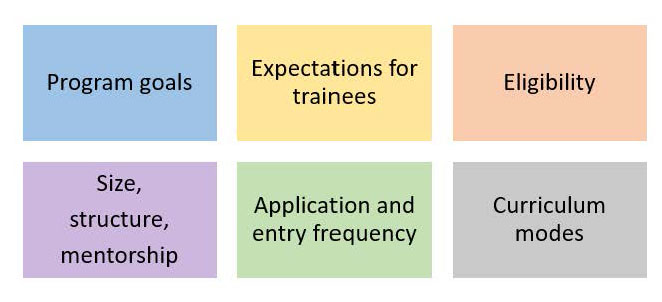
The resource provides a guide for decision-making in designing an appropriate training program (Fig 1). Each decision affects the others, collectively defining parameters for the training program.

Doc1-b
Figure 1: Decisions to be made while designing an NROAD-based RD training program.

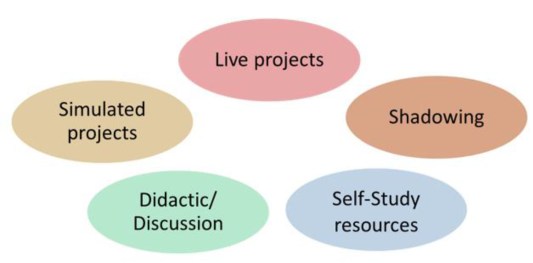
NROAD to RD also offers curriculum modes, or training delivery methods, from which to choose (Fig 2). Most programs will likely include a range of delivery methods, from self-study to shadowing to live or simulated work projects, as suits their goals and mentoring capacity.

Doc2
Figure 2: NROAD’s recommended curriculum modules

Curriculum suggestions include RD basics; navigating large grants, individual grants, and limited submissions; project management; team science; diversity and inclusion; and other institutional/research-related/career related topics. The curriculum module section is further broken down into sub-categories with recommended reading resources and suggested assignments for each.

Finally, NROAD to RD offers suggestions for program and trainee evaluation to ensure refinement and success.

Interested in NROAD to RD?

The NROAD to RD framework is available to all NORDP members and may be requested HERE. In the coming months, the “Phase II” working group under the auspices of the NORDP Professional Development Committee will create additional resources (e.g., case studies and job simulations), navigate the logistics of hosting these resources on the NORDP website, and evaluate resource usage.

Acknowledgements!

The Phase I working group was chaired by Samarpita Sengupta, and consisted of the following members: Peggy Sundermeyer, Trinity University; Joanna Downer, Duke University; Page Sorensen, then at the University of California San Francisco; Sharon Pound, University of Tennessee, Knoxville; Rebecca Latimer, University of Virginia; Nicole Frank, University of Utah; Beth Moser, Maricopa County Community Colleges District; and Sarah Messbauer, University of California, Davis.

NROAD to RD was developed initially using resources generously shared by UT Southwestern Medical Center’s NeAT program (Samarpita Sengupta), University of California San Francisco’s Internship program (Page Sorensen), The University of Tennessee, Office of Research & Engagement’s Onboarding Resources (Jennifer Webster), and University of Nebraska–Lincoln’s Onboarding Resources (Kathryn Partlow).

Current Phase II WG members are Joanna Downer, Rebecca Latimer, and Samar Sengupta with several new members: Danielle Matsushima at Columbia University; Elaine Lee, Boston University; Maile Henson, Duke University; Alexis Nagel, Medical University of South Carolina, and Dawn McArthur, BC Children’s Hospital Research Institute. Peggy Sundermeyer remains on the WG as a consultant with supplementary assistance from Jacob Levin, MIT.

Submitted by Samarpita Sengupta

NORDP fosters a culture of inclusive excellence by actively promoting and supporting diversity, inclusion and equity in all its forms to expand our worldview, enrich our work, and elevate our profession.

It’s Here! NORDP Resource Creates Inroads into RD Careers: NROAD to RD

Why formal RD training?

Research Development (RD) is a career of strategists, planners and figure-it-outers. Most of us “fell into” the role and realized later that what we do is RD. We’ve figured out and honed our skills along the way.

However, the field is growing (if the first-ever sold-out NORDP conference is any indication!), and so a considerable need exists to shorten and ease that learning curve. Similarly, people looking at RD as a potential career may feel unsure about how to get started, or how to “test the waters” given the variability across RD offices.

With this in mind, NORDP launched a working group in June 2018 under the Strategic Alliances Committee to create a resource to help RD offices develop training programs relevant to their own needs. Indeed, the “NROAD to RD” training program framework is based on the idea that some RD-relevant skills and knowledge can be taught – and it offers a menu of options from which to choose.

The NROAD to RD, or the NORDP Resource for Organizing and ADapting a Training Program toward Developing an RD career, is the culmination of a year’s worth of work by the working group (with input from each of NORDP’s standing committees), a beta test at Duke University’s School of Medicine, and a soft launch at the 11th Annual NORDP conference in 2019.

How does NROAD to RD work?

The goals of NROAD to RD are to “provide RD offices with a framework to (1) develop their own training/apprenticeship/internship programs, and (2) employ that framework to introduce, recruit, and train individuals interested in a RD careers.” RD offices can choose among the suggested components and add additional components as necessary to ensure relevance to their individual office and institution’s missions.

The resource provides a guide for decision-making in designing an appropriate training program (Fig 1). Each decision affects the others, collectively defining parameters for the training program.

Doc1-b
Figure 1: Decisions to be made while designing an NROAD-based RD training program.

NROAD to RD also offers curriculum modes, or training delivery methods, from which to choose (Fig 2). Most programs will likely include a range of delivery methods, from self-study to shadowing to live or simulated work projects, as suits their goals and mentoring capacity.

Doc2
Figure 2: NROAD’s recommended curriculum modules

Curriculum suggestions include RD basics; navigating large grants, individual grants, and limited submissions; project management; team science; diversity and inclusion; and other institutional/research-related/career related topics. The curriculum module section is further broken down into sub-categories with recommended reading resources and suggested assignments for each.

Finally, NROAD to RD offers suggestions for program and trainee evaluation to ensure refinement and success.

Interested in NROAD to RD?

The NROAD to RD framework is available to all NORDP members and may be requested via email to Dr. Samarpita Sengupta (samar.sg@gmail.com). In the coming months, the “Phase II” working group under the auspices of the NORDP Professional Development Committee will create additional resources (e.g., case studies and job simulations), navigate the logistics of hosting these resources on the NORDP website, and evaluate resource usage.

Acknowledgements!

The Phase I working group was chaired by Samarpita Sengupta, and consisted of the following members: Peggy Sundermeyer, Trinity University; Joanna Downer, Duke University; Page Sorensen, then at the University of California San Francisco; Sharon Pound, University of Tennessee, Knoxville; Rebecca Latimer, University of Virginia; Nicole Frank, University of Utah; Beth Moser, Maricopa County Community Colleges District; and Sarah Messbauer, University of California, Davis.

NROAD to RD was developed initially using resources generously shared by UT Southwestern Medical Center’s NeAT program (Samarpita Sengupta), University of California San Francisco’s Internship program (Page Sorensen), The University of Tennessee, Office of Research & Engagement’s Onboarding Resources (Jennifer Webster), and University of Nebraska–Lincoln’s Onboarding Resources (Kathryn Partlow).

Current Phase II WG members are Joanna Downer, Rebecca Latimer, and Samar Sengupta with several new members: Danielle Matsushima at Columbia University; Elaine Lee, Boston University; Maile Henson, Duke University; Alexis Nagel, Medical University of South Carolina, and Dawn McArthur, BC Children’s Hospital Research Institute. Peggy Sundermeyer remains on the WG as a consultant with supplementary assistance from Jacob Levin, MIT.

Submitted by Samarpita Sengupta

NORDP fosters a culture of inclusive excellence by actively promoting and supporting diversity, inclusion and equity in all its forms to expand our worldview, enrich our work, and elevate our profession.

A Message from NORDP’s President

Greetings, NORDP!

I would like to welcome you to a new year as your President. Thank you for the opportunity to serve you this year.

This year, your Board is working on putting together a Strategic Plan to move NORDP forward over the next decade and beyond. Many of you (over 1/3 of you!) participated in the Member Services survey earlier this year, which was our first step to finding out how you, as members, are using NORDP. Thank you for your participation! This information is helping guide us in our activities in the coming year.

In the next few months you may receive a phone call or an email from First Point, the organization working with us on your Strategic Plan. Please be candid with them. They are gathering information for a SWOT analysis and getting reports ready to inform your Board during the retreat in September. 

In fact, you can help us with the process right now! Every week or so leading up to the Strategic Planning in September, we will be posting a short poll, posing a question to you to help us gather information for our Strategic Plan. To participate in the first question, please visit here to let us know what you think NORDP should focus on.

Throughout the year, please make use of the listserv to ask your colleagues about RD, and don’t forget to subscribe to the NORDP Blog for relevant NORDP and RD news.

Also, I want to know what matters to you. I am starting a two-way communication avenue called “Ask the President.” Please, if you have any questions or comments about NORDP and/or the Research Development field, just “Ask the President” by emailing president@nordp.org.

I look forward to working with all of you next year!

Cheers,

Karen “Fletch” Fletcher

Karen Fletcher
Director, Grants Resources & Services
Office of Research | Appalachian State University
John E. Thomas Hall | ASU Box 32174 | Boone, NC  28608

President 2019-2020
National Organization of Research Development Professionals (NORDP)
www.nordp.org

NORDP 2019 Conference Notes: Building the RD Professional’s Toolbox and Skills for Developing Project Evaluation Plans for Grant Proposals

Slides: Building the RD Professional’s Toolbox and Skills for Developing Project Evaluation Plans for Grant Proposals

Presenters:

  • Katie Allen, Kansas State University, Office of Educational Innovation and Evaluation
  • Morgan Wills, Kansas State University, Office of Educational Innovation and Evaluation
  • Makenzie Ruder, Kansas State University, Office of Educational Innovation and Evaluation

Thanks to our session scribe, Paige Belisle, Harvard University!

This highly engaging NORDP session presented by Kansas State University’s Office of Educational Innovation and Evaluation team offered attendees tools and resources for considering grant proposal evaluation plans. The session explored terms and ideas common to evaluation plans and provided guidance for Research Development professionals who are new to this aspect of proposal development. Defining evaluation as determining the value or worth of a project, the presenters suggested that evaluation can also be described as a means to document the success of a particular program.

The presenters explained that first, you will need to determine criteria indicators for making your assessment. Many funding agencies will have a list of required documents and specific instructions for what is required within the evaluation plan. An internal evaluation will require the research team to evaluate their own work, while an external evaluation will be conducted by someone independent from the project. Essentially, an evaluation asks whether a project’s overall purpose is being met, given the requirements of the program solicitation. For example: do the PIs need to produce publications, or gather and report on a specific form of data? Have they met these goals successfully?

As a Research Development professional, there are many ways that you can help the PI prepare their evaluation plan. You can help a PI identify the supplemental documents that they will need to gather to be compliant with the solicitation. The RFP language used to describe similar types of evaluation plan components can vary from sponsor to sponsor, as will the agency’s specific guidance for things to include within those components. This sponsor-specific language and terminology will be important to ensuring the proposal’s competitiveness. PIs may need assistance in considering what to budget for their project’s evaluation. The presenters advised that an external evaluation budget should be roughly 10% of the total proposed budget for the project. In the budget justification, you might suggest that the PI specify why the evaluation will cost what they are proposing. For example, will the external evaluator need to travel to the PI’s lab to assess the project? You can also provide assistance by reviewing the proposal’s project communication plan and timeline.

What did you hear at this presentation that surprised you?

Because I do not personally assist faculty with budget preparation, I was interested to learn that an external evaluation budget is often roughly 10% of the total proposal budget.

What resources did you discover at this presentation? 

The presenters put together a comprehensive list of links and additional resources on the topic of evaluation, which can be found here: http://bit.ly/OEIE_NORDP

What was the most interesting question asked by an audience member, and what was the presenter(s)’ response?

One audience member asked how to approach the topic of developing an evaluation plan with a faculty member who may be apprehensive about the process of an external evaluation. The presenters explained that one way to frame evaluation is to think of evaluators as “critical friends” who can help bring a project to the next level. The presenters explained that, in their own experience, when a PI works with an evaluator once, they begin to appreciate the process and benefits of evaluation.

Tales from the Listserv: What does it take to cultivate multiple effective science teams in a targeted focus area?

The below blog consists of catalogued answers to an RD question posed on the listserv. 

NORDP Listserv Question from:

Jeff Agnoli, Education, Funding and Research Development
The Ohio State University

Hello NORDP Colleagues: we are searching for resources (programs, curricula) to develop university-level interdisciplinary faculty leaders—so, going one level up from “what does it take to be a great leader of a science team” to “what does it take to cultivate multiple effective science teams in a targeted focus area”?

There are programs out there to develop leadership skills in faculty, but they often aim toward becoming a dean or a department chair. How do we develop and support faculty leaders tapped with growing a new strategic interdisciplinary focus area/center?

Responses:

Melanie Chase, Ph.D., Facilitator, Advisor, Coach
Change Solutions

This Robert Wood Johnson Foundation Interdisciplinary Research Leaders Program is an exciting opportunity to advance interdisciplinary research for health equity: http://interdisciplinaryresearch-leaders.org/about-the-program/. Interdisciplinary Research Leaders is a leadership development opportunity for teams of researchers and community partners, including community organizers and advocates. These teams use the power of applied research—informing and supporting critical work being done in communities—to accelerate that work and advance health and equity. Their innovation helps build a Culture of Health, one that enables everyone in America to live longer, healthier lives.

Kim Patten, Director of Research Development Services
The University of Arizona

We’ve been looking at developing a similar program.

Sarah Bronson, Ph.D., Associate Dean for Interdisciplinary Research
Penn State College of Medicine

I just met Suresh Garimella last week at a BTAA Academic Leadership Seminar and he told me about this program he is running for the first time this year. It sounded neat although I have not contacted him yet for the syllabus, see https://www.purdue.edu/research/flair.php

M.S. AtKisson, Ph.D., President
AtKisson Training Group

Since peeling off my former company, I’ve worked to fill exactly this niche—research leadership development. My approach has been to translate some of the work that has a long history in the business world to the language and the needs of researchers. The business programs often start from the idea that the person sits in a hierarchy, which people answer to them and they answer to people above them. For center directors or leaders of multidisciplinary teams, the other researchers are really their equals.

For developing research leaders, I do an individual coaching program over 8 weeks. I use a combination of an adapted a curriculum and just straight up leadership coaching (I’ve trained through CTI).

If anyone would like more information, please contact me off list. http://www.atg.consulting/

Susan Carter, J.D., Research Development Director
Santa Fe Institute

There is a leadership development component to the faculty and leadership retreats that have been a part of our CREDITS (Center for Research Excellence and Diversity in Team Science) project in California…the lead PI for that NSF funded project is Barbara Walker at UCSB.

Holly Hapke, Ph.D., Director of Research Development
University of California-Irvine

  • First, there is a Science of Team Science listserv that “facilitates knowledge sharing among individuals engaged in, studying, facilitating, and supporting team science, in the US and internationally. It is maintained by the SciTS Team of the National Cancer Institute of the U.S. National Institutes of Health.” (scitslist@list.nih.gov) You may want to subscribe and consult its members as well since interdisciplinarity is certainly a component of many team science undertakings.
  • Second, the Robert Woods Johnson Foundation Interdisciplinary Research Leaders Program provides fellowships to support the development of interdisciplinary research leadership skills for scholars working in the area of health equity. See: http://interdisciplinaryresearch-leaders.org/about-the-program/. It might be a resource to consult.
  • Third, at UC-Irvine the Institute for Clinical and Translational Science (ICTS) supports the ICTS Team Science Support Committee, which implements theoretical and evidence-based tools to improve, assess, and evaluate the capacity of interdisciplinary translational science teams. Its members provide consultations. See https://www.icts.uci.edu/services/team.php for more information and contact information.

Holly J. Falk-Krzesinski, Ph.D., Vice President of Research Intelligence
Global Strategic Networks

Other than perhaps some offering at the annual Association for Interdisciplinary Studies conference (you’ll need to check the web site), I’m not aware of any particular training/professional development program. Here’s a set of resources I recommend if you consider developing something anew:

  • Creating Interdisciplinary Campus Cultures: A Model for Strength and Sustainability, by Julie Thompson Klein à Julie is amazing, she’s been a collaborator for years, you may want to invite her to campus at some point;
  • Julie and I published an article about P&T policies for interdisciplinary research (IDR) and team science (TS), Interdisciplinary and collaborative work: Framing promotion and tenure practices and policies;
  • Breaking Out of the Box: Interdisciplinary Collaboration and Faculty Work, by Marilyn J. Amey and Dennis F. Brown;
  • Facilitating Interdisciplinary Research, National Academies Press;
  • Practising Interdisciplinarity, Peter Weingart and Nico Stehr;
  • A Guide for Interdisciplinary Researchers highlights the essential attributes and support required for successful interdisciplinary and transdisciplinary research, at the individual, team and research environment levels;
  • Another collaborator of mine, Prof. Michael O’Rourke, is the Director of the Michigan State Center for Interdisciplinarity is also an expert worth reaching out to. He presented a webinar last year November to the Intereach group.

Jill Jividen, Director of Research Development
University of Michigan

Another resource for us – consultants – Hanover has been working with our Law, Business, Glenn, and ASC folks on some other projects. This ppt describes the resources available to faculty at different career stages.

https://www.nordp.org/2018-conference-session-2#potomac1

Members can login to Circles and learn more about Developing Research Faculty Leaders HERE

NORDP fosters a culture of inclusive excellence by actively promoting and supporting diversity, inclusion and equity in all its forms to expand our worldview, enrich our work, and elevate our profession.

MSI Member Cameo: Brooke Gowl

As an organization, NORDP fosters a culture of inclusive excellence by actively promoting and supporting diversity, inclusion, and equity in all its forms to expand our worldview, enrich our work, and elevate our profession for decades to come.  

To further enable a richly diverse and robust national peer network of research development professionals as well as organizational representation, we are highlighting members from minority serving institutions (MSIs) in a new blog series.

Our second cameo introduces Brooke Gowl.

Who: Brooke A. Gowl, Ph.D., Research Liaison Officer
Where: University of Houston Graduate College of Social Work
Number of Years in RD: 10+
Length of NORDP Membership: 6 years

What attracted you to NORDP?Brooke Gowl.jpg

I was attending a Cancer Prevention and Research Institute of Texas conference, and a colleague mentioned NORDP, asking me if I had heard of it. I had not, but I looked into it and joined the trial access listserv. I really liked what I saw in the listserv and became a member.

How does your NORDP membership enhance your own career? Your institution’s or departmental goal-setting related to advancing research?

NORDP has truly enhanced my professional life through networking at the conference, participation on the Member Services Committee, and serving as Regional Representative in the Southwest since 2017. I have also been involved in the mentoring program both as a mentor and mentee, and both roles have enriched my own RD experience.

My college and university have benefitted with the access to the wide range of resources NORDP has at its disposal. We were able to bring an NIH K Award expert to campus who I had heard present at a prior NORDP conference. Membership has also helped us educate our campus on what the RD profession is and also recognize our value to its mission.

What have you enjoyed most about your NORDP membership?  

I have really enjoyed the opportunity to meet new people from all over the U.S. and the world. It has gotten me out of my shell to network and make connections and gather resources. NORDP allows us all to bounce ideas off and ask questions of colleagues about RD as well as career development, especially on the listserv!

Have you implemented something you’ve learned at the annual Conference in your RD career?

I implemented the Houston Research Developers Network (HRDN), an informal network that provides Houston area RD professionals a way to stay connected, ask each other questions, bounce ideas off one another, etc. Although HRDN is not an official part of NORDP, I attribute the idea for the network to discussions I had with colleagues at the 2017 NORDP Annual Conference and my experiences serving as Southwest Regional Representative and member of the Member Services Committee.

What recommendations do you have for other Research Development professionals from similar institutions considering NORDP membership?

I would say just take the plunge and volunteer! I have always found NORDP to be enriching, but that enrichment grew exponentially after I became more involved. However, if you are not sure just how involved you want to be initially, then start small.  NORDP will take whatever time you can give. Don’t feel like you need to commit to being a board or committee member. Volunteer at the conference. Seek out committee chairs to see if your expertise can help on a project. We truly value our members and want you to feel connected however works best for you.

Compiled by Daniel Campbell, Member Services Committee

New NORDP Board Member Cameo: Joanna Downer

Joanna Downer is one of two new elected NORDP Board Members in 2019. We thank Joanna for her service to NORDP!

Who: Joanna Downer, Ph.D. – Associate Dean for Research Development
Where: Duke University School of Medicine, Research Development Office
Number of Years in RD: 10
Length of NORDP Membership: 8 years

When and how did you enter the field? What kind of RD work do you do?

Downer2

I entered RD in the spring 2009 to help the institution respond to the federal stimulus package, otherwise known as “ARRA”. Funded by Congress to keep the economy moving after the economic downturn of 2008, the stimulus package included a lot of funding for NIH and “shovel ready” projects. After working on three construction grant applications that spring and summer, the School invited me to start an effort to facilitate development of complex research grants. At first RD activities were on top of my other responsibilities, but over time I negotiated an exclusive focus on RD. The office has since grown to 5 FTEs, including myself.

Our primary charge is still facilitating development of complex research grants (providing project management, expert guidance, critical review, comprehensive edits, and compilation, among other services). We complement this effort through direct support for a small number of individual investigators and by offering training sessions through existing programs for faculty and grant managers. As a School of Medicine, our portfolio is largely NIH, but over the past year a colleague has proactively enhanced faculty awareness of DOD and NSF opportunities, and so applications to other sponsors are increasing.

What’s your history with NORDP? How have you engaged with the organization (committee work, conferences attended/presented)?

I joined NORDP in 2010 after learning about it through a Duke colleague at the time, Rick Tysor. However, I wasn’t able to attend a conference until 2015, when the timing was moved to late April/early May and – finally – away from the NIH deadline for P-type grants. I happened to be part of a panel that first year, after responding to a request on the listserv from Eva Allen of Indiana University Bloomington for co-presenters on teaching faculty to write. Working on a presentation with other NORDP members in advance of the meeting allowed me to start making connections early, and the camaraderie of everyone at the meeting sealed my fate – I found the conference to be so engaging and invigorating that I committed to bringing my whole team every year, a request the School agreed to. I’ve presented at each Conference since then, which I find to be a great way to both contribute my knowledge to the RD community and gain insights from others, through development of panel presentations and through discussions at and after the sessions. I also have hosted a networking dinner each year except 2019 – my topic of choice was always “work-life balance.”

Since 2016, I’ve also been involved in committee work, joining and then quickly volunteering to co-chair the Professional Development Committee. Last year I also joined the Strategic Alliances Committee as a member of its Training Working Group and as the liaison to the National Association of Science Writers. This year, I was honored to be among NORDP’s Rising Star awardees.

What relationships have you built as a result of NORDP (new colleagues, connections to institutions where you previously had no point of contact)?

Joining NORDP and attending NORDP conferences has been my principal avenue for meeting others engaged in RD outside of Duke, and I’ve found the listserv and conferences to be invaluable. The only downside I can detect at this point is that now that I’ve made so many friends and contacts through NORDP, it can be hard to find time to meet new people for time spent catching up with folks I’ve met in years past! One way I’ve tried to carve out time to meet new people – even if just in passing – is volunteering for the registration desk at the conference.

What inspired you to run for a position and serve on the NORDP board?

I feel at “home” in NORDP and I’m eager to give back, to help shape the organization’s next 10 years, and to make sure others feel as welcome as I did.

What are you most excited about as a board member?

I understand the organization is taking part in a strategic planning process over the coming year, and I very much look forward to participating in that process. I’m also very excited about advocating for new professional development opportunities that the Professional Development Committee and others will be working toward in the coming year, including enhanced online and electronic learning opportunities and a full roll-out of the “NROAD to RD” training program framework that Samarpita Sengupta of University of Texas Southwestern is leading. These expanded resources are also likely to help drive re-design of the NORDP website, and so I look forward to being at least familiar with those efforts.

Compiled by Daniel Campbell, Member Services Committee

NORDP fosters a culture of inclusive excellence by actively promoting and supporting diversity, inclusion and equity in all its forms to expand our worldview, enrich our work, and elevate our profession.