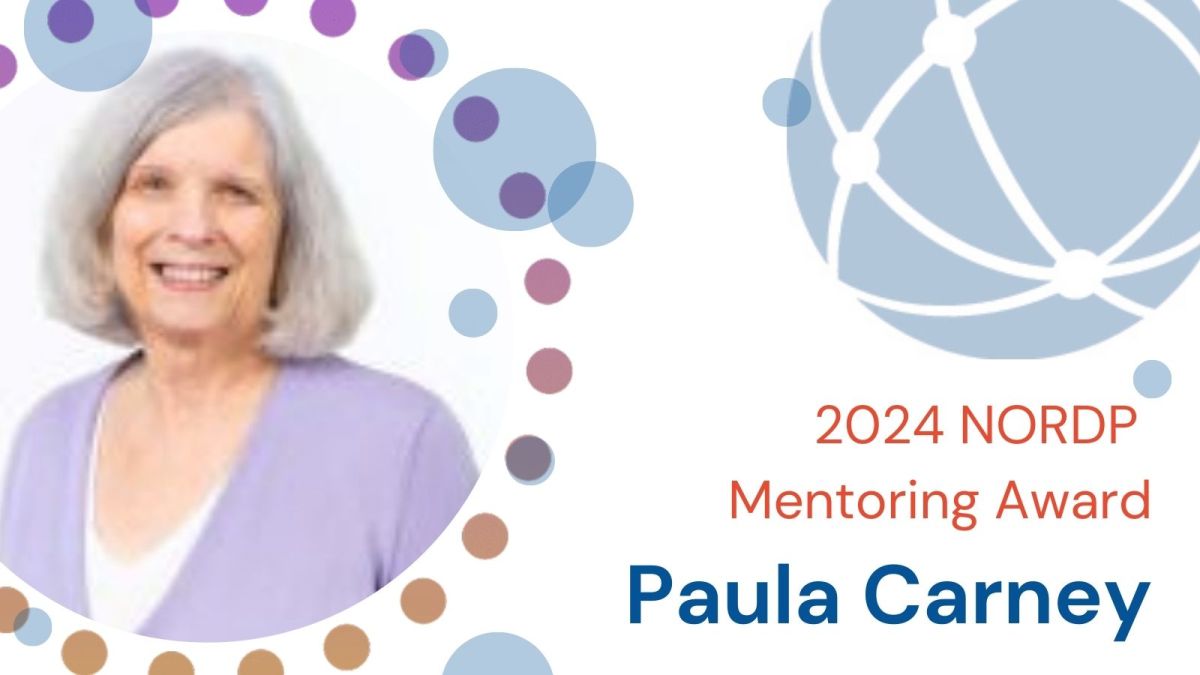
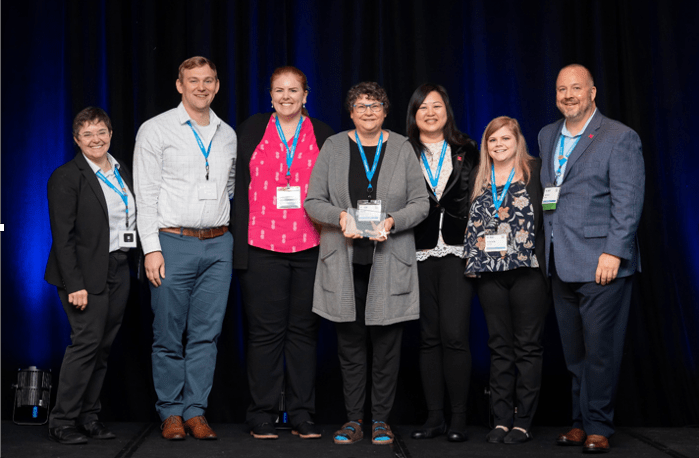
First awarded in 2022, the NORDP Mentoring Award recognizes an individual NORDP member’s unique ability to provide an engaging, supportive, and inclusive environment for professional and/or personal growth through mentorship in the research development community. This award is bestowed with the acknowledgment that effective mentoring occurs through formal and informal channels and may vary in style and substance.
Who: Paula Carney
Where: Loyola Chicago University
Number of years in research development: It depends. Paula started doing what she likes to call “Research Career Development” when she was a faculty member, perhaps beginning in the 2008/2009 timeframe.
Length of NORDP membership: 6 years

Q: How did you first get involved with research development and mentoring?
A: My journey with research career development—focusing on the person doing the research—began when I was a faculty member in Nutrition and Public Health at the University of Tennessee. As one of the only social scientists in a primarily basic science department, I often found myself explaining, mentoring, and bridge-building.
When I relocated to Chicago and joined Northwestern University, I worked with Holly Falk-Kryzisinki as our team developed their Clinical and Translational Science Award (CTSA). I served as the PhD director for all education and training programs through the CTSA in the medical school. My role included adapting Chris Pfund’s training program for clinical and translational researchers, with significant involvement in curriculum development—this was around 2009.
I later expanded my mentor training at Northwestern to include the medical school and eventually the entire university. I discovered that having an effective approach to mentoring was crucial, especially for those situations where a mentee gets the greatest, best-known mentor in the world, but isn’t getting any actual mentoring.” We developed programs for postdocs and junior faculty before there was an established curriculum.
My career path then led me to Chicago State University, a minority-serving institution, where I served as dean, associate provost, and professor. Though we didn’t have a formal program, I continued with informal mentoring, which was always my approach. After some family needs arose, I stepped back and joined Loyola’s School of Social Work, where I could concentrate on people and outcomes in an urban environment, both very near to my heart.
When the pandemic hit, I pivoted to focus more on consulting individuals—the one-to-one aspects of mentoring rather than group activities. Despite the challenges along the way, it’s been an extremely satisfying experience professionally, allowing me to apply all my previous experiences in new contexts.
Q: What was your initial understanding of mentoring and how has that grown over time?
A: I think I initially came to mentoring through my role as a faculty member. I’ve always been drawn to it because it’s such a natural part of career development. When we consider the various developmental roles in research—mentoring, consulting, educating, training, and supervising—I found myself naturally moving between these roles depending on the needs of the interaction.
For me, mentoring was always an extension of my role as an educator. I quickly learned that just because you train people doesn’t mean they’ll succeed—there are different tests and challenges they’ll face. That’s why I look at things both at the individual and organizational level, and everywhere in between.
My understanding has evolved to become more visual over time. I see mentoring as existing along several continuums—from individual to organizational, and from organic to more structured approaches. The key is figuring out the space you need to be in and what the person, group, or organization needs at any point in time. It’s very dynamic.
This perspective has been valuable in our work with the NORDP Mentoring Committee, where we’re recognized as an exemplar for association-based mentoring. We’re now exploring how to extend this approach to other job classifications and components of the research enterprise.
Q: What does being a good mentor mean to you?
A: Good mentoring means mentoring from the side. I picture the mentoring relationship as two (or more) people sitting together—none having more power than another. It’s about figuring out how to help each other. I also believe that research development professionals have so much knowledge and influence to help faculty. So good mentoring means owning that influence and building that knowledge and influence into service for faculty.
Q: What do you wish you had known when you began your mentoring journey?
A: Trust yourself. Trust your intuition. Nothing’s going to break, and you’re not going to do anything wrong. I’d also recommend reading and exploring broadly and taking time for reflection.
I often use the iceberg metaphor—what you see is just 10% of what’s there. The real learning comes from getting beneath your neck and out of your head. It’s about trusting and recognizing your intuition through reflection and taking time to explore the softer side of mentoring.
I wish I had known sooner that we all have our saboteurs—those little voices that sit on your shoulder saying, “Don’t do that. Nobody’s going to be interested in that.” You need to silence those voices.
Another important realization is that while you should focus on the mentee, much of what they need is already inside them. You’re just guiding them a little bit, helping them discover their own path. I had one mentee who realized at the end of our formal relationship that she didn’t want to be in this field at all. So our work shifted to figuring out where she actually wanted to be.
That’s the beauty of mentoring relationships—sometimes they evolve beyond the original context. The connections continue because you genuinely like each other and continue to learn together. It’s really, really cool.
Q: What have you found most rewarding, and most challenging, about being a mentor?
A: One of the most rewarding aspects has been developing a vision for how mentoring can function at both individual and organizational levels. The dynamic nature of finding the right space to meet people’s needs at any given moment is both challenging and fulfilling.
A particularly rewarding project was developing a logic model last year with Kristin Boumann that positions NORDP as an exemplar in association-based mentoring. This work has allowed us to think about how we can extend our approach to other job classifications and components of the research enterprise.
For example, we’re now meeting with Clinical Research Coordinator groups at several universities on a multi-year project where I’m serving in a consulting role. It’s challenging work that takes us beyond our usual NORDP initiatives, but it’s incredibly rewarding to see our mentoring model being adapted and implemented more broadly.
The challenge is always balancing the organic, relationship-based aspects of mentoring with the need for structured programs that can be scaled and measured. But that tension is also what makes mentoring work so interesting and impactful.
Q: What advice do you have for others within NORDP who wish to follow in your footsteps?
A: Just get involved. Just do something and say something. NORDP is an organization that is remarkably flat in its structure, as is the field of research development itself. That openness creates numerous opportunities for contribution.
I think that’s what makes our organization and association special—there’s a place for everyone. Having worked in more hierarchical environments where I was responsible for things like accreditation, I really appreciate the collaborative nature of NORDP.
Your experience might vary depending on your institutional context—working in the humanities will be different than in an engineering school—but the key is to find your niche and contribute from your unique perspective. Faculty involve research development professionals very differently from other people in the system, which gives us a special vantage point.
The beauty of NORDP is that you can bring your whole self to the organization. Whether you’re interested in mentoring, professional development, or other aspects of research development, there’s space for your voice and contributions. Don’t wait for an invitation—just jump in and get started.


 NORDP News