Pacific Region Conference Roundup: Research Development During the Pandemic: Research Developers are Resilient

Submitted by NORDP Pacific Co-Representative, Eric Wayne Dickey, Western Oregon University

NORDP’s Pacific Region represents the states of Alaska, California, Hawaii, Oregon, and Washington, and NORDP’s global reach to members in British Columbia, Eastern Russia, Korea, Japan, Philippines, Australia, New Zealand, and other countries east of China. Following the successful in-person, 2019 regional meeting at UC Davis, the Pacific region’s co-representatives (Barbara Sasso and Eric Wayne Dickey) wanted to continue to provide members opportunities to grow their networks and expand their knowledge base. But doing so during a pandemic seemed a monumental task.

First things first, we recruited an all-star, all-volunteer conference planning committee: Susan Emerson, Leah Gorman, Michael Helms, and Katie Lindl all stepped forward to answer the call. After some soul-searching, we decided to confront the pandemic head on by asking ourselves, “how can we continue to do the work we do?” At the time of this early planning stage, ominous clouds of ashes loomed over much of the west coast, adding to anxiety of the pandemic. Research Developers have to be resilient in times of stress, so we decided that responding to the pandemic would be the theme of our conference.

Sunrise through clouds of ash, 9/28/2020 photo by Eric Wayne Dickey

Once the theme was picked and a timeline was established, we put out the call for abstracts, and we were off and running!

The three-day virtual conference included morning and afternoon sessions. A featured session started each morning of the conference and included Russell Wyland from NEH, Mike Lauer from NIH, and a panel of Government Relations personnel.

Another highlight was the Conversation Roadblocks workshop led by the NORDP Committee on Inclusive Excellence. The three-day regional meeting also featured a variety of NORDP member-initiated presentations and lightning talks that explored how Research Development professionals manage their work remotely and during times of crises. The sessions provided helpful tips and demonstrated the resiliency of RD professionals.

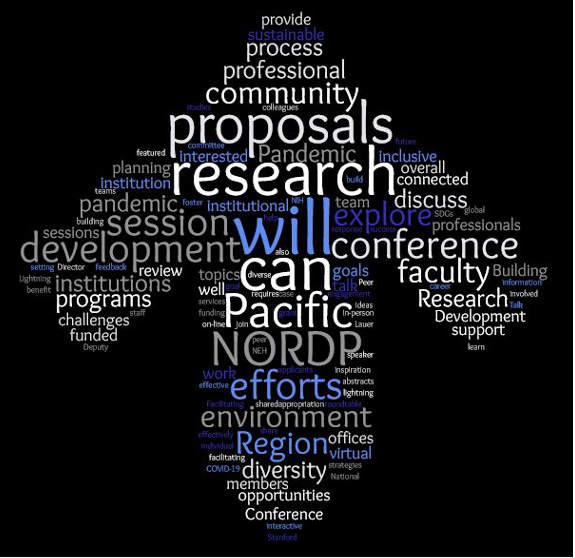
Word cloud generated using words from the abstracts

The final Happy Hour session explored some ideas for future Pacific Region conferences, such as providing sessions on building relationships via networking and mentoring, facilitating multi-institutional collaborations, and growing the RD profession by encouraging graduate students to participate in NORDP. Overall, the Pacific Regional meeting was favorably received by attendees, and it provided a road map for future events.

If you are interested in planning future events for the Pacific Region, feel free to reach out to Barbara or Eric.

The session materials are available on the NORDP site: https://nordp.memberclicks.net/2020-pacific-regional-links

Last but not least, the conference planning committee wants to acknowledge the important support provided by Laura Nakoneczny and Arielle Stout of First Point Resource Management. Their expertise in planning such events was invaluable. We could not have done it without them.

NORDP-NE Regional Winter (Virtual) Road Trip to Dartmouth College, Hanover, New Hampshire


Submitted by NORDP NE Communications Coordinator, Bethany Drews Javidi, University of Connecticut

The NORDP-NE region invited their colleagues from the Atlantic region to join them on a virtual road trip to Dartmouth on December 8 to discuss how research development professionals can support research in the humanities. The road trip to Dartmouth was the third virtual road trip for the region and gave NORDP colleagues the chance to escape their home universities and connect with colleagues over a lively discussion of the important work and contribution of humanities scholars.

Charlotte Bacon, Director of GrantGPS at Dartmouth, provided the energy and vision to coordinate a fantastic meeting. Charlotte gave the attendees an informative presentation on the strategies RD professionals can take to promote the success and wellbeing of humanities scholars.

In addition, a slate of humanities scholars shared their perspectives with the region during a panel discussion. We were fortunate to hear from Laura Edmondson, Professor of Theater, Israel Reyes, Associate Professor of Spanish and Portuguese, and Cori Tucker-Price, Post-Doctoral Fellow in in Ethnicity, Race, and Migration in the U.S. Context. The panel reflected the range of disciplines active in the humanities and the needs of faculty at varying stages in their careers.

“The event was an energizing one that provided not only great ideas & insights to bring back to my office, but also the chance to virtually engage in conversation with colleagues across the regions,” said Daniel Campbell from the Atlantic Region.

A highlight of the meeting was anthropology professor Sienna Craig’s reading of her poems, “Mars Venus Moon” and “Supermarket.” Her reading gave us all a chance to reflect on life and loss in the pandemic. Thank you, Sienna!

Seventy-five RD professionals from New England attended the meeting. NORDP-NE is grateful to Eric Si, Communications and Events Specialist (our wizard behind the curtain), and Anne Maglia, Associate Vice Chancellor for Research Administration and Integrity, at UMass Lowell, who generously contributed their institutional resources and expertise in virtual conferencing to make our three road trips a reality. Many thanks also to Kimberly Eck, NORDP President, who made a special appearance and gave introductory remarks.

Thanks go to our other contributors as well: Anne Maglia, Member, NORDP Board of Directors, who got the group up to speed on events at NORDP national; Jeralyn Haraldsen, Chair of the NORDP-NE Advisory Committee, who convened and chaired the meeting, Edel Minogue, Chair Elect of NORDP-NE and the other members of the NORDP-NE Advisory Committee who contributed their time and ideas to make the meeting a success.

NORDP 2020 Conference Notes: Scientists in Research Development: Turning Ideas into Compelling Proposals

Over the next several weeks, we will share notes from select NORDP 2020 virtual presentations. Check out the learning management system for details on all of the NORDP 2020 available presentations: https://nordp.mclms.net/en/package/list

  1. Login with your NORDP member info.
  2. Select the session you are interested in viewing.
  3. Go to the Session Materials box and click on Materials which will take you to the presentation video and slides. 
  4. The session will also appear in your personal course list for future viewing.

Presenters

  • Justin Flory – The Biodesign Institute, Arizona State University
  • Deborah Frank – Washington University School of Medicine
  • Samarpita Sengupta – University of Texas Southwestern Medical Center
  • Jessica Moon – Stanford University

Thanks to our session scribe, Daniel Campbell, Old Dominion University!

Key points from the session 

A RD scientist can leverage their own experiences by providing tailored education programs, personalized courses, and effective training for faculty investigators to communicate their research to the community at large.

Scientists in RD can help faculty develop a strong research question by deciding whether it is an important one to answer, if it feasible to answer, and to critically read the literature.

RD scientists can help raise potential reviewer criticisms, suggest alternative experiments, suggest controls, and evaluate data analysis plans.

In multidisciplinary proposals a RD scientist can serve as an extension of the PI that will allow them to focus their expertise. They also act as the common denominator to facilitate a multi-disciplinary team and help interconnect the science.

Scientists transitioning to RD face several challenges such as, imposter syndrome, understanding the institutional structure, and expanding the breadth of their editing beyond their core discipline.

What did you hear at this presentation that surprised you?

The imposter syndrome is a challenge faced by many folks who come from the postdoc world and who are now tasked with providing guidance to faculty who used to be their superiors in the higher ed hierarchy.

What was the most interesting question asked by an audience member?

Question – What motivates you and keeps you going in this field?

Answer – Seeing how many proposals are not funded and in many cases it is due to ineffective communication. Faculty have many great ideas & skills and we can help them with the communication element in our dual roles as scientists and skilled communicators.

NORDP Announces the Availability of Membership Scholarships

NORDP is pleased to announce the availability of twenty scholarships to support membership renewals in fiscal year 2021. 

In recognition of the impacts of COVID-19 on institutional funding for professional development, the awards will cover individual regular, trainee, and emeritus membership renewal costs for active, graced, and lapsed members as of June 1, 2020.  

The awards support NORDP’s richly diverse and robust national peer network of research development professionals, enabling members to continue benefiting from:

To apply, please complete your APPLICATION FORM by 5pm (submitter’s local time) on December 31st, 2020. 

We look forward to expanding the Membership Scholarship program in FY22.

Funding for this first round of scholarships was provided by Elsevier, s a proud and long-standing sponsor of NORDP. As a global leader in research information and analytics, Elsevier helps researchers and research executives advance science and research for the benefit of society. Our Research Intelligence solutions combine quality, structured, interoperable data, advanced analytics and an array of indicators and metrics that offer actionable insights to address critical challenges and expand research excellence. Learn more. Elsevier is committed to advancing equity, inclusion and diversity in the global research ecosystem to ensure that research benefits from a diverse research workforce to reach its full potential in achieving a sustainable and equitable future. Learn more.

NORDP fosters a culture of inclusive excellence by actively promoting and supporting diversity, inclusion and equity in all its forms to expand our worldview, enrich our work, and elevate our profession.

Mentor Training for Research Development Professionals – Registration Open for January 2021 Webinar Series

Are you a mentor? A mentee? Do you find yourself formally or informally mentoring staff or faculty? Are you ready to explore mentoring competencies that can be utilized across the work of research development (RD)? This interactive webinar series covers the 9-module Entering Mentoring curriculum, initially developed for mentoring researchers and tailored for RD professionals. A recent webinar series attendee commented: “EXCELLENT training! The ideas presented are very applicable both to mentoring both within the research development profession and elsewhere in the research enterprise – the things I have learned and practiced in this course are incredibly valuable to me as I provide mentoring to faculty, particularly early stage investigators and junior faculty, in the area of grantsmanship.”

Using evidence-based strategies, participants will build upon competencies crucial to the success of the mentoring relationship and expand mentor training across the research enterprise. Participants who complete the entire curriculum will receive a certificate of completion. The curriculum results from an association between the NORDP Mentoring committee and the University of Wisconsin Center for Improvement of Mentored Experiences in Research (CIMER) in collaboration with the National Research Mentoring Network (NRMN), organizations involved in developing and validating the original curriculum. RD professionals at all levels of mentoring will explore how mentoring (shown to improve career outcomes, impact employee engagement and retention, and lead to more inclusive work environments) can benefit mentors and mentees in RD.

This webinar series will be presented and facilitated by the NORDP Mentoring Committee. There are three certified CIMER Trained Facilitators, and four Trained Facilitators on the Mentoring Committee.

Webinar Schedule: Interactive Webinar Sessions will be held on 5 Tuesdays (Jan 26 – Feb 23, 2021; 2-4 pm EST) and follow up open sessions on Thursdays (Jan 28 – Feb 25; 2-3 pm EST).

Register TODAY for the webinar series (30 participant limit): https://nordp.memberclicks.net/2021-mentoring

If this series doesn’t fit in your schedule, share your scheduling preferences to help us plan for future Mentor Training by completing a survey of your preferences.

Questions? Contact us at mentorprogram@nordp.org.

PEERD Workshop Reflection: University of Minnesota

Staff at the University of Minnesota (UMN) developed a staff networking group called the Research Advancement and Development Professionals Network (RADPN) because there is no centralized RD office. RADPN was designed to share expertise and network among staff doing research development work coming from different backgrounds, many of whom had not heard the term, Research Development. RADPN planned a conference for October of 2019, with the goal of introducing staff to research development as a field, including the resources provided by NORDP.

The Workshop

The NORDP PEERD Expert gave a keynote presentation on strategic research development, highlighting the differences between research administration and research development and the differences between transactional RD activities and strategic RD activities. Following the keynote, the NORDP PEERD Expert conducted a workshop that took a deeper dive into the heart of RD, including the roles and responsibilities of RD professionals and various institutional models of RD. Then, the NORDP PEERD Expert guided attendees through several interactive RD scenarios on research grand challenges/team science, internal funding, corporate outreach, and external funding.

The Impact

The event helped UMN RD professionals put their work in the context of research development as a professional field, helping them realize that they were already engaging in research development. It also introduced them to RD resources at the university and national level that could help them improve their strategy and effectiveness. The event also empowered staff who were already engaged in RD work, improving their ability to understand how research development relates to other research support functions.

The Opportunity

Take advantage of the experience and knowledge of PEERD Experts who can sculpt a presentation and/or workshop to meet the needs of your team, office, department, college, university, etc. NORDP PEERD Experts are willing to provide outside expertise on a variety of research development topics. To learn more about the services provided by PEERD, visit https://www.nordp.org/peerd-consulting-program or email PEERD@nordp.org.

NORDP 2020 Conference Notes: Spy Networks and Scholarship – Work with your Library to Gather Intel and Win at Research Development

Over the next several weeks, we will share notes from select NORDP 2020 virtual presentations. Check out the learning management system for details on all of the NORDP 2020 available presentations: https://nordp.mclms.net/en/package/list

  1. Login with your NORDP member info.
  2. Select the session you are interested in viewing.
  3. Go to the Session Materials box and click on Materials which will take you to the presentation video and slides. 
  4. The session will also appear in your personal course list for future viewing.

Presenters

  • Jeff Agnoli, The Ohio State University
  • Rebecca Bryant, OCLC Research
  • Nina Exner, Virginia Commonwealth University

Thanks to our session scribe, Daniel Campbell, Old Dominion University!

Key points from the session 

Libraries are not ends in themselves, they are shifting from collection centric model to engagement-oriented model supporting teaching, learning and research workflows

Libraries are becoming partners in the research enterprise. They enhance researcher productivity, facilitate analysis of research, and make research visible to the scholarly community and beyond.

Librarians are very skilled at finding the literature; awareness of trending topics within fields, crossing disciplines for potential impact on other areas, alerting services to keep up with new literature, and citation management.

The Ohio State University has developed a University Libraries Research Commons which serves as a neutral physical/virtual space; offers consultations, education & training, referrals, and space to showcase.

Libraries are often viewed as neutral players and can be very helpful with communication across a team of researchers.

What did you hear at this presentation that surprised you?

Librarians can use bibliometrics to help PI’s strategically build the impact of their publications over time.

What was the most interesting question asked by an audience member?

What type of librarian would help with competitive intelligence?

Response: Their title varies depending on the institution, but examples include Research Impact Librarian, Bibliometrics/impact, Business subject specialist, Scholarly communications, or Metrics Librarian.

What else from this session should NORDP members know?

The presenters used a virtual whiteboard during the Q&A portion and it was a great example of live interaction and sharing of ideas on RD partnerships.

November 2020 Summary Board Memo

The Board of Directors held their November Board meeting last week. We voted to approve investments that will strengthen our programs and support our members:

The Board approved an investment to strengthen and streamline the 1:1 Mentoring Program led by the Mentoring Committee.

With support from an external sponsor, the Board approved a member scholarship fund developed and administered by our Member Services Committee and Committee for Inclusive Excellence.

Look for more information about these programs coming soon.

A reminder that I, along with other NORDP Officers, am hosting a drop-in office hour once a month on the first Monday at 11am (eastern). You can find the link to office hours and other event on the NORDP calendar.

Sincerely,

Kimberly Eck

Kimberly Eck, MPH, PhD
Associate Vice President for Research
Emory University

President 2020-2021
National Organization of Research Development Professionals (NORDP)
http://www.nordp.org

NORDP fosters a culture of inclusive excellence by actively promoting and supporting diversity, inclusion and equity in all its forms to expand our worldview, enrich our work, and elevate our profession.

NORDP 2020 Conference Notes: Mentoring Lightning Storm


Over the next several weeks, we will share notes from select NORDP 2020 virtual presentations. Check out the learning management system for details on all of the NORDP 2020 available presentations: https://nordp.mclms.net/en/package/list

  1. Login with your NORDP member info.
  2. Select the session you are interested in viewing.
  3. Go to the Session Materials box and click on Materials which will take you to the presentation video and slides. 
  4. The session will also appear in your personal course list for future viewing.

MC: Jan Abramson, NORDP Fellow

Thanks to our session scribe, C. Scott Balderson, University of Utah!

Lightning Talks and Presenters:

1. Using Poetry to Mentor Faculty in Developing Research, Eric Wayne Dickey – Western Oregon University, edickey@wou.edu

The Mentoring Committee’s resident poet, Eric Dickey, explains how he uses poetry to create a shared vocabulary and experience with collaborators, as well as utilizing it as metaphor or simile to help explain complex concepts and assist scientific researchers, who may not be avid writers, find greater appreciation for and ease with the creative process necessary to write proposals or project reports. His talk provides some great examples that he uses regularly, and he urges participants to try similar narrative forms like songs and movies that can help audiences open discussion.

2. Mentoring as a Professional Development Journey, Angela Jordan – University of South Alabama, ajordan@southalabama.edu

When Angela Jordan first contemplated becoming a mentor for NORDP, she thought that she had few of the qualities she associated with the role in the context of this organization: she’d been in RD less than 5 years; her background was humanities, not science; she “only” had a Master’s degree; and she’d only been a mentor in our program for a year. Still, she decided to make the leap, and in doing so, she discovered a wealth of things. She had much to offer (her framing of elements of the experience in terms of “appreciative inquiry” and having a “growth mindset” are helpful constructs) yet realized that becoming a mentor was not an end point but a continuing part of her own development journey.

3. Following the Leaders, Erica Pitre – University of Louisiana at Lafayette, erica.pitre@louisiana.edu

Erica Pitre came to academic Research Development after years many years doing equivalent work in industry and building her skills and approaches to suit the needs of that field. This presentation is a brief examination of her first year in making the transition to academic RD, the obstacles she faced using the tools and techniques she’d refined in her previous career, and the wisdom to cope and prevail that she found in NORDP and its mentoring program.

4. Piloting Accountability Groups for Peer Mentoring Among Early Career Faculty, Kathy Partlow – University of Nebraska-Lincoln, kcpartlow@unl.edu

Ever the lover of data and the power that inferences from them can give to aid in mentoring program design and execution, Kathy Partlow unveils a pilot program for peer mentoring faculty around grant writing at her institution, complete with preliminary results and her thoughts on the meaning behind some of those as well as tips on ways other programs could be structured differently for different results. You could describe this as a natural experiment, in that Kathy allowed faculty groups different options with regard to frequency of meetings and type of accountability and then got to see what, if any, impact this had on faculty proposal submissions. Interesting results!

5. A Concrete Example of the Benefits of Being a Mentor: Creating a CV for Research Development, Jennifer Glass – Eastern Michigan University, jglass5@emich.edu

A common concern for some looking to enter into the Mentoring Program as a mentee is focus: how will you use the experience with the mentor? Do you want to refine your skills? Increase your network? Develop leadership? Explore new areas of RD? Transition to a new role? All of the above? It can be overwhelming and paralyzing. Jennifer Glass uses the example of working with a mentee on the very specific shared goal of documenting their RD activities and updating their CVs with a real focus on Research Development. Amazingly, in this very short presentation, she takes us through the process in a way that makes the (perhaps daunting) task feel completely replicable. I’m watching this one a few more times, until my own resume is done!

6. From Novice to Expert in RD – Mentor/Mentee Perspectives, Paula Carney – Loyola University Chicago, pcarney2@luc.edu

As part of establishing good mentoring relationships, it can be helpful to know what “level” the individuals are operating at in terms of research development. Paula Carney puts her background in psychology (with nods to the developmental psych giants) to good use by adapting a paradigm for RD levels, complete with practical examples, that allows users to ascertain where they are and, more importantly for the mentoring context, the type of professional activities and achievements they might see in mentors having already attained the level they would like to achieve. I think this topic is especially valuable as we consider whether formalized Certifications in our field would be beneficial.

7. Mentoring: Viewing the Engagement from the Mentee’s Perspective, John Barfield – Tennessee State University, jbarfield@tnstate.edu

If the previous talk was heavily weighted to an RD application of psychology, John Barfield’s topic takes us down a more philosophical path. Throughout his years, John has accumulated a view of the mentoring relationship as being mentee-focused, yet acknowledging that it is very much a two-person relationship that takes continual effort. As with most of us, he mentors in a variety of ways and settings to different types of mentees, and he has used this diversity of experience to distill some principles of being a good mentor (by always trying to see through the eyes of the mentee) and presents this philosophy in colorful and effective similes and examples.

8. Mentoring with Vulnerability, Hilda McMackin, Vanderbilt University, hilda.mcmackin@vanderbilt.edu

Hilda McMackin builds on the previous two talks, blending a philosophy of mentoring with some approaches like active and empathic listening that were developed in counseling settings. Her inspiration came from the book Dare to Lead by Renee Brown, who coins the concept of “rumbling with vulnerability.” Hilda applies that idea for mentoring as a way of establishing trust and connection necessary to the deepest relationships. She advocates having the courage to share, to connect what may not be similar experiences but different experiences that elicit the same emotions. Show the same interest and attention you want another person to have for you and your ides. Be vulnerable and hang in there through things that may not always be comfortable. In that way, trust is developed that allows true curiosity and real expectation setting to flourish without a façade of limits imposed by the fear of sharing ourselves with the person we’re mentoring or being mentored by.

Thanks for your interest in the Mentoring Lightning Storm. Feel free to reach out to any of the presenters, or email mentorprogram@nordp.org for more information.
PEERD Presentation Reflection: Old Dominion University

PEERD Presentation Reflection: Old Dominion University

Old Dominion University (ODU), a doctoral-granting R2 institution located in Virginia, was in the process of conducting strategic planning for their research enterprise. They decided to seek out an external expert opinion on the research landscape, especially at the federal level. A NORDP PEERD Expert gave the presentation remotely to the faculty committee leading the strategic planning process. Prior to the presentation, the NORDP PEERD Expert met with institutional leadership to glean background information, so that the presentation would be tailored to the unique culture of ODU.

The Presentation

The NORDP PEERD Expert gave a presentation about the policies and climate of federal agencies, a forecast of future funding and research investments, and ways that ODU could grow its research to be competitive for future funding. The presentation began with an overview of ODU’s sponsored research trends in comparison with other institutions across the nation, followed by a discussion on national research issues and some examples of significant investments from research intensive institutions. The presentation concluded with an identification of several opportunities for ODU to pursue.

The Impact

Sometimes an outside perspective can be a catalyst in reaching consensus about which strategic direction the institution wants to take. This was a critical point in time for ODU to include an outside expert who brought in new ideas, new funding possibilities, and a fresh perspective on what ODU could do to enhance research and research funding. PEERD Experts have a lot of experience not only at their institutions, but also nationally. The PEERD presentation at ODU gave the faculty committee confidence in the decisions for their research strategic plan and helped move along the process.

The Opportunity

Take advantage of the experience and knowledge of PEERD Experts who can provide an outside perspective during a critical moment in your strategic planning. Including an expert assessment can help your institution to refine where best to make strategic research investments. To learn more about the services provided by PEERD, visit https://www.nordp.org/peerd-consulting-program or email PEERD@nordp.org