NORDP 2020 Conference Notes: Encouraging and Supporting Multidisciplinary Team Science and Collaborative Proposals – Part 1

Over the next several weeks, we will share notes from select NORDP 2020 virtual presentations. Check out the learning management system for details on all of the NORDP 2020 available presentations: https://nordp.mclms.net/en/package/list

  1. Login with your NORDP member info.
  2. Select the session you are interested in viewing.
  3. Go to the Session Materials box and click on Materials which will take you to the presentation video and slides. 
  4. The session will also appear in your personal course list for future viewing.

Presenters

  • Sandra Holden, Ph.D. – Assistant Director, Stanford Research Development Office
  • Babette Heyer, Ph.D. – Director, Research Strategy Development at the Stanford Cancer Institute
  • Sarah Ott – Senior Grants Consultant, Hanover Research

Thanks to our session scribe, Daniel Campbell, Old Dominion University!

Key points from the session 

Institutional level incentives can involve seed grants, faculty release time, recognition in the promotion & tenure process, priority access to RD staff and Red Team review. RD level often does not have the authority to set these items up, but we can support implementation of these programs by administering seed grants, coordinating Red Team reviews and prioritizing support for team science proposals.

RD level strategies can involve encouraging faculty to meet others from different fields, share bios & research interests on internal databases, and RD staff can foster connections among PI’s you work with as an individual.

Important first steps when considering a project include: a detailed review of FOA; ask does the PI have the time to do it right; confirm institutional support; solicit funder input; and establish partnerships.

It is important for the team to be thinking not only about how to write the proposal, but how they will work well together. Team Science Guiding Questions to consider include:

  • What is your rationale?
  • Are you ready to collaborate?
  • How will you address and manage essential team processes?
  • Do you have the technology and resources required?
  • How will you communicate and coordinate?
  • How will team leadership, management, and administration look?
  • How will you resolve conflict?
  • How will you evaluate your collaboration?

It is important to have an institutional level advocate ideally who can be a supporter of the project when hurdles or issues develop.

What did you hear at this presentation that surprised you?

When developing the project timeline use the last 1/3 to review combined elements.

What was the most interesting question asked by an audience member?

Is there an optimal number of team members to make a proposal competitive? 

Response: There is no ideal number. It is really determined with the scope of and what is required by the individual project. The key is to have engaged participants, engagement not number is the most important aspect.

What else from this session should NORDP members know?

There are a lot of great resources discussed by the presenters including project management tools, proposal writing resources, document management considerations, and networking activities.

There’s also a Part 2 that is an informal Q&A session that is a follow-up to Part 1.  
Midwest/Mountain Region Launches Virtual Event Series

NORDP’s Midwest/Mountain Region – Iowa, Kansas, Missouri, Nebraska, North Dakota, South Dakota, Idaho, Montana, Wyoming, Nevada, Colorado, Utah, Alberta, and Saskatchewan – convened its first meeting outside of the annual conference in September. NORDP’s President, Kimberly Eck, kicked off the meeting by getting the group excited about the value of regional connections. Prior to the meeting, the region participated in an interest survey to allow members to shape regional activities. Of the 56 survey participants from 21 institutions/organizations, 39% joined NORDP less than two years ago and 23% are non-members able to explore the value of NORDP membership through regional activities. Several of our institutions are state universities and most (88%) grant PhD degrees.

Over the next year, the Midwest/Mountain region will be building our community through a series of virtual events that are related to how RD is organized/structured at our institutions. Topics will be prioritized based on level of interest expressed in the survey, including metrics (79%), services (77%), and communication strategies (68%). In breakout groups during the inaugural meeting, most of our discussion gravitated towards how our #1 area of interest was metrics. Being able to pull out the value and impact of RD has become even more important considering budget constraints and fewer resources. In post-event feedback, one participant noted that the discussion on metrics “made me feel less alone.” 

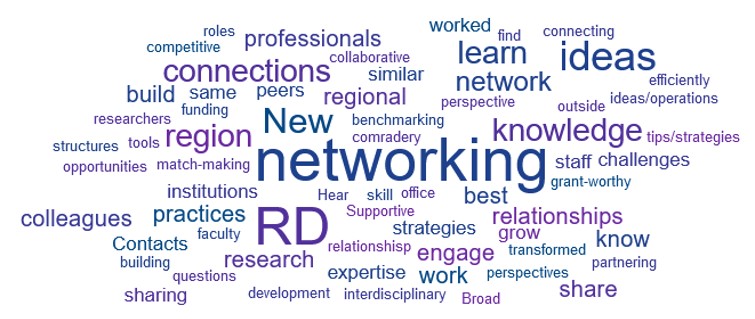
What would you like to get out of regional events? For Midwest/Mountain members, a word cloud of our responses shows our top priorities are networking and making new connections; sharing ideas and knowledge; and learning from each other.

The value of these discussions will be enhanced by including a diversity of voices and improving representation across states and types of institutions, offices, experience levels, etc. The regional events are open to NORDP members and non-members, so please reach out to any of your Midwest/Mountain RD colleagues and encourage them to join us!

The next virtual Midwest/Mountain regional event in our series, which will be focused on Metrics, is on Tuesday, December 8, 12-1 pm EST. Please register for the event here.

Feel free to contact us directly with any questions.

Catherine Determan, Washington University in St. Louis, cdeterman@wustl.edu 

Lisa Nanstad, University of Colorado Boulder, lisa.nanstad@colorado.edu 

Kathy Partlow, University of Nebraska-Lincoln, kcpartlow@unl.edu 

Call for Abstracts Now Open for NORDP 2021

Call for Abstracts Now Open! 
NORDP 2021 
May 2021 • Online

The 13th annual NORDP Research Development Conference will be held ONLINE in May 2021.

Abstracts are now being accepted for NORDP 2021. All abstracts must be submitted electronically no later than 11:59 PM Pacific Time on Monday, December 14th, 2020. 

Submissions for abstracts for ALL sessions can be made here (these include workshops, 60 and 90 minute presentations, pre-recorded oral presentations, lightning talks, roundtables, and posters). Please take a few moments to read the instructions before logging in and submitting your abstract. A PDF version of these instructions can also be downloaded.


Stay Connected! 

Follow @NORDP_official on Twitter for all the latest #NORDP2021 updates, including featured speaker confirmations, exciting topics to be discussed, and more. 

Conference Email Contact: rdconf@nordp.org

NORDP fosters a culture of inclusive excellence by actively promoting and supporting diversity, inclusion and equity in all its forms to expand our worldview, enrich our work, and elevate our profession.

Save the Date: 2021 NORDP Great Lakes Region Virtual Retreat

SAVE the NEW DATES!
2021 NORDP Great Lakes Region
Virtual Retreat

DATES: January 27 – 29, 2021

THEME: Research Development in Pivotal Times

HOST: Indiana University Office of the Vice President for Research

SCHEDULE AT A GLANCE

DAY 1:
Diversity and Inclusion
Networking, keynote and breakout discussion groups

DAY 2: Driving Research Development beyond COVID-19
Networking, panel discussion, breakout discussion groups

DAY 3: Keynote: “Telling the Research Story”
Concurrent sessions, Great Lakes business meeting, and happy hour

REGISTRATION: This event will be free, but registration is required. Registration information to come soon.

We hope you can join us in January for our winter retreat, and we eagerly look forward to seeing you. Follow @NORDP_official on Twitter and the NORDP News blog for the latest announcements and information.

October 2020 Summary Board Memo

The Board of Directors held their October Board meeting last week and annual retreat virtually last month. Below are a few highlights:

The Board prioritized three objectives that are critical to achieve in the upcoming year:

Objective 3.1 Make RD101 the signature training for all interested in RD. With a successful pilot of RD101 under our belts and given members’ substantial interest, we are turning out attention to ensuring that RD101 can be offered multiples times per year sustainably.

4.1 Create a plan toward inclusive excellence throughout the organization and 4.3 Define explicit structures for intentional access to opportunities within NORDP. Both of these objectives support our goal as articulated in the strategic plan to be a welcoming community that values excellence through diversity, inclusion and equity broadly considered. We have many volunteers from multiple committees developing plans in response to these objectives building on and amplifying the amazing work that the Committee on Inclusive Excellence already does.

I look forward to sharing updates on our progress in the future.

A reminder that I, along with other NORDP Officers, am hosting a drop-in office hour once a month on the first Monday at 11am (eastern). You can find the link to office hours and other event on the NORDP calendar.

Sincerely,

Kimberly Eck

Kimberly Eck, MPH, PhD
Associate Vice President for Research
Emory University

President 2020-2021
National Organization of Research Development Professionals (NORDP)
http://www.nordp.org

NORDP fosters a culture of inclusive excellence by actively promoting and supporting diversity, inclusion and equity in all its forms to expand our worldview, enrich our work, and elevate our profession.

NORDP Liaison Report: Network of Academic Corporate Relations Officers (NACRO)

RD professionals and corporate relations officers advance research when they work together

Companies need things from universities: graduates, access to facilities, access to intellectual capital. Universities need things from companies: jobs for graduates, help with commercialization, funding.

Universities’ corporate relations officers help connect companies with universities, but they may lack deep knowledge of the research landscape. They may not know about the promising postdoctoral fellow’s innovation to transform the field, the unique core facility to address a testing need, or the multidisciplinary team to work with on a large proposal. That’s why research development and corporate relations make a great team: their complementary expertise is a natural area for collaboration to strengthen the research enterprise.

This is where the relationship between NORDP and NACRO comes in.

Don Takehara, NORDP’s NACRO Liaison

NORDP’s Strategic Alliances Committee (SAC) has been engaging with NACRO for several years, exploring the natural synergies between these two university functions. NORDP’s volunteer liaison responsibility is shifting to Don Takehara, Associate Director for Research, College of Engineering Office of Research, University of Illinois at Urbana-Champaign.

With more than 500 members, NACRO provides professional development and best practices related to university-industry corporate relations. “As higher education plays an increasing role in economic development, and in light of the challenging fiscal environment in which many of our institutions operate, it is more important than ever for colleges and universities to create and maintain dynamic relationships with business and industry,” the NACRO website declares.

In support of his RD role, Takehara has been a member of NACRO for eight years, even before he joined NORDP. He recently agreed to take over the NACRO liaison responsibilities previously held by NORDP Board member Rachel Dresbeck, who is a co-chair of SAC.

The relationship between the two organizations began in ­2017, when Dresbeck and NORDP Board member Peggy Sundermeyer presented on research development at the NACRO conference in Seattle and met with the NACRO Board to explore how the two organizations could work together . 

“This partnership with NACRO fits well into SAC’s strategic priorities by strengthening our reciprocal relationships with sister organizations. We now have a memorandum of understanding between the two groups, providing benefits such as complementary registrations at conferences. Our work informs one another and provides a type of competitive intelligence for both groups,” Dresbeck says.

Serving as a SAC liaison has also benefitted Dresbeck’s own RD work, helping her institution initiate new relationships with local businesses, both large and small. She encourages NORDP members to take advantage of this partnership with NACRO, which can help them work more effectively with their own corporate and foundation development colleagues.

Takehara echoes the benefits of RD professionals engaging with NACRO and their own universities’ corporate and foundation staff. “It’s important for corporate relations and research development members of the two groups to learn how to work better together,” he says.

An example of joint activity includes presentations at the 2018 NORDP Conference in Arlington, where Dresbeck and Eileen Murphy, Kerry Morris (both NACRO and NORDP members), as well as NACRO member Brett Burns presented case studies on the value of working together.  Murphy and Morris have been instrumental in deepening this important relationship. The following year, NACRO’s Co-presidents, Megan Greenawalt from the University of Pittsburgh and Adam Johnson from the Michigan Technological University, led the Leadership Forum at the NORDP 2019 Annual Research Development Conference. And following that, NORDP’s 2019 Great Lakes Regional Meeting, chaired by Jill Jividen and Beth LaPensee, included three sessions about RD and corporate relations and was led by Takehara.  Sessions included center directors discussing how to engage industry partners on large-scale proposals, corporate executives explaining how to engage industry in research initiatives, and a corporate relations panel discussing their perspectives on RD.

Many resources on the NACRO website are significant to strong RD strategy. For example, Takehara served the NACRO Industry Perspectives Subcommittee for its “Research Report: “Industry Perspective on Academic Corporate Relations” that can be found here.

More information on NACRO and the NORDP Liaison program can be found on the SAC liaison page, including a NACRO “Profile” link with members-only information for NORDP members. For more information about serving as a NORDP Liaison, please contact Karen Eck,  who serves as SAC co-chair, along with Dresbeck, Gretchen Kiser, and Ann Maglia.

NORDP fosters a culture of inclusive excellence by actively promoting and supporting diversity, inclusion and equity in all its forms to expand our worldview, enrich our work, and elevate our profession.

PEERD Review Reflection: University of Alabama

This image has an empty alt attribute; its file name is Picture1.png

The University of Alabama (UA), the first public university in the state, hosted NORDP PEERD experts for a PEERD review in 2018. Faculty success in research is enabled through the Office for Research and Economic Development (ORED), in partnership with the colleges, schools, and research institutes at UA. Specifically, the Office of Proposal Development (OPD), and the Office of Research Development (ORD), within the ORED, have been charged with identifying and delivering a suite of services to support faculty research, scholarly, and creative endeavors.

The Process

The two PEERD experts held a pre-review phone call with institutional representatives to learn of any background information needed prior to the review, help identify key stakeholders to include in the meetings, and plan out logistics. One PEERD expert traveled to Alabama, while the other joined virtually. The PEERD experts spent two business days meeting with key stakeholders and inquiring about the research and proposal services provided, as well as the overall effectiveness of the Office for Research and Economic Development. These were the primary foci of the review, as requested by UA. Each PEERD review is as unique and diverse as the host institutions, who identify the foci for the review. Within 10 business days following the on-site review, the PEERD experts provided a first draft of the PEERD report for the institutional representatives to review and provide their feedback. Once finalized, the PEERD report was provided to university leadership.

The Impact

The PEERD experts provided three overarching recommendations:

  1. Enable and empower faculty to achieve the overall university vision by defining a new vision for centralized Research Development services and support,
  2. Create meaningful connections between a centralized Research Development office and other units, and
  3. Build awareness for/messaging about Research Development services and support of university-wide success in research.

Within each recommendation are several best practices and insights into implementing them on campus. The PEERD experts recommended that research performance goals include both measures of quantity and quality for research and included some guidelines for identifying those measures and implementing a vision for research development. They also recommended instituting a regular schedule of meetings between staff and leadership in order to create a networked institutional knowledge base, allowing for more consistent and higher quality services. Other recommendations included developing a strategic plan for growing RD, increasing the number of RD staff as well as the services provided by RD staff, developing RD metrics and measures, and creating communications plans, including an “outreach tour”.

As a result of these recommendations, the Office for Research Development (ORD) was separated from the Office of Proposal Development (OPD) to better communicate to faculty where to go for specific assistance and support. ORD and OPD are now included in monthly meetings with the Associate Deans for Research. A member of the ORD noted that attending these regular meetings has resulted in an increased awareness of what the ORED is doing and planning and has allowed her to share her firsthand knowledge with faculty. Also, one of the PEERD experts provided the staff with marketing materials, including brochures and flyers, that were used as models to develop the materials that highlighted the different support services provided by the two offices.

The Opportunity

Take advantage of the experience and knowledge of PEERD experts to provide validation for your growing RD offices. Utilize PEERD results to expand RD efforts, improve upon services currently offered, and increase effectiveness. PEERD can assist you in seeing gaps in resources and provide strategic planning advice on how to fill those gaps to help increase competitiveness. To learn more about the services provided by PEERD, visit https://www.nordp.org/peerd-consulting-program or email PEERD@nordp.org

NORDP Liaison Report: OCLC Report on Social Interoperability in Research Support

Jeff Agnoli in Ohio State’s Research Development Office serves as a NORDP liaison to OCLC, a nonprofit global library cooperative providing shared technology services, research, and community programs. He recently shared an OCLC report, in which he and other RD interviewees participated.

Social Interoperability in Research Support: Cross-campus Partnerships and the University Research Enterprise, by Rebecca Bryant, Annette Dortmund, and Brian Lavoie, explores the social and structural norms that shape cross-campus collaboration and offers a conceptual model of key university stakeholders in research support. Information about their goals, interests, expertise, and the importance of cross-campus relationships was synthesized from interviews. The report describes the network of campus units involved in major categories of research support services and concludes with recommendations to establish and maintain successful cross-campus relationships. Download the free report at: https://oc.lc/social-interoperability.  

Working to Overcome Conversation Roadblocks on Our Journey to Justice

Contributed by Committee on Inclusive Excellence (CIE) members Jane Garrity, Etta Ward and Gretchen Kiser

It seems like every week in 2020 brings a new avalanche of news stories on institutional racism, social injustice, and voices raised in protest. NORDP members, like so many others, are looking for ways to be leaders, allies, and agents of change for our communities and campuses. We acknowledge the tremendous exhaustion and pain of our BIPOC members from the many years of trauma and oppression and join in solidarity to share the burden of change agency. There is so much we could and should be doing toward racial and social justice. Despite the daunting task ahead of us all, we need to initiate the first and fundamental step toward effecting enduring meaningful change – personal, sometimes difficult conversations with our friends, colleagues, and families. Starting and maintaining conversations leads to other critical actions that will be needed to dismantle the systems, processes and procedures that make it possible for inequities and discriminatory practices to persist. Unfortunately, many ‘would-be’ allies face conversation roadblocks preventing them from this critical action step.

The Committee on Inclusive Excellence (CIE) is leading the charge to bring opportunities for dialogue to NORDP members that will move us beyond simply checking off boxes on a diversity plan or proclaiming that we are realizing our diversity mission goals. Until we all feel that we belong and are valued, we still have work to do toward becoming a more inclusive, welcoming, and actively anti-racist organization. The CIE hosted a series of discussion sessions over June and July, and again on September 30, that were guided by a framework tool – Conversation Roadblocks – developed by Catalyst (https://www.catalyst.org/), a global nonprofit founded in 1962 that helps organizations accelerate inclusion and professional progress for women and other under-represented groups at work.

These sessions were open to all NORDP members who chose to participate and were centered on anti-Black racism and the associated structures of social injustice. These sessions invited participants into uncomfortable conversations on racism and focused on identifying and surmounting the specific fears and assumptions that keep us silent on this issue. Specifically, we discussed conversation roadblocks such as a sense that there is not really a problem to address, the fear of negative consequences if one speaks up, or an assumption that talking will not solve anything. Honestly addressing these roadblocks is the first step towards building a framework for future action to build a culture of anti-racism at both NORDP and our home institutions.

Each Conversation Roadblock event included an opportunity for participants to collectively set ground rules for engagement toward creating a safe space to openly share our thoughts and feelings and to respectfully listen to the perspectives and lived experiences of others. In breakout groups, we reviewed the short but powerful Conversation Roadblocks document and shared stories of how we have encountered conversation roadblocks in our own lives and where we still struggle. The groups then presented key points of their discussions, and participants brainstormed some next steps for our collective journey to justice.

Attendees testified to the power that even these initial conversations can have, e.g.:

“I had a colleague who is a person of color reveal that she had changed her birth name and spent her childhood trying hard to NOT be associated with a non-White race/ethnicity. I thought how exhausting that must be to everyday have to put so much energy in denying a part of who you are. No one should have to do that.”

“I was skeptical about the level of impact an exercise like this could truly make in just one and a half hours. But I walked away with a commitment to the work of racial and social justice, especially learning my own roadblocks and hearing ideas for additional action steps moving forward.”

On-going, honest and open conversation on these issues is critical to true enduring transformational change. Thus, NORDP will be hosting these Conversation Roadblock sessions each quarter for the next year. And, because such discussion is just the beginning of our journey to justice, NORDP’s CIE will also be hosting a developmental series for NORDP members on topics like privilege, allyship, intrinsic bias, cross-cultural collaboration, intersectionality, power dynamics, and institutional racism. In addition, keep an eye out for a climate survey on diversity, equity, and inclusion in early 2021. We hope that you’ll participate in these opportunities to make your voice heard, listen to others’ stories, and continue the hard work of dismantling systemic and structural racism and discrimination in our personal and professional spheres of influence.

Reference: Catalyst, Conversation Roadblocks (October 10, 2019) (https://www.catalyst.org/research/overcoming-conversation-roadblocks-infographic/)

NORDP fosters a culture of inclusive excellence by actively promoting and supporting diversity, inclusion and equity in all its forms to expand our worldview, enrich our work, and elevate our profession.

2021 NORDP Awards • Due November 4

NORDP has created three new awards to celebrate the outstanding accomplishments of members making exemplary contributions to the organization, the profession, and/or the field. These awards honor the excellence and impact of NORDP members and recognize contributions of NORDP member-leaders, including the practice or production of new knowledge related to activities such as (but not limited to):

  • strategic research advancement,
  • communication of research and research opportunities,
  • enhancement of research collaboration and team science, and
  • proposal development.

NORDP Awards will celebrate the distinctive achievements of individuals, collaborative groups or work teams, programs or projects, and organizations. Winners of NORDP Awards will be recognized during the annual NORDP Research Development Conference.

Nominations for NORDP Awards, including self-nominations, may be submitted by any NORDP member in good standing. Unless otherwise indicated, current members of NORDP’s Board of Directors are ineligible to submit nominations (including self-nominations). Information about prior NORDP Award recipients is available here.

All nominations for NORDP Awards (including the existing Rising Star Award) will be accepted through a new InfoReady NORDP awards portal and nominations will be due the first Wednesday in November, annually. 

See more about award types below, and submit nominations by November 4, 2020.

Questions? Join us October 14, 3:30-4:15 pm EDT for a discussion about new NORDP award opportunities:

https://us02web.zoom.us/j/87332077727 | Meeting ID: 873 3207 7727

Award Types

Innovation Award

Recognizes individuals, groups, or team; functional units; or organizations who leverage unique skills or resources to kick-start innovation in research development and advance the profession or the field in ways that generate evidence of promise or demonstrable results. Innovations leverage partnerships, experiment with tools and techniques, or generate and share knowledge to advance NORDP and the work of its members.

Eligibility: Regular NORDP members (i.e., non-board members) in good standing are eligible for individual nomination. NORDP members in good standing and current members of NORDP’s Board of Directors may be included as part of nominations for groups, teams, functional units, or organizations.

Leadership Award

This award honors a member, a group of members or a team, a research development unit, or an organization that demonstrates exceptional leadership and/or a deep commitment to volunteerism in ways that advance the profession or field of research development.

Eligibility: Regular NORDP members (i.e., non-board members) in good standing are eligible for individual nomination. NORDP members in good standing and current members of NORDP’s Board of Directors may be included as part of nominations for groups, teams, functional units, or organizations.

NORDP Fellow

Designation as a NORDP Fellows is made to recognize the long-term accomplishments of members who have made sustained contributions to NORDP and worked tirelessly to advance research development as a profession and/or as a field. Status as a NORDP Fellow is the highest professional distinction the organization may bestow on a member. No more than one percent of NORDP members will be named Fellows annually. 

Eligibility: Regular members (i.e., non-board members) in good standing who have maintained an active NORDP membership for at least five consecutive years are eligible for nomination.

Rising Star Award

The Rising Star Award is bestowed on up to three members annually in recognition of outstanding, early volunteer contributions to NORDP and strong potential for future contributions to the organization and the profession or the field. Rising Star recipients receive waived registration for a subsequent NORDP annual conference. 

Eligibility: Regular members (i.e., non-board members) in good standing who have maintained an active NORDP membership for fewer than five consecutive years are eligible for nomination. Current and past board members are ineligible for this award.

NORDP fosters a culture of inclusive excellence by actively promoting and supporting diversity, inclusion and equity in all its forms to expand our worldview, enrich our work, and elevate our profession.