A New Year’s Resolution for Mentors: Register for CIMER Mentor Training for RD Professionals

by: Paula Carney

Mentor Training for Research Development Professionals – Registration Open for January/February 2023 Workshop Series;

Are you a mentor? A mentee? Do you find yourself formally or informally mentoring staff or faculty? Are you ready to explore mentoring competencies that can be utilized across the work of research development (RD)? This interactive webinar series covers the 9-module Entering Mentoring curriculum, initially developed for mentoring researchers and tailored for RD professionals. A recent webinar series attendee commented:

“EXCELLENT training! The ideas presented are very applicable both to mentoring both within the research development profession and elsewhere in the research enterprise — the things I have learned and practiced in this course are incredibly valuable to me as I provide mentoring to faculty, particularly early stage investigators and junior faculty, in the area of grantsmanship.”

recent participant

Using evidence-based strategies, participants will build upon competencies crucial to the success of the mentoring relationship and expand mentor training across the research enterprise. Participants who complete the entire curriculum will receive a certificate of completion. The curriculum results from an association between the NORDP Mentoring committee and the University of Wisconsin Center for Improvement of Mentored Experiences in Research (CIMER) in collaboration with the National Research Mentoring Network (NRMN), organizations involved in developing and validating the original curriculum. RD professionals at all levels of mentoring will explore how mentoring (shown to improve career outcomes, impact employee engagement and retention, and lead to more inclusive work environments) can benefit mentors and mentees in RD.

This webinar series will be presented and facilitated by the NORDP Mentoring Committee. There are six certified CIMER Trained Facilitators, and two Trained Facilitators on the Mentoring Committee.

Webinar Schedule:

Two sessions are scheduled each week: Interactive Workshop Sessions will be held on 5 Tuesdays (January 31–February 28, 2023; (2-hours) 2–4 pm EST/11 am–1 pm PST) with an application and reflection session on Thursdays (February 2–March 2, 2023; (1-hour) 2–3 pm EST/11 am–1 pm PST.

Register TODAY for the webinar series (30 participant limit). Please register to receive login information for all workshop sessions.

Registration: National Organization of Research Development Professionals (memberclicks.net)Mentor Training for Research Development Professionals

If this series doesn’t fit in your schedule, share your scheduling preferences to help us plan for future Mentor Training by completing a survey of your preferences.

Questions? Contact us at mentorprogram@nordp.org.

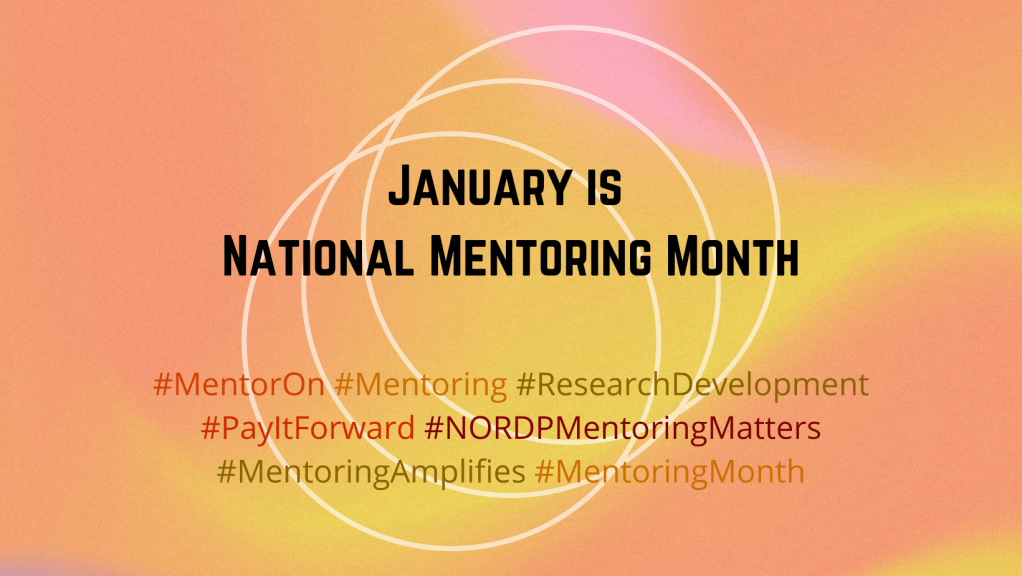
January is National Mentoring Month

Written by the NORDP Mentoring Committee

The Mentoring Committee invites every NORDP member to celebrate National Mentoring Month January 1 – 31. Originally developed as a campaign to expand quality mentoring opportunities for youth, the month-designation can be a catalyst to remember the mentors and mentees who have supported you along your path.

This images has a gradient background of yellows, soft pink and orange. A text heading says, "January is National Mentoring Month." There are hashtags near the bottom of the image meant to inspire readers to use and follow on social media. The hashtags include: #MentorOn, #Mentoring, #ResearchDevelopment, #PayItForward, #NORDPMentoringMatters, #MentoringAmplifies, and #MentoringMonth.

National Mentoring Month, in addition to the early summer months, is a time of year where engagement from NORDP members interested in becoming a mentor increases. This year, with the support of the mentoring community, we are encouraging you to go beyond digital engagement and become involved in real life. Mentoring relationships are at their best when connections are made, sustained, and invested in.

Watch social media and engage in conversation on mentoring (using #NORDPMentoringMatters and #MentoringMonth), take time to listen to a podcast or two (The Science of Mentorship from the National Academies of Sciences, Engineering, and Medicine is a great listen), or explore the NORDP Wisdom Share Learning Library (register here if you don’t have an account in Wisdom Share). Here are some dates to make note of:

January 7 — I am a Mentor Day — own it!

January 17 — International Mentoring Day — #MentoringAmplifies support around the world

January 21 — Thank Your Mentor Day — share your story to inspire

Also explore some offerings from the National Research Mentoring Network (NRMN).

The National Research Mentoring Network (NRMN) is an NIH grant-funded initiative whose entire purpose is to diversify the STEM workforce by providing researchers across all career stages in the biomedical, behavioral, clinical, and social sciences field with evidence-based mentorship and professional development programming that emphasizes the benefits and challenges of diversity, inclusivity, and culture. Their program achieves that through mentorship, networking, and professional development through their online networking platform, MyNRMN, which has over 21,000 mentors and mentees.

How to Leverage the NRMN Network Webinar Series (Monthly Series) – Jan. 17 at 11am CST. Register here: https://unthsc.zoom.us/webinar/register/WN_z3ZWYl8TRSyyHPosIoIc9w

The NORDP Mentoring Program is a benefit available to all NORDP Members. The Mentoring Committee strives to provide resources and support for all NORDP Members interested in mentorship. To do this, the committee leverages national partnership and engages in a variety of scholarly activities. Members supporting members as mentors, mentees, or as part of a peer mentoring or learning group, making NORDP and the profession of research development a stronger community!

Applications will open in the spring for the 1:1 or the Cohort Mentoring Program. Peer Mentoring Groups are also available to join any time, and we invite you to start 2023 by joining and exploring opportunities within the Mentoring Committee. For more information, email the Mentoring Committee and a member of the Leadership Team will respond!

Happy New Year!

Reflections: Cohort Mentoring Group

The 2022-23 Mentoring Program started in July, with a new pilot cohort mentoring program. The Cohort Mentoring Group consists of matching three mentees with similar interests with one shared mentor based on the WisdomShare matching algorithm. The Mentoring Committee caught up with a mentoring cohort and in this post, mentor Kate Bullard and her mentees, Kelsey Haasevoort, Josh Tychonievich, Hayley Bohall share their reflections. 

Dr. Kate Bullard, who serves as the mentor in the cohort, is a Senior Research Program Development Officer in the Office of the Vice Provost for Research at Lehigh University. She manages limited submissions, internal seed funding and research development for the University. Additionally, she works with the Vice Provost on strategic initiatives to improve the research environment at the University. 

Dr. Kelsey Hassevoort is a research development manager and leader of the Community-Academic Partnerships Core in the Interdisciplinary Health Sciences Institute at the University of Illinois Urbana-Champaign. She facilitates new research initiatives and supports community-academic partnerships in health. She also works with Illinois Extension and other campus partners to develop and coordinate collaborations between undergraduate and graduate scholars and community organizations.

Hayley Bohall is the Assistant Director of Research Development within Knowledge Enterprise at Arizona State University.  Research Development (RD) works with research faculty, staff, and leaders to improve funding success and grow the research enterprise. RD seeks to empower and embolden every faculty, staff, and student member of ASU to increase their competitive edge in support of the expanding quality and quantity of the research enterprise. Hayley’s primary responsibility is to support and manage limited submissions, internal grant competitions, and nominations to various federal and non-federal agencies. She interacts with faculty and staff across disciplines to provide research development support and provides solutions to issues associated with sponsored projects. 

Josh Tychonievich is Research Development Program Director at the Institute for Scholarship in the Liberal Arts at the University of Notre Dame. Josh provides research development and project management support for the arts, humanities, and social sciences, with a primary focus on helping faculty in the College of Arts and Letters develop, fund, and realize their research agendas.

Q1: What influenced you to apply to be a mentor and a mentee for the 2022-23 NORDP Mentoring Program? Why did you choose the cohort mentoring model?

A: Mentor Kate: I hoped that I could share some of what I’ve learned over the years. I came to research development after doing other things so I hoped that some of that life experience could be useful. The cohort model wasn’t one I explicitly chose but I am enjoying it! 

A: Mentee Kelsey: I have participated in the NORDP mentoring program as a mentee for the last two years, but made the decision this year that I was ready to step into a mentor role. However, I was still looking for some support in the mentoring space so when I saw the cohort model, I thought it would be a perfect fit!

Q2: Have you participated in a 1:1 mentoring model before? How has this experience been different or similar?

A: Mentor Kate: I have participated in 1:1 mentoring before and in many ways it is similar. It is a chance for the mentee to take stock of where they are professionally and think through their goals. Obviously with a group there is less time for each mentee but there is also the chance to learn from each other. 

A: Mentee Josh: I convene the Communications Peer Mentoring Group for NORDP, but aside from that, this cohort is my first mentoring experience. I find that I benefit not only from the advice of the designated mentor but also from the perspectives of my fellow mentees.

Q3: What was your favorite part about this cohort mentoring model? 

A: Mentor Kate: It takes the pressure off of me! Seriously I’ve learned from the mentees in the cohort and they are absolutely learning from each other. It is a really good support group. 

A: Mentee Hayley: Multiple perspectives. One of the primary purposes of a mentoring program is to hear and learn from someone else’s experiences. In this cohort model, not only am I learning from and encouraged by my mentor but also my fellow mentees, who each bring their unique RD background.

Q4: How has participation in the Mentoring Program helped broaden your horizons about Research Development in general and/or affected your daily work in particular? 

A: Mentor Kate: I am more intentional about mentoring my direct report and encouraging her to seek out additional mentors.

A: Mentee Kelsey: Participating in the mentoring program has really broadened my network with NORDP and helped me think about how I want to navigate my career. Now that I’ve experienced being a mentor and a mentee, it’s clear that the learning goes both ways. One thing I love about the cohort mentoring model is that you get to learn not only from your mentor, but from your fellow mentees! Having those additional perspectives allows for a much richer conversation and I find I leave each meeting with actionable advice that informs the way I work.

Q5: What surprised you about being a mentor or a mentee?  

A: Mentor Kate: For me the preparation it takes for each meeting. I absolutely enjoy them but I also have to make sure to block a bit of time to prepare for each one. In part this is because I want to ensure each member of the cohort gets time and space in the hour a month. 

A: Mentee Josh: I’ve been pleasantly surprised by how beneficial the mentoring program has been. I’ve already made good use of the suggestions offered by my mentor and fellow mentees. They’ve made me a more effective RD professional. I look forward to our meetings each month!

Q6: Any words of wisdom or encouragement for those wanting to apply next year? Any other thoughts you would like to share?  

A: Mentor Kate: As a mentor or mentee you will definitely benefit! It really is not a huge amount of time per month and it pays dividends well beyond the investment.

A: Mentee Hayley: Don’t hesitate to apply. The cohort model takes some of the pressure off the mentee and has allowed me to enjoy the time we spend together, and I look forward to our meetings. In these first few months, I have already seen my RD career from a new perspective.  


The 2022-23 NORDP Mentoring Program is now in full swing! Applications for the 2023-24 cycle will open in the spring, keep an eye out for emails from the NORDP listserv. Additional mentoring opportunities are available through the Peer Mentoring Groups that are open for participation throughout the year via the WisdomShare platform.

Investment in mentoring is an investment in you. As the new year approaches, we encourage everyone to resolve to invest in themselves next year!

NORDP Award Highlights Innovation

At the 2022 NORDP Annual Conference, a group of NORDP members were recognized with the 2022 NORDP Innovation Award for their contributions to the research development profession. Before 2022 comes to a close, we celebrate their work that resulted in a valuable resource for research development organizations and individuals: the NORDP Resource for Organizing and ADapting a Training Program toward Developing an RD career (NROAD to RD).

An image of an empty, straight roadway stretching forward. The road is bordered by deciduous trees lit by low, golden sunlight. Beyond the trees on both sides of the road are large, flat farm fields. The photo has.a sense of possibility, hope, and forward progress.
Photo by Karsten Würth on Unsplash

NROAD to RD was designed to help RD professionals and offices develop internship and training programs to expand the RD community. It brought together representation from each NORDP committee and used crowd-sourcing to identify materials;

Easy to access at https://nordp.mclms.net/en/package/6128/course/6797/view, the program provides a framework and growing library of resources. RD offices can access modules and add additional components to create a program relevant to their individual office and institution. While originally developed as an internship/training tool, NROAD to RD serves as an innovative tool that can be adapted for training or onboarding new RD members, or even for professional development. It has already been accessed and used by more than 150 members.

The effort was chaired by Samarpita (Samar) Sengupta, Assistant Professor and Director of Research at The University of Texas Southwestern Medical Center’s Department of Physician Assistant Studies. She fondly recalls the teamwork that made NROAD to RD possible.

“This effort arose from my work as a Strategic Alliance Committee liaison to the National Postdoc Association, which identified a need for training related to research development for postdoctoral scholars. Working with Peggy Sundermeyer, the chair of SAC, we realized that a centralized approach wouldn’t work. So, we pulled together different perspectives, tapping expertise from NORDP’s various committees.”

The NROAD to RD team leveraged existing resources and created new tools to create an innovative resource will help grow the RD field and community. Their dedication of countless volunteer hours for brainstorming, creating, persevering, and was recognized with the 2022 NORDP Innovation Award. 

Phase 1 piloted in 2018, followed by Phase 2 work focused on implementation and dissemination. In early 2021, the Phase 2 team conducted a survey of users to determine return on investment and identify areas for improvement.

“As opposed to dropping into the storm without a parachute, now postdocs and others can learn about the RD profession and potentially join our growing field,” Sengupta says. “Previously, there was no way for RD offices to provide such information, no training or internship structure to utilize. We filled a gap that people didn’t even realize they had. Many NORDP members are also using this resource for onboarding new employees.”

In addition to Sengupta, NROAD to RD’s Phase I working group included Peggy Sundermeyer, Trinity University; Joanna Downer, Duke University; Page Sorensen, previously at the University of California San Francisco; Sharon Pound, University of Tennessee; Rebecca Latimer, University of Virginia; Nicole Frank, University of Utah; Beth Moser, previously at Maricopa County Community Colleges District; and Sarah Messbauer, University of California, Davis.

The NROAD to RD team now lives under the NORDP Professional Development committee. Phase II WG members include Joanna Downer, Rebecca Latimer, and Samarpita Sengupta from Phase I, with several new members: Danielle Matsushima, Columbia University; Elaine Lee, Boston University; Maile Henson, Duke University; and Alexis Nagel, Medical University of South Carolina. Peggy Sundermeyer; Jacob Levin, Levin Global Group; and Jeff Agnoli, the Ohio State University, provided consulting support as and when needed. 

A “living resource,” NROAD to RD is being continually modified to update materials and add items requested by users. The team is now a working group of the NORDP Professional Development Committee.

Once again, NORDP thanks these tireless RD professionals who made NROAD to RD possible. Visit the Professional Development Committee website to learn more and access this and other online RD resources.

Effective Mentoring Roles: Coach and Sponsor/Champion

by Kristin Boman, MPH & Paula Carney, PhD

The NORDP Mentoring Program continues to be an important member benefit, first matching Mentor-Mentee pairs in 2011, and growing to support the professional development of NORDP member Mentors and Mentees through effective programs, resources and tools. Mentors support a collaborative relationship designed to engage the Mentee in personal and professional growth and development. This practice helps acquire essential competencies needed for career success. One important component of the mentoring relationship identifies a mentor network that can serve Mentees. A second component identifies roles Mentors can fill as part of the relationship. Specifically, Mentors may serve as Coaches, and/or Sponsors/Champion at different times in a research development professional’s mentored career development. 

The NORDP Mentoring Committee designed the My MESHH Network (Mentorship, Expertise, Support, HelpingHands) which is part of the Mentor Program Onboarding Packet. Mentors and Mentees report that the tool is especially useful, and enables the Mentee to identify a mentor network as well as mentor roles that can serve the Mentee’s professional development. My MESHH Network is designed to be a dynamic tool that can help a Mentee identify and connect existing and prospective relationships to meet evolving professional goals, including the roles that may be needed to support the mentoring relationship.

A Mentee can identify the role(s) needed from a Mentor. For example, a career guidance Mentor may use coaching skills so the Mentee can identify values to inform career direction. A Mentee may then seek out a Mentor who can serve as a Sponsor for professional development related to these values. 

Although the NORDP Mentoring Program is designed for Mentors and Mentees who are at different institutions, the tools and mentoring roles could also be used in mentoring programs within an institution or in situations when a supervisor also has a mentoring role.  

Definitions of Coach and Sponsor/Champion roles as well as scenarios of how each role may contribute to the mentoring relationship follow:

COACH

Definition: Coaching is a method that enables the Mentee to develop and succeed in their jobs and lives. One definition of coaching is “…partnering with clients in a thought-provoking and creative process that inspires them to maximize their personal and professional potential”. Two main tools used in coaching are asking powerful questions and exploring values, so the Mentee identifies goals and strengths, overcomes limiting beliefs, emotions, and obstacles, and improves well-being, life satisfaction and performance.

Example Scenario: A Mentee expresses interest in changing their career – from grant writing within a PI-led small research institute to a broader office of research role. They accept a school-level research administration position with an opportunity to build research development services within the school. The hiring manager soon left and so did the research development opportunity; the Mentee is now unhappy in the role. As their Mentor, asking powerful questions (open-ended questions that send Mentees in search of discovery, such as “Look ahead one year; standing there, what decisions would you make today?”) and supporting the Mentee’s identification of values (What is important to you? What do you want?) are two coaching skills that can support the Mentee’s journey.  

SPONSOR/CHAMPION

Definition: A Mentor can sponsor a Mentee by putting them in the “right place at the right time” for a specific opportunity by serving as an advocate and using their network and influence. A Mentor can also champion a Mentee for broader career advancement in an organization or profession.

Example Scenario: A Research Development Professional identifies that they want to develop expertise in the Science of Team Science (SciTS) and seek a professional role that provides an opportunity to attain a leadership role in this area. The primary Mentor and Mentee together identify a NORDP member for their My MESHH Network who can be an advocate and guide and who also has a voice at the SciTS table to serve in the Sponsor/Champion role. The Mentor, who is active in SciTS organizations, introduces the Mentee to members in the organization’s special interest group to champion their involvement. Several years later, the Mentor identifies a team science position and serves as a Sponsor for the Mentee as they apply for the job opportunity.

SUMMARY

Awareness of approaches that support Mentor/Mentee interactions can lead to meaningful relationships. Learn more about the NORDP Mentor Program and its resources here

REFERENCES/RESOURCES

Hewlett, S.A. (2014, January 21). Are you ready for a sponsor? Harvard Business Review. https://hbr.org/2014/01/are-you-ready-for-a-sponsor

ICF. (2021). ICF, the gold standard in coaching: Read about ICF. https://coaching federation.org/about 

Yacobucci, M. (2021, June 22). How to be a strong sponsor and advocate for faculty. National Center for Faculty Development [webinar]. https://www.facultydiversity.org/webinars/facultysponsor

Tools ‘n Tips: Making Presentations that Stick

Presented by Melanie Bauer

Many of our workshops to faculty contain some pretty dry information. How do you keep them engaged for the entire presentation? You need to give out “nuggets of wisdom” (takeaways that apply to them). These “a-ha” moments better stick when they directly benefit them.

Examples of workshop topics and how to turn them into a “nugget of wisdom”
  1. Timeline
    • From – Create a detailed timeline for your proposal writing journey
    • To – Planning to write takes longer than you think
  2. Sections
    • From – Learn about the sections of a grant proposal and how to tell a compelling story
    • To – Be a storyteller and entrepreneur
  3. Pitfalls
    • From – Understand common pitfalls for first-time and experienced grant writers
    • To – Find your fits and reach out & All the pieces matter
  4. Tips
    • From – Find out tips for making your proposal stand out
    • To – Get graphic & Grant writing is like applying for a job
Additional “takeaway” examples
  • Follow the money
  • Don’t be a square
  • Know how funders walk and talk
  • Funder priorities are the sprinkles
  • Win friends and influence reviewers
  • Third time’s a charm
  • Level up or move along
Resources:
  • How to design & teach workshops that work every time by Robert Fitzpatrick & Devin Hunt (www.workshopsurvival.com)
  • Prezi (there is a free version) – www.prezi.com
  • This TNT presentation was recorded and can be viewed HERE.
Past TNT recordings can be found on the NORDP Learning Management System (LMS).
  • Past TNT recordings can be found on the NORDP website.
  • Log into your NORDP account (www.nordp.org)
  • Look for the “Quick Links” menu (blue)
  • Select “NORDP LMS”
  • Make sure you are seeing “All Courses” – scroll down to the bottom and select “SHOW ALL COURSES”
  • Search for “TnT”
  • Select the “TnT (Tools and Tips) Talks”
The next TNT presentation will be Tuesday, December 6th at 12:00pm (eastern).
  • TNT: Writing for a Lay Audience – Presented by Susan Elkins
  • Register HERE.

Do you have a great Tool or Tip you would be willing to share? If so, please contact Dawn McArthur or Emily Devereux. We would love to hear any requests and we’ll see if we can’t find a presenter!

It’s Almost time for the First McHuddles of the 2022-2023 Mentoring Program Year!

By Brooke Gowl, Research Development Associate, Duke University

NORDP Members, come join in the fun of the McHuddles! There are McHuddles for Mentees and Mentors, and you are welcome to sign up for one or both.

McHuddle with Mentees will be held on November 9th at 1:00pm Eastern: Register now.

McHuddle with Mentors will be held on November 9th at 2:00pm Eastern: Register now.

McHuddles, informal gatherings hosted by the NORDP Mentoring Committee, are an opportunity to share ideas, ask questions, and collectively learn from other mentees/mentors and are led by the Facilitator Team. While the expectation is that McHuddles will serve as support for current and former NORDP Mentoring Program participants, all are welcome!

During each McHuddle, there will be breakout sessions led by NORDP Mentoring Program Facilitators. I have attended these sessions in the past as a mentor and a mentee and enjoyed talking with other mentors and mentees in a safe, fun, supportive, and informal atmosphere. A McHuddle is also a nice break in your busy day. During the session, participants introduce themselves and often give some insights into their personalities by answering a fun question, such as, “If you had a superpower, what would it be?” or “What is one of the most interesting places you have visited?” We laugh and enjoy the group camaraderie, and of course, discuss mentoring and how our mentoring relationships are developing. We also talk about additional resources we could use or are using that can be shared. McHuddles are a wonderful reminder of the terrific, supportive community of RD professionals that comprises NORDP.

During the McHuddle you will meet our team of Facilitators. Facilitators serve as a resource and point of contact with the mentoring committee. You can contact a Facilitator if you have any concerns about your match, have any difficulties connecting with your mentee/mentor, or have any questions in general about the program.  These conversations are confidential and meant to support your experience with the program. You can find the list of the Facilitators on your WisdomShare Dashboard at https://nordpmentoring.mywisdomshare.com/.

Dresbeck’s Initiative Recognized with 2022 NORDP Fellows Award

Long before NORDP was established in 2010, Rachel Dresbeck was bringing her creativity and initiative to research development in Oregon. As one of NORDP’s earliest members and most dedicated volunteers, she was designated the 2022 NORDP Fellow at our organization’s annual conference in May.

2022 NORDP Fellow Rachel Dresbeck, Senior Director of Research Development at Oregon Health & Science University

The NORDP Fellow designation recognizes the long-term accomplishments of members who have made sustained contributions to NORDP and worked tirelessly to advance research development as a profession. Status as a NORDP Fellow is the highest professional distinction the organization may bestow on a member.

Rachel is Senior Director of Research Development at Oregon Health & Science University, where she has worked since 2004. Having served eight years (2013–2021) on NORDP’s Board of Directors, she is known to be a voice for a practical approach and to diffuse conflict with her calm but direct manner. In 2014, she received the Holly J. Falk-Krzesinski NORDP Service Award given in recognition of outstanding service to NORDP and to the RD profession. She chaired and hosted the 2014 conference in Portland, where she introduced networking dinners and the Idea Showcase. She has also served in leadership capacities on NORDP’s Strategic Alliances Committee (SAC) and Communications Working Group, among numerous other roles. 

When asked what her best work for NORDP has been to date, she mentions two primary areas – the SAC and the Leadership Forum. “I’m especially devoted to SAC and to figuring out how to engage and retain leaders at NORDP through opening new ways for them to develop professionally,” she says. She considers strategic alliances to be critical for NORDP’s organizational growth and development, allowing NORDP to be a player in the national and international research space. NORDP’s Leadership Forum, which she helped create with NORDP members Gretchen Kiser and Jennifer Lyon Gardner, launched in 2017. This emerging program creates a dedicated space for experienced RD professionals to discuss emerging RD trends and the research landscape more broadly.

Rachel is especially keen on collaboration and often considers her role as a clearinghouse for worthy information. Working with Oregon colleagues, she established the Oregon Research Development Group, which connects diverse institutions across the state. “What NORDP has taught me is that it helps to band together. If you find a buddy, there’s nothing you can’t do,” she says.

She remembers the early days when 100 people turned out to attend the second NORDP conference in Chicago—and she realized she had found her people.  Now, with more than 1,000 members, the organization has grown tremendously. “We can’t recognize everyone’s accomplishments enough,” she says, acknowledging that she was among a group of NORDP members to conceive NORDP’s awards program.  

Rachel’s RD career has its roots in communications. With a Ph.D. in English from the University of Oregon, she started out teaching college English composition. In 1998, she heard that an institute at the local medical school wanted someone to help them with writing and editing their papers and proposals. She started working with postdocs, then with a faculty member on an NIH R01.

“I had some grant writing experience, but not NIH. So, I got hold of a successful R01 sample, deconstructed it; re-engineered the proposal, and got the funding,” she recalls. She established her own science writing and editing business—eventually, she had so much work that she had to either find someone else to pay the overhead or hire staff, which would take her away from the thing she loved the most: helping scientists bring their science to life. So, in 2004, she joined OHSU full-time. Today, she has a faculty appointment and teaches science writing and proposal writing. She supports researchers with proposal development and other areas of training, such as a workshop called “People Management for Principal Investigators.” She also runs internal funding programs for OHSU, as well as advising senior research leadership on strategic research initiatives.

Rachel is the 16th NORDP leader to be designated a Fellow. A full list of NORDP Fellows is available here

NEW Coaching & RD Peer Mentoring Group (PMG) Forming

PMG Organizers: Don Takehara, Jet LeBlanc, Joanna Downer, Paula Carney, & M. S. (Peg) AtKisson.

The 2022 NORDP Conference included multiple sessions that addressed the discipline of coaching and how it can be used in research development (RD), including faculty research career development, research leadership development, and research team engagement.

The Coaching & RD Peer Mentoring Group (PMG) is now being launched to provide a vehicle for supporting NORDP members interested in coaching.

Coaching fits a broader collection of skills in the RD skillset to further faculty research career development and reflects the dynamic nature of the RD profession. Coaching is a powerful process that encompasses a distinct set of competencies. The International Coaching Federation defines coaching as “partnering with clients in a thought-provoking and creative process that inspires them to maximize their personal and professional potential.” Coaching often unlocks previously untapped sources of imagination, productivity, and leadership. Trained coaches can engage individual faculty to address research career and research leadership development, facilitate research team engagement, and promote development of research leaders. 

Using the peer mentoring model, the Coaching & RD PMG’s goals are to: 

  • Enable members to explore coaching as part of the RD skillset 
  • Develop programs to offer coaching as an RD service at the institutional level
  • Assess coaching as a contributor to faculty and organizational research attainment
  • Provide a setting for accountability and continuous improvement for RDs interested in coaching in research development

The Coaching & RD PMG is for NORDP members who may be curious about becoming a coach to add to their RD skillset, interested in adding coaching to an institution’s faculty research career, research leadership development, or research team engagement programs, as well as other opportunities for RD professionals that may benefit from inclusion of coaching.

NORDP Members can view and join PMGs via the WisdomShare Platform.


NORDP members interested in learning more about all eight active PMGs can do so at the 2023 Peer Mentoring Group (PMG) Orientation on Wednesday, October 26, 2022, noon-1:30 pm Eastern.  

Register Here

2022-2023 PMGs:

  1. Career & Professional Development: exploring how to become more efficient and effective in our roles
  2. Coaching & RD: developing and implementing coaching as part of the research development (RD) skillset
  3. Communication: promoting awareness of RD opportunities and publicizing research
  4. Collaboration and Team Science: building collaborations and interdisciplinary research programs
  5. Leadership & Management: leading in both official and unofficial capacities
  6. Mentorship Training: discussing and supporting mentoring best practices for mentors and mentees
  7. Proposal Development: supporting faculty grant seeking and increasing extramural funding
  8. Strategic Planning & Advancement: guiding policy and planning for enhanced research and scholarship

Announcing the NORD/InfoReady 2022 Cycle II Grant Awardees

The New Opportunities for Research Development (NORD) Committee is excited to announce the NORD / InfoReady Grant Cycle II 2022 Awardees, sponsored by InfoReady and NORDP.


NORD/InfoReady Grant Awardee Sanjukta Choudhury

Sanjukta Choudhury, from the University of Saskatchewan, was awarded $4,714.18 for the project, “Identifying Equity, Diversity, and Inclusion (EDI) Gaps in Faculty Research to Inform Research Development Practices: The Case of a Canadian Research-Intensive University” 

This project aims to advance Equity, Diversity, and Inclusion (EDI) in faculty research through identifying barriers that researchers face in academia for meaningful EDI integration in research, and by gathering inputs on possible actions to address those barriers. The proposal addresses a pressing question in the disciplinary field of Research Development (RD) and proposes a three-step plan: a) developing a better understanding of the details of the problem picture that our researchers are facing to generate and nurture an inclusive research environment, b) discussing/consulting the identified problems with RD professionals for possible solutions, and c) communicating the findings with the broader research community internationally. Choudhury anticipates that the findings will impact the perspectives and understanding of both the researchers and research administration leadership/ professionals, resulting in an expansion of the resource allocation and improved training / services around adopting a more inclusive research guidance and practices. The research will influence enhanced EDI skills for RD professionals and larger scale research and collaboration among RD professionals internationally, broadening the recognition that is necessary to sustain a deep and lasting change in RD.


NORD/InfoReady Grant Awardee Kathryn Duvall

Kathryn Duvall, from East Tennessee University, was awarded $5,000 for the project “Developing strategies to improve and facilitate collaborative research” 

Through a collaboration with an university institute and a regional committee on research and academics, Duvall’s project seeks to better understand the barriers, opportunities, and facilitators to fostering and enhancing interdisciplinary research around a central focus area (child and family health) with administrators, faculty, staff, trainees, and community organization representatives in a regional sample of south central Appalachian institutions for higher education. Duvall will develop a data dashboard around a central research focus (child and family health) within the region to provide information that will improve communication about work being conducted in the region, and foster collaborative teams which include more clinical faculty. 


NORD/InfoReady Grant Awardee, Pammala Petrucka

The Nursing Unit for Research & Scholarship Excellence (NURSE) led by Dr. Pammla Petrucka, from the University of Saskatchewan, was awarded $5,000 for the project “Exploring the role of research development in building a strong culture of research: Co-creating with researchers and research development professionals through participatory diagramming”

This study seeks to better understand how the professionals that support and strengthen the research process can build a positive research culture for faculty and institutions, and ultimately enhance research development as a profession. Petrucka and participants will create a research development cycle diagram to illustrate (i) how decentralized and targeted research development supports activities that can build research culture within the College of Nursing and beyond and (ii) identify lessons learned, best practices, tools, and resources to advance the profession within North America. The results of this study will provide insights into the role research development plays in creating a strong culture of research within an academic unit from the perspectives of researchers and research development professionals. By examining the beliefs, values, knowledge, and actions that build culture, research institutions will be better positioned to continue to create a permanent culture shift that builds an environment for research success.

Congratulations, Sanjukta, Kathryn, and Pammla!