The National Organization of Research Development Professionals (NORDP) is pleased to announce a new program called NORDP Consultants. Through the NORDP Consultants program, experienced NORDP members enter into multi-year agreements with client organizations to facilitate strategic planning aimed at growing research, deliver research development services, and conduct capacity building activities.
The NORDP Consultants program builds on the success of the NORDP Program for External Evaluation of Research Development (PEERD), which provides an array of services to client organizations interested in valuable benchmarking tools, best practices, and guidance to enhance research development program activities and further the research enterprise at their institutions. Typically, PEERD is a short-term engagement lasting a few weeks that culminates in a report including a set of recommendations that the client organization can implement on their own timeline as resources allow. In contrast, NORDP Consultants enter long-term engagements and not only make recommendations but also help implement them with an emphasis on capacity building.
Led by Kimberly Eck, MPH, PhD, Immediate Past President of NORDP and Associate Vice President of Emory University, the NORDP Consultant Program will begin with a pilot in early 2022. Through the generous support of Eric and Wendy Schmidt via recommendation of the Schmidt Futures program, NORDP Consultants will provide a total of 2,400 hours of support to four Historically Black Colleges and Universities (HBCUs) over the course of the two-year pilot project.
About the pilot project, NORDP President, Jill Jividen, said, “The funding from Eric and Wendy Schmidt provides a unique and exciting opportunity for NORDP to advance its commitment to diversity, equity and inclusion in research and demonstrate the value of Research Development, as we partner with HBCUs to strengthen research activities and increase the diversity of scholarly and scientific communities nationally.”
Over the next several months, NORDP will call for applications from NORDP members seeking to become a NORDP Consultant; release a request for proposals from potential evaluators; and invite HBCUs to apply to participate in the pilot.
The project will be thoroughly evaluated and two modes of engagement (primarily in-person vs. primarily virtual) will be compared. The results of this pilot project will inform the NORDP Consultant program. NORDP hopes to expand the NORDP Consultant program in the future.
Do you support research development (RD) at a predominately undergraduate institution (PUI) or other small, teaching-intensive institutional context?
Please help us to build knowledge about the ‘landscape’ of RD at PUIs by completing the NORDP PUI survey!
Findings from the survey, which should take approximately 15 minutes to complete, will help the research team (members of the NORDP PUI Affinity Group) to understand the context and needs of RD professionals at PUIs, and ultimately to develop supportive resources, programming, and advocacy tools. Participation in the survey is voluntary. No individuals or institutions will be publicly identified, and no identifying information will be released outside of the research team.
Thank you in advance for contributing to the advancement of RD at PUIs! Questions may be directed via email to any of the research team members at the below addresses.
The Leadership Award award honors a member, a group of members or a team, a research development unit, or an organization that demonstrates exceptional leadership and/or a deep commitment to volunteerism in ways that advance the profession or field of research development.
Who: Gretchen Kiser, Executive Director – Research Development Office
Where: University of California San Francisco
Number of years in research development: 20
Length of NORDP membership: 11 years
What initiative are you the most proud of in your role as a NORDP volunteer?
I would say that NORDP’s efforts to integrate diversity as an organizational mandate is something I am proud to have initiated. When I became NORDP President, Rachel Dresbeck told me that you only have a year in the role and you need to choose something specific to champion. I felt that NORDP had to do more to encourage inclusion and support diversity in an active way, both in our ranks and the organization itself.
In addition to modifying the NORDP committee structure into the form that exists today, we also set in motion a diversity working group that has now turned into the Committee on Inclusive Excellence (CIE). We worked and are still working hard to infuse these values into all that NORDP does.
I believe that diverse voices make teams and organizations stronger. It is important to me that we reflect that value in NORDP. Working in RD, we serve in key roles on our campuses where we can serve as instigators of change, acting as change agents for this kind of inclusive excellence mindset.
How has your service to NORDP enhanced your career?
I always leaned in heavy when opportunities presented themselves during my time with NORDP. My service has enabled me to have experience in leadership roles that I would not have in my day job. My involvement on the board especially has provided invaluable experiences quite relevant to my career progression.
NORDP has also afforded me the visibility as a professional person of value. Many folks in RD are not always lifted up with awards and recognition at their home institutions as this is sometimes limited for professional staff in the academic area. I have been a conference chair, developed leadership programs, served as a leader on a non-profit board, presented conference posters, workshops, and panel presentations, developed important relationships with national and international leaders through my NORDP roles, and grown my strategic planning skills through NORDP organizational projects like developing the CIE and NORD.
Additionally, my engagement with NORDP has provided me with a huge cadre of colleagues to bounce ideas off and share both successes and failures. Some of my closest friends are colleagues from NORDP and some of my most valuable colleagues are my friends from NORDP.
How did you hear about NORDP and what made you join initially?
A research administration colleague at an institution where I worked previously had heard about a small group called NORDP. I was Director of Special Projects reporting to a VPR at the time and what I did sounded like RD to her. I immediately checked it out and realized it was my group of people. It brought together a myriad of things for me; the ability to adapt and extrapolate experiences, strong organizational skills, the ability to communicate across research disciplines, the judgement to recognize the critical elements at hand, and a passion for research.
What relationships have you built as a result of NORDP?
I have made many lifelong friends and colleagues over the years. I now have a huge support network both professionally and personally for career and my job. Whenever I begin a new project, I can always find someone who has been involved with something like it or who is willing to brainstorm on it. NORDP is an exceptional resource, and it offers a rare joy in the way I can call someone up about virtually anything. The tone of NORDP has always been one of holding each other up instead of competing with each other. The comradery and mutual respect have been uplifting and strengthening throughout my decade plus membership.
Describe how NORDP has changed from when you initially joined
Our commitment to diversity across the organization has been a big change. A structure of mentoring has become a large part of NORDP as well. It was not always codified, but the Mentoring Committee has made significant advances in offering mentoring of all types to our membership. Another change is that things are much more structured than at the beginning e.g., our system of committees and their key goals. Overall, the culture of sharing and volunteerism is still the same and we are always trying to expand and provide more resources to our members.
What recommendations do you have for members to get more involved with NORDP?
Getting involved gives you so many opportunities for growth in things like data analysis, strategic planning, facilitation, etc. It also gives you a chance for professional visibility that RD folks don’t always get elsewhere. NORDP is a living resource that provides countless chances for networking, people you can call on for advice/questions, past conference presentations, program examples, and so on.
The options are limitless, and you can take your engagement in any direction with NORDP. Throughout my time I have been involved as a presenter at numerous conferences, in exploring RD Continuing Education, as chair or member for several Committees, Conference Chair, Vice President, and President, as well as numerous other areas. To be fair, volunteering for NORDP does take a time commitment. But, it affords you so many avenues to grow and do good: you won’t regret it!
Compiled by Daniel Campbell, Member Services Committee
Conversation with Kate Duggan who led efforts to create the newly launched resource.
Who: Kate Duggan, Assistant Director, Research Intelligence
Where: Brown University
Years in RD: 4 years
NORDP Membership: 4 years
What prompted you to initiate the effort to create this guide?
It began last year as one of the initiatives that we looked to explore on the Member Services Committee (MSC). When I initially joined NORDP I worked with six or seven colleagues who were already involved and provided me with guidance on how to navigate the organization. Throughout my years in NORDP I met numerous people who did not have the benefit of co-workers who were also members. It got me thinking about the things that I had wanted to see when I joined and provide a place for new members to find answers to their questions about available resources.
We put together a working group within MSC that involved Barbara Sasso, Brooke Gowl, Elizabeth Festa, Heather McIntosh, and Kara Luckey. Our main goal was to put everything that NORDP has to offer in one place which would provide a one stop shop to show what we were all about.
Many NORDP resources are underutilized, and we wanted to show members how to make those things work for you. Translating these things into your work was also a key goal. My favorite part of the guide is our suggested action items. Our thinking was that if you go through the steps of acting on an item you will be more likely to do it again and become more engaged with everything NORDP has to offer.
What did you learn about NORDP from your work on this project that surprised you?
My main takeaway from this project was the realization of the amazing amount of work being done by volunteers throughout NORDP. So many members are giving of their time and expertise on all the committees, conference, mentoring, etc. It really is humbling to know that such a strong network is out there to assist members with virtually anything.
The project also gave me the perspective of a new member looking at how to dive into the pool. I knew more than most new members back when I joined due to my colleagues. The process forced me to think about what I would want to know and what would be valuable to someone coming to NORDP as a new member.
I really hope that people will try some of the suggested action items and be open to learning something new about NORDP. I would consider it a win if folks gain new insights or inspiration and get more involved with what the organization has to offer.
Final thoughts?
Consider joining the MSC. We are always looking for ideas on how to recruit and retain members. The guide will serve as great extension of the committee and provide ways to tap into what NORDP has to offer. Thank you to all my MSC colleagues who helped put this together and I hope the NORDP membership finds the guide to be a valuable resource.
NORDP launched the Certification Taskforce in Fall 2020 to explore the potential of certification for our organization. We have completed several brainstorming sessions, which resulted in a path forward for our work and requires your help.
Fall 2021 will launch focus group discussions in parallel with examining the path to certification for other similarly situated organizations as a comparison. The focus group will inform the design of a member survey to explore overall interest in pursuit of certification for Research Development.
We are holding four focus group sessions based on key demographics of our members:
Transitioning to RD + Early Career (interested in career in RD but not in RD; currently working in RD <=3 years)
Experienced (working in RD for >3 and <=10 years)
Advanced (working in RD for >10 years, but not at an executive level)
Executive (VP, Sr. Director)
These focus groups will be meeting during fall 2021. Participants will be asked to work with our facilitators for one 90-minute session. *Sessions will be recorded.*
We are interested in hearing from RD professionals from all levels of experience as well as from all institutional designations and RD unit types. Whether you are a leader in RD planning your personnel’s budget for professional development or an entry level RD professional seeking to gain knowledge and skills to take your career to the next level, we would love to hear from you!
If you have interest in and ability to participate and identify with one of the above groups, please complete the interest form here: LINK. We ask that you submit your information on or before Aug 30, 2021. We will follow up with invitations throughout September for sessions in October.
Thank you for your interest in supporting this work in support of NORDP’s KRA 3.4 – Career and Professional Development–Explore potential for formal certification of RD.
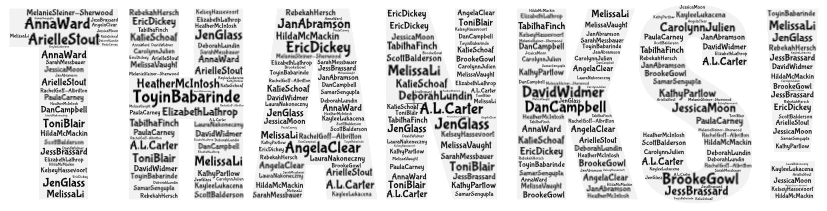
This year’s Mentoring Program kicked off with an exciting two-day Celebrating Mentoring Days in June with more than 100 registrants! The event featured an inspirational presentation from our keynote speaker Dr. Kelly Diggs-Andrews on the science behind effective mentoring, and a special panel discussion on mentoring across differences – we would like to express a sincere ‘thank you’ to our guest panelists, Angela Clear, A.L. Carter, and Sarah Messbauer for sharing their experiences, perspectives and insight.
The event also brought a closure to the 2020-21 mentor-mentee cohort on a positive note through McHuddles for mentors and mentees, and it also launched the orientation activities for the 2021-22 Mentoring Program. A record-breaking 107 mentor-mentee pairs are participating in this year’s program.
Other program highlights included demonstration of the newly adopted Wisdom Share software (many thanks to the NORDP Board of Director for their support!), a quick reboot of the On-board Packet tools, and a refresher on the Peer Mentoring Groups focusing on an array of research development topics, from Career & Professional Development, Leadership & Management to Proposal Development and more.
It takes a village to organize and run the Celebrating Mentoring Days! We want to give a big shout-out to the MC organizers and the more than 30 MC member volunteers who made this year’s inaugural event a huge success!
Having fun is better shared with others even in zoom!
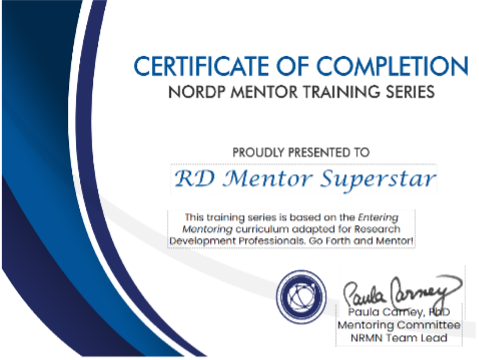
The NORDP Mentoring Committee’s Mentor Training Team held a mentor training workshop in May-June 2021. Twelve NORDP members from 10 states participated in the 5-week workshop, covering the 9-module Entering Mentoring curriculum initially developed for research mentors and tailored by the NORDP Mentoring Committee for RD professionals. Developed in collaboration with the University of Wisconsin Center for Improvement of Mentored Experiences in Research (CIMER), RD professionals explored key mentoring competencies that can benefit RD mentors and mentees that have been associated with improved career outcomes, employee engagement and retention, and more inclusive work environments. The workshop was facilitated by NORDP members Jan Abramson, Toni Blair, Kristin Boman, Paula Carney, Tabitha Finch, Rachel Goff-Albritton, Kathy Partlow, Erica Severan-Webb, and Samarpita Sengupta. All participants and facilitators are invited to participate in other Mentoring Committee activities. The next Mentor Training Workshop is being planned and will be announced soon. If you would like to be contacted when the next workshop series is scheduled, please complete this form.
Who: Rachel Goff-Albritton, Assistant Director – Office of Research Development
Where: Florida State University
Number of years in research development: 4 1/2
Length of NORDP membership: 4 1/2
What initiative are you the most proud of in your role as a NORDP volunteer?
I am really proud of my role in mentor training for RD professionals over the past two years. Over my time as part of the mentor training subcommittee of the Mentoring Committee I have helped to create training materials and worked with three cohorts of NORDP members to provide training sessions using evidence-based practices. We have helped teach them effective mentoring strategies using an interactive discussion-based training in collaboration with national centers and organizations (CIMER and NRMN) who are tasked with cultivating effective mentoring in the U.S.
How has your service to NORDP enhanced your career?
My involvement with NORDP has helped me find best practices for my office by learning from other offices across the country as well as other committee members. They have given me ideas for educational workshops and other events for faculty. I am also putting the mentoring strategies learned from my volunteer work into use in my role as assistant director and while supervising students. I have also learned how to be a peer mentor, and I am learning as much from my peers as they learn from me. The Mentoring Committee is a fun one to be on and one where everyone is truly trying to give back, which is what I enjoy the most about it.
How did you hear about NORDP and what made you join initially?
My boss, Beth Hodges, who is also my mentor, is great about providing staff members with professional development opportunities. She believes that it is important to be involved in your national organization to make sure you are providing services and resources that are cutting edge and relevant. I was able to attend the conference during my first year and I have always left the conferences feeling pumped to do my job with lots of new ideas. I really love this about NORDP!
What relationships have you built as a result of NORDP?
I have made a lot of friends across the country through my engagement with the Mentoring Committee. I have had mentors and mentees who have now become colleagues, such as Jenn Glass, Deborah Lundin, and Tanya Volkert. I have learned from their experiences and brought them back to FSU. I have really enjoyed working with Jan Abramson, Kathy Partlow, and Paula Carney, as well as with the rest of the mentor training subcommittee! I am constantly gaining little chunks of knowledge from them on how they approach their roles as RD Professionals.
Describe how NORDP has changed from when you initially joined
The Mentoring Committee has really improved the resources provided for the mentor/mentee pairs. They truly help build relationships and now offer different mentoring options like peer mentor groups, which provide mentoring for any type of experience you are looking for. I also served on the Nominating Committee where I have seen many improvements on the nominating process for board and officer positions, and the mentoring committee’s Facilitators Subcommittee, where volunteers have improved the roadmap for mentor/mentee relationships and the facilitator check-in process throughout the annual program.
What recommendations do you have for members to get more involved with NORDP?
Join the Mentoring Committee as we have a lot of fun! Volunteer with any committee and you will meet people who will provide you with opportunities for growth and professional development. There are mentors on every committee who offer many learning opportunities. You can also present at conferences. Every time I present I meet someone new who does what I do and we become collaborators. You are helping NORDP as a volunteer, but you also gain a great deal as well.
Compiled by Daniel Campbell, Member Services Committee
In a partnership with InfoReady, NORDP launched a New Opportunities in Research Development (NORD) grant Initiative which began funding grants in 2018 that support the disciplinary field of Research Development. Eleven grants of up to $2500 each have been awarded to date. A new grant cycle will be announced in the Fall of 2021.
Please keep an eye out for the call for proposals and/or visit the below link in the coming months to check for application details on the competition:
Who: Susan Ferrari, Director of Corporate, Foundation & Government Relations
Where: Grinnell College, Grinnell, Iowa
Proposal: Faculty Development and Institutional Grant Leadership at Small Liberal Arts Colleges
What problem in Research Development are you looking to solve with your project?
Grinnell is a small school with about 1,700 students and 180 faculty FTEs. We have a number of institutional grants here, which are common at many smaller schools, and they cover areas of both research and pedagogy. At many schools, including Grinnell, these grants were historically run out of the Dean’s Office, but we’ve begun to shift to having more faculty members run the grants, particularly in cases where they have subject matter expertise that’s relevant to the grant.
I had seen this phenomenon across the liberal arts sector and had been talking with my peers about what it means to have faculty run these programs effectively. I talked to faculty who have led successful institutional grants to learn what did and did not work and to determine what we can use from their experiences to enhance future programs to develop grant leaders.
What is the status of the project now?
I have completed interviews with faculty at Grinnell and at Carleton College, a small liberal arts school in Northfield, Minnesota, which is similar to Grinnell. The next steps will be transcribing the interviews, analyzing the data, and writing a report.
Do you have any suggestions for NORDP members considering submitting to the 2021 competition?
My first suggestion is to do it! This has been a great educational exercise for me. I have a background in life sciences research with a little experience in qualitative research. The feedback that I received through the application process was very beneficial. It was helpful in teaching me to be attentive to what I was putting forward and made it clear on how I needed to clarify the import of what I was trying to do. Kim Littlefield was one of my reviewers who spent a great deal of time with me shepherding the feedback to help me improve my project.
What did you find the most challenging?
Figuring out how to make a case on the relevance of this work to RD professionals working in different institutional contexts was challenging, but having to do this really strengthened the project.
What did you find the most surprising?
The interviews have been both inspiring and depressing. I had not anticipated that this project would be therapeutic for the faculty who have led these institutional grants. Many of them had lingering frustration and pain, even when the grants were successful and many years prior. It made me think that it would make sense to build more opportunities for reflection into these programs that would allow faculty to process what they have learned and what the project has meant to them.
I see these institutional grants as a blending of scholarship and service, and, at best, they provide faculty members with an opportunity to write their own legacy and leave their mark on campus. I will be using a modified version of the survey from this project for future exit interviews with faculty to gauge what is and what is not working.
What would you say is your main takeaway from this experience?
I think faculty grant leaders would really benefit from a more developed community within and across institutions of other faculty who are leading similar efforts. It can be a challenge to lead a campus-wide initiative without any real authority. Faculty would really benefit from more interaction with others who have had similar experiences. Ultimately, people are just looking to talk to others who have been in their shoes.
What are your plans for sharing or disseminating what you learn in this project?
I plan to share my findings with leadership at both Grinnell and Carleton, and I hope to present at a future NORDP conference. I would also like to share it with other organizations I am involved with, such as the College of Liberal Arts Sponsored Programs group (CLASP) and the Associated Colleges of the Midwest. Ultimately, I would love to write about my findings in a professional journal as well.
Has this experience changed how you approach your RD work?
When I started this job, I did not realize how much emotional labor is part of running a grants office. A big part of my role here is helping people deal with rejection and frustration as they wend their way through a research career. It also helped me think about how our role needs to continue to support and develop mid-career & senior faculty as well. In RD we focus a lot on early career folks, but we also can play a role in helping experienced faculty rise to new challenges, such as leading institutional projects.
What are/will be the outcomes of your research?
My hope is that I can set up a system to best support faculty here who are leading institutional grants. I would like to be able to put together a multi-institutional network of faculty to share ideas and get real feedback in a supportive community of practice.
Compiled by Daniel Campbell, Member Services Committee
Are you an established research development (RD) leader at your organization, or do you aspire to fast-track your journey to institutional RD leadership? If so, you should consider applying to participate in the 2021 NORDP Leadership Forum!
What is the NORDP Leadership Forum?
The Leadership Forum creates dedicated space for experienced RD professionals to discuss emerging RD trends and the research landscape more broadly. It also provides a platform to workshop strategies that leverage the strengths of RD to capitalize on those trends in ways that will benefit research at our institutions. The Leadership Forum is a benefit of NORDP membership, and carries no additional cost.
What’s happening at the 2021 Leadership Forum?
● We’ve expanded the Leadership Forum from a half-day conference event to a series of four, 3-hour virtual workshops, plus a virtual orientation and closing/report-out session. These workshops will take place one day/week starting in late September 2021, concluding in early November 2021, at times to be determined based on participants’ availability.
● The themes of these four workshops are:
» Infusing inclusivity into RD – it’s incumbent on RD leaders to be deliberate about inclusion and diversity in the programs they manage and the research teams they build and support » The future of RD work – emerging innovations in RD (pandemic-driven or otherwise) » Network activation – inviting leaders from other campus offices and key external partners (e.g., government relations and advancement representatives) to advise RD leaders on how to best mobilize the research teams they’ve cultivated or enabling programs they are developing » Taking the RD approach on the road – helping other campus offices to see the value in taking a relationship-focused, rather than transaction-focused, approach to faculty in the way that is so critical to RD
● Within the time of the workshops, each Leadership Forum participant will have opportunity to create an Action Plan to implement within their home organization, using the strategies they learn and skills they develop in the Leadership Forum
● As always, the Leadership Forum will provide many opportunities to network with fellow institutional RD leaders within NORDP, as well as featured panelists, speakers and workshop facilitators from other research sectors (government relations, advancement/development officers, and more)
Who may apply? How do I apply?
The Leadership Forum is for NORDP members. It is best suited for those members who are established organizational leaders, or who consider themselves to be on a clear track to organizational leadership. We assess eligibility not by job title, terminal degree or number of staff supervised, but by what insights, ideas or experiences you can bring to the conversation surrounding the four themes outlined above.
The participating cohort will be capped at 40 people, to enable close interaction among all participants and between participants and workshop leaders/panelists. The 2021 Leadership Forum cohort will include a mix of RD leaders recommended by NORDP committees/groups, as well as NORDP members who self-identify as having interest and who are selected through an open application process. All prospective participants must first submit an application through InfoReady.
To Apply:
Submit your application (profile information plus responses to questions assessing your interest and qualifications) via NORDP’s InfoReady portal by Wednesday, July 28, 2021.
Applications will be reviewed by a committee of NORDP members, and those selected to participate in the 2021 Leadership Forum will be notified the week of August 9, 2021.
Also Seeking Volunteers!
We will be seeking volunteers to coordinate breakout sessions and other activities during the Leadership Forum workshops. This is a golden opportunity for RD leaders (who might have more limited availability) to engage in this volunteer capacity. If you are interested in volunteering to facilitate a breakout session or otherwise assist with the Leadership Forum, please contact Daniel Arriaga, Senior Special Projects Coordinator in the UT Austin Office of the Vice President for Research. For more information, please visit our website.


 NORDP News