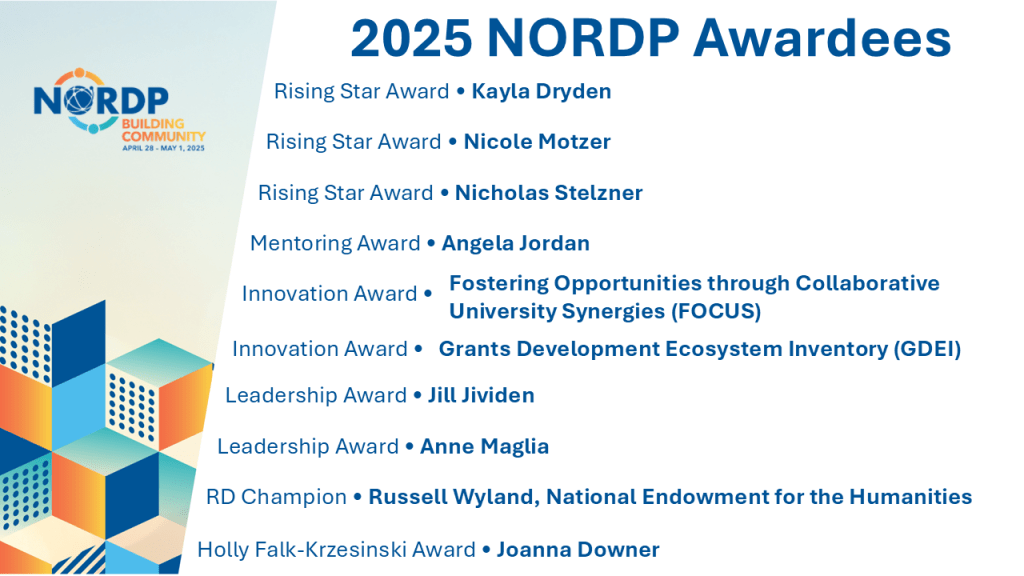
NORDP is powered by the excellence and impact of its members. Each year, NORDP Awards celebrate the outstanding accomplishments of NORDP members making exemplary contributions to the organization as well as the practice and/or study of research development. NORDP Awards honor the distinctive achievements and contributions of individuals, collaborative groups or work teams, programs or projects, and organizations.
Recipients of 2025 NORDP Awards were recognized during the annual NORDP Conference held virtually from April 28 – May 1. In the coming months, you will have a chance to learn more about each awardee through in-depth interviews that will be shared through NORDP News. Congratulations to all of the fantastic awardees for your service to our organization and profession!
Rising Star Award
Kayla Dryden, The University of Texas at Austin
Nicole Motzer, Montana State University
Nicholas Stelzner, University of Washington
Mentoring Award
Angela Jordan, University of South Alabama
Innovation Award
Fostering Opportunities through Collaborative University Synergies (FOCUS): Tracy Gatlin and Nicole Motzer (Montana State University), Carly Cummings and Ryan McAllister (University of Idaho), Heather Borck, Matthew Dwyer, Nathan Meier, Jackson Hardin, and Tisha Gilreath Mullen (University of Nebraska-Lincoln), Carrie Busha and Aurora Pinkey (University of Nevada, Reno), Jeri Hansen and Dawnie Elzinga (Utah State University)
Grants Development Ecosystem Inventory (GDEI): Kara Luckey (Seattle University), Jennifer Glass (University of Massachusetts Dartmouth), Dean Gerstein (Pomona College), Sarah Robertson (Bryn Mawr College), Amy Chan-Hilton (University of Southern Indiana)
Leadership Award
Jill Jividen, University of Michigan
Anne Maglia, University of Massachusetts Lowell
Research Development Champion Award
Russell Wyland, National Endowment for the Humanities
Who: Dr. Eva Allen, Senior Research Development Specialist, Biological Sciences Division
Name of organization/institution where they work: University of Chicago
Number of Years Working in RD: 23 years
Length of NORDP Membership: 13 years
When and how did you enter the field? What kind of research development work do you do?
Eva found herself in a tough situation in her first year of graduate school at Indiana University (IU) for evolutionary biology when she learned that she didn’t share common research interests with the lab she was working with. Because of this, she cobbled together two different advisors for a topic she developed. However, neither of them had grant funding for her work. So, Eva wrote proposals, drawing on her strengths as a writer; she grew up with an English professor father and served as a writing tutor as an undergraduate.
After earning her PhD, she stayed on at IU providing research development support to her department. This role expanded over 20 years, as described in the 2020 New Board Member Cameo blog post. In 2021, she became the Assistant Director for Research Advancement of IU’s Environmental Resilience Institute.
From IU, Eva was recruited to ASU, where she worked in the central RD office, founded and led by Faye Farmer and Karen Walker. This role had a very strong emphasis on proposal management, and it’s where she realized that proposal management is what she had been doing all throughout the years developing complex proposals.
After a year at ASU, an opportunity presented itself within the Biological Sciences Division at University of Chicago. There, the Research Development Team supports approximately 400 investigators, both tenure-track faculty and clinical investigators, focusing on large, complex applications. When there’s downtime, they will work on smaller submissions or consult with PIs who are planning large submissions. With an RA on the team who handles most paperwork, like biosketches and budgets, Eva can focus on engaging with the researchers on the science and how they’re articulating it. She ensures that communication is clear, from high-level concepts down to editing the document.
What’s your history with NORDP? How have you engaged with the organization (committee work, conferences attended/presented)?
When Eva first joined the campus level team at IU in 2012, she learned about NORDP from colleagues and attended the national conference. She’s attended every conference since then, and presented at many of them. In 2014, she joined the Conference Workshops Organizing Committee, eventually co-chairing the group for the 2018 and 2019 conferences. After a year on the Executive Committee for the 2020 conference, she stepped away from that work to join the Board of Directors.
During Eva’s first year on the Board she trained as Assistant Treasurer, and served as Treasurer in 2021 and 2022. During 2023, the fourth year of her first term, Eva was an informal immediate-past treasurer, consulting and supporting the transition. In the current Board term, she is not serving in an executive office. Her primary responsibilities are being a liaison for the Professional Development Committee and leading a task force to update NORDP’s website to make it more useful for prospective and current members.
What motivated you to run for the NORDP Board for a second term?
Eva credits her first Board term as being a very valuable professional development experience. Expanding her network and deepening relationships during this first term proved extremely rewarding. Last May, near the end of her first term, the Board laid out a strategic roadmap, and Eva wanted to stay on to be part of leading implementation of those plans.
What are you most excited about as a new NORDP Board member?
One pillar of this roadmap is cultivating volunteer opportunities for growth. The board recognizes the importance of ensuring that volunteer pathways are available, accessible and clear, and that expectations are well-laid-out and reasonable. This is important so that volunteers do not burn out. Also, the board wants to increase the professional growth, positive experience, and active engagement of volunteers. Eva is aiming to leverage the updated website to highlight information on volunteering and on the benefits of being a member of NORDP.
Established in 2021, the NORDP Consultants Program is dedicated to expanding the national research ecosystem by providing research development services to minority-serving institutions and emerging research institutions (ERIs) to build research capacity. These engagements are supported by a cadre of peer-approved consultants and are always provided at no cost to the partnering institutions via the support of external sponsored funds.
With funding from the National Science Foundation (OIA-2331578), the NORDP Consultants Program is pleased to announce the partners joining Cohort IV. Each institution has recently expressed or renewed its commitment to strengthening its research activity and connecting scholarship to student learning and societal impact. They are:
California State University Bakersfield, a public Hispanic-Serving Institution in California;
City University of New York John Jay College, a public Hispanic-Serving Institution in New York;
Quinnipiac University, a private emerging research institution in Connecticut; and
Winston-Salem State University, a public Historically Black University in North Carolina.
In the cohort model of engagement, ERIs receive up to 600 hours of consultant support, an investment in their research infrastructure, and access to professional development and networking activities. Cohort IV will kick off their two-year intensive engagement in October 2025. The request for proposals for ERIs to join Cohort V will launch in January 2026. Interested ERIs and friends of the program can sign up for communications here.
The NORDP Consultants Program’s reach is expanding! With sponsorship from the Carnegie Corporation through the University Administrators Support Program (UASP) managed by The International Research & Exchanges Board (IREX), the NORDP Consultants Program is also pleased to serve as the virtual host for the 2025 UASP Fellows in Research Development. Six fellows from five universities across the African continent, Addis Ababa University (Ethiopia), University of Ghana (Ghana), Kwame Nkrumah University of Science & Technology (Ghana), Obafemi Awolowo University (Nigeria), and University of Lagos (Nigeria), will join NORDP Consultant Program staff and experts from Emory University to explore various topics in research development in a multilateral exchange during several months in spring 2025.
Thank you to the more than 40 individuals who work and volunteer for the NORDP Consultants Program!
Written by the Mentoring Committee Marketing and Communications sub-committee
Don’t miss out! Applications for the 2025–2026 NORDP Mentoring Program close this Friday, May 16. All NORDP members are encouraged to apply again this year as a mentor, mentee, or both—mentors are especially needed! This program offers invaluable opportunities for research development professionals to connect with experienced colleagues who volunteer their expertise and support. Participants can join repeatedly and choose between two matching options: the traditional 1:1 Dyad or the dynamic 1:3 Mentoring Cohort.
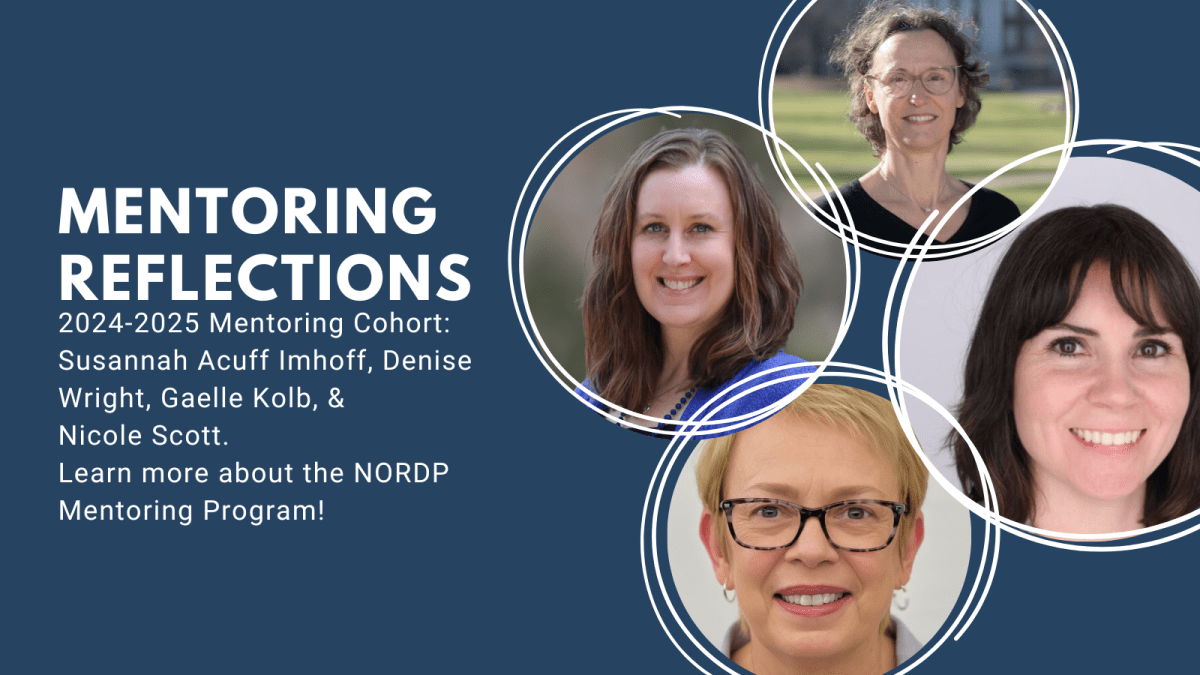
The program kicks off on July 1. Be sure to register by May 15 and mark your calendars for the NORDP Mentoring Program Orientation on Wednesday, June 25, from 1:00 to 2:30 PM ET. To inspire both new and returning participants, we’re excited to share insights from a 2024-2025 Mentoring Cohort, highlighting their motivations and appreciation for this unique format. Meet the cohort …
Susannah Acuff Imhoff
Susannah Acuff Imhoff (SAI) Susannah Acuff Imhoff manages Transcend Initiatives as Senior Associate Director of Research Development at Washington University in St. Louis, supporting interdisciplinary research networks and team science. Previously, she was Assistant Director of Research Development at Vanderbilt University, aiding faculty in strategy and proposal development. Her experience includes roles at the U.S. Pharmacopeia and in higher education, including teaching Cultural Anthropology. Susannah holds degrees from the University of Memphis.
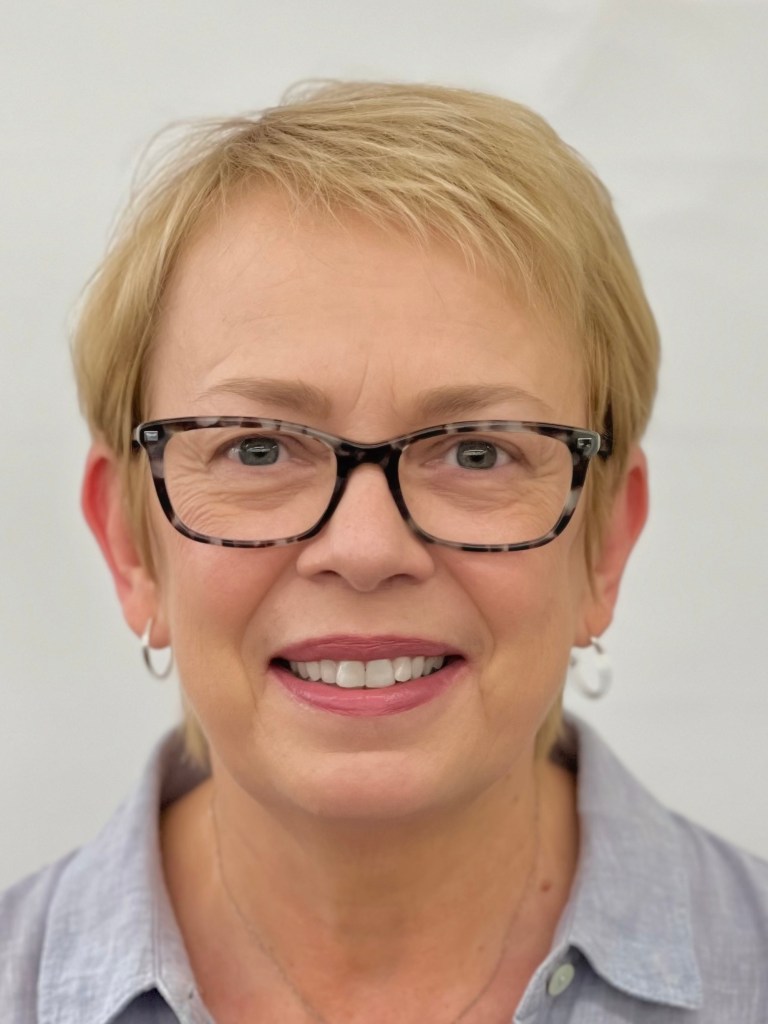
Denise E. Wright
Denise E. Wright (DW) is a Research Development Officer at Emory University, focusing on mega proposals and strategic initiatives. Her background includes higher education publishing with significant project management and editorial experience. Denise earned a PhD in History from the University of Georgia and a BS in Political Science from Kennesaw State University.
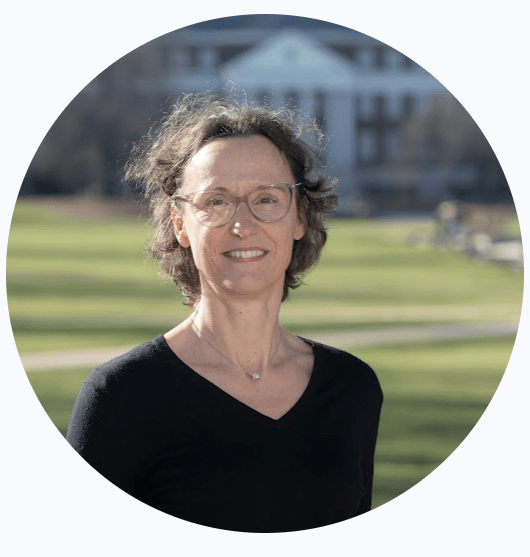
Gaelle F. Kolb
Gaelle F. Kolb (GK) is a Proposal Development Manager at the University of Maryland College Park, previously serving as Grants Development Specialist for Neuroscience and Cognitive Science. Earlier roles include positions at Johns Hopkins Medical Institutions and the National Institute for Allergy and Infectious Diseases (NIAID). Gaelle holds advanced degrees in Biology-Health from the University Victor Segalen in France and completed a postdoc at NIAID.
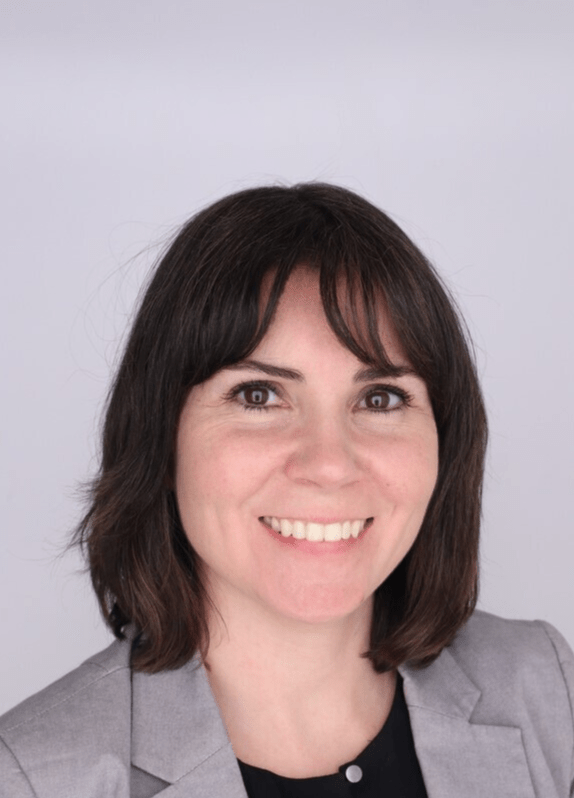
Nicole M. Scott
Nicole M. Scott (NS) is a Research Project Manager at Iowa State University, contributing to the new ResearchPOST unit that supports project management. Prior to this, she managed projects on individual grants at the university. Nicole holds degrees in biology from Iowa State, primatology from Roehampton University, and cognitive science.
Q1: What influenced you to apply to be a mentor and a mentee for the NORDP Mentoring Program? Why did you choose the cohort mentoring model?
Denise Wright (DW): I applied to be a mentee because, having served as both a mentor and mentee in other professional capacities, I recognize the value of peer mentoring. In August 2023, I was new to research development. After enrolling in RD101, I began to understand just how much I did not know. A mentoring cohort seemed the obvious place to gain from others’ experiences.
Gaelle Kolb (GK): Being a mentor myself to students and professionals I met in my previous career, I realized the need to find a mentor and mentoring group in which we can bounce ideas about my current professional aspirations. RD being so broad and so broadly interpreted, I feel that a cohort model is better for hearing more diverse voices.
Nicole Scott (NS): Being newer to NORDP, I knew there was a wealth of knowledge out there I could tap into to learn about the field quicker than if I had tried to pick it all up as I went. Being part of a cohort modeling meant that instead of learning from one person, I could learn from 3! And they have taught me so much!
Susannah Acuff Inhoff (SAI): I applied to be a mentor in the hope that some of the experience that I’ve gained through my years in RD could be of service to others who may be facing similar encounters or circumstances, and with the expectation of gaining my own new insights and perspectives from collegial relationships in RD outside of my pre-existing university orbits. I was excited to learn that I’d be mentoring a cohort in partnership with three other people.
Q2: Have you participated in a 1:1 mentoring model before? How has this experience been different or similar?
GK: Yes, I still meet regularly with my mentor who was my supervisor and retired a decade ago. Early on, our meetings were more focused on my career paths and professional preparation. Since our 1:1 mentoring has been ongoing for more than a decade, our relationship has evolved to share our passion for diverse cuisines.
NS: In other organizations, I’ve been both a mentor and a mentee in a 1:1 model. Being part of a cohort meant that there was less pressure on me to drive the conversation and I got to hear multiple perspectives.
SAI: I have participated in 1:1 in other fields, and informally in RD. I found the cohort model to be more robust in terms of the full group (including the mentor) benefiting from shared discussion and ideas. Together, I felt we could solve or make headway on any challenge, even those that may have been outside of my direct experience. It also felt self-sustaining and truly more of a partnership.
Q3: What was your favorite part about this cohort mentoring model?
DW: My favorite part is the community we have created. The members of our group have different job titles and areas of interest/specialty, but all are generous, thoughtful professionals. During this particularly trying time for anyone involved in the research enterprise in the U.S., this group has been a place to share information, commiserate about challenges, and seek advice from a trusted circle.
GK: Initially, I was fond of how different our professional roles looked. Now, after a few months, I really enjoy the natural way discussions pop up during our meetings. Our mentor is not directing any discussion with a set agenda allowing us to reflect and share in a natural way. I always look forward to our meetings!
NS: Getting to meet three fabulous people!
SAI: The camaraderie and sense that we are all checking in on and rooting for one another – and that every participant has incredible value to offer.
Q4: How has participation in the NORDP Mentoring Program helped broaden your horizons about Research Development in general and/or affected your daily work in particular?
DW: Because the members of our cohort have such varied specialties, I have a greater understanding of the diversity of roles within the research development community.
GK: It helped me make sense of why I felt that I was doing so many different jobs. I am also inspired by my mentor who shows great composure. I value my cohort very much as it opened my horizons on how much more we can do in RD and help shape my career ambitions.
NS: Participation in this group has broadened my horizons in RD by providing me with the space and access to others doing this work at other universities. There are so many ways to be successful in this area so hearing from others and how they are successful (or not) expands my toolbox and sparks new ideas.
SAI: I’ve applied much of my colleagues’ advice on everything from daily work-life balance to how to approach team science with different types of groups. It is confidence-building to realize that there is consensus on an approach because others have the same experience, for example, or to have access to a broader set of ideas on sensitive subjects that may relate to the profession but are too candid for certain professional forums outside of a mentoring relationship.
Q5: What surprised you about being a mentor or a mentee?
DW: There were no real surprises other than the pleasant one of finding that my cohort fell rather quickly into comfortable conversations.
GK: As a mentee, I am still learning and looking forward to learning more!
NS: I was surprised at how quickly we could fill an hour of conversation.
SAI: The reciprocal knowledge and friendship that grew naturally out of our shared support of one another.
Q6: Any words of wisdom or encouragement for those wanting to apply this year? Any other thoughts you would like to share?
DW: I would encourage anyone who, like me, is new to research development to join a mentoring cohort. By connecting with people outside your office and institution, you can begin to grasp just how multifaceted research development is. You’ll also develop professional relationships and may, if you’re as lucky as I have been, make some new friends.
GK: I would suggest a cohort model as it is professionally enriching to learn how RD looks at other institutions. I also like the geographic diversity of our group!
NS: My motto is “always learning.” There is always something new you can learn from someone else, no matter how experienced you are, and in mentor/mentee relationships that learning happens both ways.
SAI: I encourage folks to try, especially to try the cohort model! Your voice is needed. I think we all have a lot to offer that may not only be based on years of experience. Don’t hold back because there is a place for everyone. Those with a lot of RD experience can also benefit from participating in a cohort model as a mentee. It has enriched my professional experience. Through participation in our wider NORDP community, you will make it stronger and expand your own sense of purpose and place.
The 2025-26 NORDP Mentoring Program registration will close this Friday, May 16. Do not wait and complete your application today! Additional mentoring opportunities are available through the Peer Mentoring Groups that are open throughout the year via the WisdomShare platform.
An investment in mentoring is an investment in you!
The New Opportunities for Research Development (NORD) Committee is excited to announce the NORD/InfoReady Grant Cycle 2024 awardees, sponsored by InfoReady and NORDP.
Beth Jager, Executive Director of Sponsored Research at Claremont McKenna College; Nicole Wallens, Director of Sponsored Research Harvey Mudd College; and Dean Gerstein, Director of Sponsored Research at Pomona College were awarded $5,000 for the project, “Steps Toward PUI/ERI Presubmission Peer Review Networks (P3RNs).”
This project will explore the development of collaborative presubmission peer review networks across collectives of predominantly undergraduate institutions (PUIs) and other emerging research institutions (ERIs). Its goal is to use these expert proposal review networks to mitigate the difficulties sponsored research officers at relatively small and/or highly teaching-focused institutions face in securing a critical mass of subject experts as compared to large-scale institutions with substantial numbers of grant-active faculty in each major field. Based upon data gathered in a series of interviews, the project team will create a workbook of best practices for faculty-led peer-review processes at PUI/ERI institutions. That workbook will facilitate future piloting of PUI/ERI Presubmission Peer Review Networks (P3RNs) that can serve as models for spreading P3RNs to institutions across the country.
_______________________________________________
The Arts & Humanities Grant Studio at the University of North Carolina, Chapel Hill, was awarded $4,950 for the project “Research Development in the Fine Arts & Humanities: A Mixed-Methods Study.”
This study will investigate the primary needs for Research Development in the Fine Arts & Humanities at UNC-Chapel Hill, which is a STEM-heavy R1 institution. As such, it faces a crisis familiar to other institutions: traditional funding sources for arts and humanities research in the U.S. are declining. There are multiple contributing factors, including a post-pandemic decline in longstanding foundation and fellowship support and a decrease in the median size of arts grants. This decline has sparked a national debate, and this project’s goal is to demonstrate how research development support can be a key factor in mitigating that crisis.
Led by Director Ashley Melzer and Postdoctoral Fellows Sara Katz, Boyie Kim, and Mariah Marsden, the team has designed the study to use a combination of quantitative surveys and qualitative interviews/focus groups with UNC-Chapel Hill faculty. This research is expected to investigate research development’s capacity to build a more robust, resilient, and interconnected funding ecosystem across the university, one that meaningfully includes arts and humanities research. Additionally, it is expected to demonstrate that research development professionals are uniquely positioned to address the issues faculty in these departments face. The data collected during the study will be accessible by other research development teams across institutions, as will external reports that contextualize UNC-Chapel Hill as a case study among other U.S. institutions, exploring broader recommendations for tackling funding challenges in fine arts and humanities research.
_______________________________________________
Scott Merrill, Program Manager in the Office of Research Development at the Cleveland Clinic, was awarded $5,000 for the project “EARS: Evaluating Awareness of Resources and Services in a Research Development Office.”
The Cleveland Clinic’s Office of Research Development (ORD) is charged with ensuring that caregivers involved in the research process—including principal investigators, research administrators, and administrative support specialists—are aware of the resources and services the office offers. The challenge is that the clinic’s more than 80,000 caregivers and 5,700 physicians and scientists are located at multiple locations. Like other central research development offices, ORD continues to hear from investigators and research personnel that the office and its services had been unknown to them. The goal of this project is to help the office understand what contributes to the lack of awareness and what strategies may be effective in mitigating it. The research process will begin with a 15-question survey to evaluate current awareness. That data will then be analyzed to determine appropriate interventions and targeted approaches. The implementation of those interventions will be followed up with a re-launch of the survey. The resulting data and analysis should allow the team to assess usage of ORD services and resources as well as identify potential weaknesses. The expected outcome is that the percentage of increased awareness will match the percentage of increased resource utilization and increased traffic on the ORD intranet site.
InfoReady Corporation and NORDP’s New Opportunities in Research Development (NORD) Initiative has launched the 2025 cycle of the NORD | InfoReady Research Grants in Research Development.
This opportunity funds research projects that support the disciplinary field of Research Development. To develop a robust understanding of Research Development and its impacts (locally, nationally, and internationally), a wide range of projects will need to be undertaken. Some of these will be empirical studies (e.g., surveys, interview studies, case studies, reviews), but others must be theoretical, conceptual, and even purely descriptive or definitional. In many ways, the path to Research Development becoming a field must begin with research that helps the field define and standardize the terms used to identify skills and practices, as well as metrics that allow us to measure both activities and their outcomes for Research Development.
Awards are expected to be up to $5,000 for projects lasting up to 18 months; however, applicants are strongly encouraged to target 12-month projects. The anticipated project period for this award cycle is November 1, 2025, through April 30, 2027.
The NORD | InfoReady Research Grants in Research Development Program is open to all interested researchers, regardless of whether they are NORDP members. A list of research topics, including the program’s priority areas of interest, is presented in NORDP’s InfoReady instance.
The application deadline is 11:59 p.m. Eastern time on Tuesday, July 29, 2025.
Board Membership: Carly and Nathan’s Journey of Commitment
The February 2025 installment of Career Stories highlighted NORDP board members Carly Cummings and Nathan Meier. Carly and Nathan have made significant contributions to NORDP and to research development (RD), and they shared valuable insights about their professional journeys, the impact of board service, and advice for those considering leadership roles within NORDP. The February installment of Career Stories was co-hosted by the Nominating Committee (NomCom), which facilitates the annual board of directors’ nomination, application, and election processes.
Carly Cummings
Senior Director of the Office of Research and Faculty Development at the University of Idaho
Carly Cummings, NORDP board member elected in 2023, is the Senior Director of the Office of Research and Faculty Development at the University of Idaho—a newly minted Carnegie R1, rural, land-grant institution. Carly started this office in 2018, establishing a team of six Research Development Specialists to deliver a 360-degree approach to enhancing the competitiveness of extramural research proposals at the University. This approach includes offering a suite of faculty development programming and seminars, tailored internal competitions for limited submission funding programs, and managing internal funding opportunities. Prior to the University of Idaho, Carly held college-level RD and RD/RA roles at two other land—grant institutions. Carly serves as an advocate for developing and implementing innovative collaborative RD approaches to achieving institutional research goals.
Nathan Meier
Associate Vice Chancellor for Research, Capacity and Competitiveness, within the Office of Research and Innovation at the University of Nebraska-Lincoln (UNL)
Nathan Meier, NORDP director and immediate past president, is the Associate Vice Chancellor for Research, Capacity and Competitiveness within the Office of Research and Innovation at the University of Nebraska-Lincoln (UNL). Directing UNL’s Research Development Group, Nathan increases faculty and institutional success by providing leadership for internal funding, proposal development, research impact, external recognition, and faculty research development programs. During the last two decades, Nathan and his team have partnered to help the UNL community secure more than $870 million in external funding. Examples of Nathan’s impact to NORDP are him serving on the working group that developed NORDP Leadership, Engagement and Development (LEAD) and initiating the Career Stories series.
Carly is in the middle of her first term, and Nathan is nearing the end of two terms on the NORDP Board, having served as the organization’s president. Reflecting on their experiences, Carly and Nathan expressed appreciation for their time as board members and emphasized that board service does not require being senior in one’s career but a deep commitment to NORDP and the RD community. Though serving on the board comes with responsibilities to ensuring the continued growth of NORDP is accompanied by the necessary administrative support and governance structures, the benefits of this service are significant. One benefit mentioned was gaining a deeper appreciation of faculty experiences and challenges, such as large proposal development processes, and managing team dynamics and collaborative work. Carly and Nathan also mentioned that board service benefits include the satisfaction of contributing to our professional organization and shaping its future, networking opportunities with other directors through regular meetings and annual campus visits, and collaborative initiatives toward shaping NORDP’s future. The takeaway is that this service engages in strengths-based, collaborative initiatives where the whole is greater than the sum of its parts, with the ultimate goal of enhancing the growth, credibility, and visibility of RD professionals.
When asked to share pro tips for those considering board service or increased involvement with NORDP, Carly and Nathan advised it is important to consider when the time is ripe to take on a leadership role and the importance of nominating others you see as strong candidates. Additionally, they noted the importance of understanding the requirements for nonprofit board service, in general, and the responsibilities and expectations of NORDP board members in particular. To help with this, they recommended conducting informational interviews with current or recent board members to gain firsthand insights as a way to better understand and prepare for the role. Nathan uses a set of six questions to guide these discussions, which he is happy to share. He also recommended accessing a copy of What Every Board Member Needs to Know, Do, and Avoid, which is a quick guide recommended to him by prior members of the NORDP board.
Carly and Nathan share a deep commitment to supporting NORDP and an enthusiasm for RD. They are both open to continued dialogue and would love to answer any questions you have for them regarding their roles as board members or their involvement in NORDP. Carly may be reached at ccummings@uidaho.edu, and Nathan may be reached at nlm@unl.edu.
We hope this blog provides some practical insights and resources to help you consider your involvement within NORDP and the plusses and potential of serving on the board. If you would like to continue the conversation, reach out to NomCom at nomcom@nordp.org or to Career Stories team member Chetna Chianese at cchianes@syr.edu.
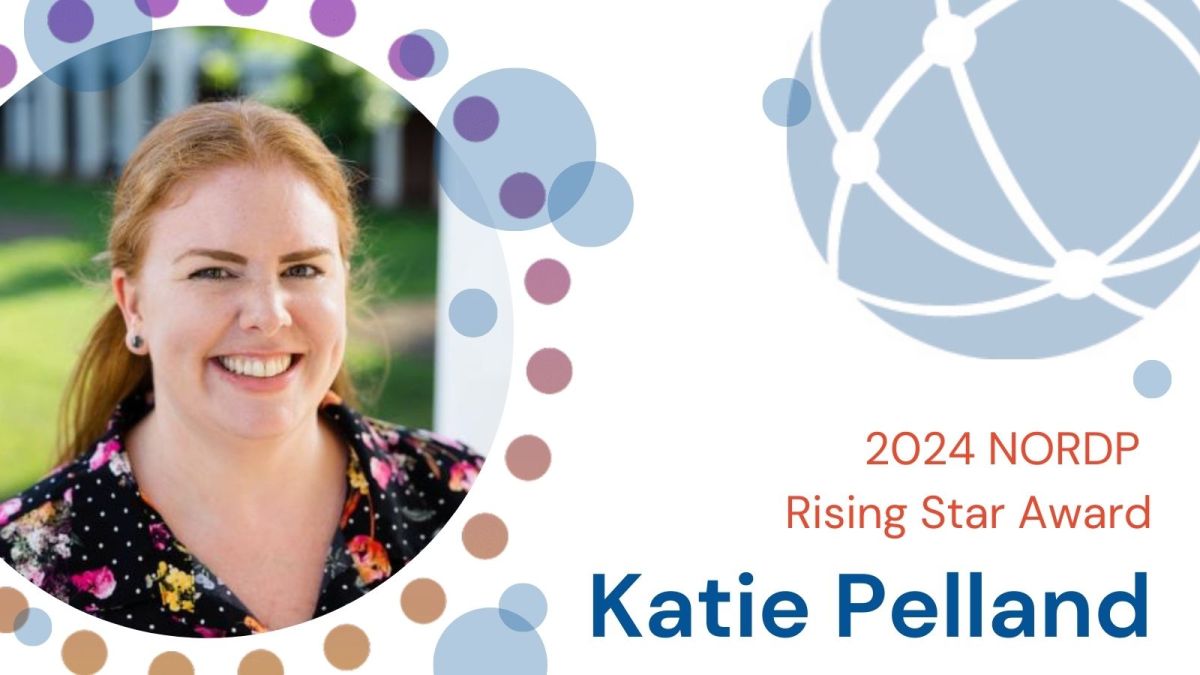
The NORDP Rising Star Award recognizes individuals for their outstanding, early volunteer contributions to NORDP and strong potential for future contributions to the organization and the profession or the field.
Who: Katie Pelland
Role: Senior Research Program Officer, University of Virginia Brain Institute
Number of years in research development: 6
Length of NORDP membership: 6 years
What initiative are you the most proud of in your role as a NORDP volunteer?
One initiative I’m particularly proud of in my role as a NORDP volunteer is the streamlining of the board application process. Through the years there have been various iterations of the Board application process and the expectations of Board candidates. One thing we did while I was the co-chair of the Nominating Committee was to examine the application process and what barriers it might pose to members running for the Board. And that resulted in us streamlining the application process to focus on what truly matters for running for the NORDP Board: why candidates want to be on the board and how they are qualified to serve. We really want to have a Board that represents the diversity of the NORDP membership and since instituting these changes we’ve seen an increase in Board candidates and NORDP members at a variety of career stages running for the Board.
Another initiative I’m proud of is creating a transparent and straightforward path to committee membership for two of the committees on which I’ve served: the Nominating Committee and Conference Committee. This process involved putting out an open call to NORDP members to gauge interest and launching a simple form for interested members to complete in order to join the committee. I think there are sometimes barriers to NORDP service, and our goal was to let NORDP members know that it’s very easy to join a committee and get involved. These efforts have strengthened both committees and brought in NORDP members who want to give back to the organization but might not have known where to start. I would love to see this process expanded to include all NORDP committees to make it easier for our members to volunteer!
How did you hear about NORDP and what made you join initially?
I first heard about NORDP while I was finishing up graduate school and working as an intern in UVA’s central research development office. My supervisor, Becca Latimer, was very active in NORDP and introduced me to the organization immediately after I started and encouraged me to join. Given her enthusiasm and the value of the community, knowledge-sharing, and resources, joining NORDP felt like a no-brainer.
What relationships have you built as a result of NORDP?
It’s a long list that ranges from fantastic one-off conversations at virtual meetings and in-person conferences to honestly some of my closest friendships. One of the things I think is so valuable about NORDP relationships is the shared understanding of our work in research development. Even though our jobs may differ, there’s a mutual comprehension and respect for what we do, which can be harder to find with colleagues outside of our field. There’s also a “rising tide lifts all boats” mentality within the NORDP community and everyone is so generous in sharing their knowledge so we can all improve.
Additionally, the mentors I’ve gained through both formal and informal channels have been invaluable. As I’ve navigated career changes, these mentors have helped me brainstorm ideas, and have hard conversations that have helped me figure out where I want to go and what I want to do. All of these relationships have given me a stronger sense of all the things that a career in RD can be.
What are you most excited about when it comes to the future of NORDP?
I’m very excited about the rapid growth NORDP, and the field of research development (RD), has been experiencing. NORDP is playing a major role in shaping how RD is evolving and expanding. I’m particularly excited about the effort to professionalize the RD profession, with the introduction of a new journal, NSF GRANTED, and NORDP’s certification or credentialing task force. These efforts are helping to establish RD as a recognized and respected career path.
Additionally, NORDP is putting more intention into skill transfer through workshops and other educational opportunities, which helps both new and experienced RD professionals broaden their skill sets. This is really important for the continued growth and development of the field, particularly for those of us who are in the earlier stages of their careers and are thinking about what our trajectory will be long-term. It’s also exciting to see representation of RD professionals in higher-level positions, such as AVPRs, which is changing the institutional landscape. This trend is likely to continue, allowing RD professionals to move up and expand their influence.
What recommendations do you have for members to get more involved with NORDP?
I have so many! My first recommendation for members looking to get more involved in NORDP is to start by joining a committee that interests you. Read up about the different committees and choose one that aligns with your passions. Then, email the co-chairs to express your interest. Most committees are always welcoming new members, so don’t hesitate to reach out.
Another great way to get involved is through the mentoring program, either as a mentee or a mentor. As a mentor for the first time this year, I’ve found it incredibly rewarding. Despite some initial imposter syndrome, my conversations with my mentee, who is new to RD, have been really insightful and beneficial for both of us.
I also know that many regions have regular Zoom or even occasionally in-person get-togethers, and attending these can help you connect with others and stay informed about what’s happening in your neck of the woods. The annual meeting is also a fantastic opportunity to get involved, and with the 2025 meeting being virtual, it will be more accessible.
Lastly, participate in the elections by attending the board candidate forum and voting for members of the Board. It’s important to have a say in who leads our organization!
What does your future in NORDP look like?
In the immediate future, I’m transitioning into the role of immediate past chair of the Nominating Committee before rolling off. I’ll miss serving on NomCom – it has been a wonderful opportunity to learn about NORDP and the Board without overextending myself, which I have really appreciated. I’m also excited to be serving as one of the Conference co-chairs this year!
Longer term, there’s so much I’m interested in doing. I’ve started to get involved with the Communications Working Group and I’d like to get more involved in NORDP’s Committee on Inclusive Excellence, whose work is increasingly important. I also plan to stay active in the Atlantic region, where there’s been a real push by our current regional leaders to make the region more active. I could see myself someday aspiring to a leadership role within the region and helping foster the same level of engagement we see in other regions like the Northeast and Great Lakes.
Written by: NORDP Mentoring Committee Communication & Marketing (McMc) Team—Vess Vessileva-Clarke, Elizabeth Lathrop, Brooke Gowl, Jessica Brassard
Applications for the 2025–2026 NORDP Mentoring Program are now open until Friday, May 16! NORDP members are invited to participate as a mentor, a mentee, or both. The NORDP Mentoring Program is a benefit available to all NORDP Members. This program enables research development (RD) professionals to network with NORDP colleagues who have volunteered to share their expertise, guidance, and support. There are two options for matching mentors and mentees in the program: the 1:1 Dyad or the 1:3 Mentoring Cohort (one mentor paired with three mentees).
Key highlights from the 2025 Mentor Recruiting Info Session (4/15).
As a growing profession, NORDP always has more mentees than available mentors.
A small but enthusiastic group of NORDP members interested in exploring the possibility of becoming mentors joined the Mentoring Committee Co-Chairs on Tuesday, April 15, for the annual Mentor Recruiting Info Session. The session began with a brief presentation on what mentoring is and a description of the role of the mentor. People with years of mentoring experience shared stories and best practices from their mentoring “careers.” Additionally, participants were introduced to the NORDP matching program details, the different mentoring “flavors” (dyads and cohorts), and common myths related to mentoring.
During the Q&A, those with experience as mentors encouraged others to become mentors! One does not have to have years of RD experience or formal mentor training in order to be an excellent mentor. Additionally, mentoring is a two-way street. As a mentor, you will likely gain as much as you give.
Mentors are provided with resources in WisdomShare to aid them in their mentoring efforts. There are also facilitators they can reach out to if they have questions or encounter situations for which they could use help. Prospective mentors were encouraged to consider a mix of mentoring experiences in dyads, cohorts, or even a dyad and a cohort in parallel.
Reflections from some of our most experienced NORDP Mentors
NORDP is a community of people who are passionate about sharing and learning with each other. When it comes to mentoring, there are many people with years of experience to share. Below are some highlights from past NORDP mentoring reflections:
Anglea: “Every mentoring relationship is unique.”
Wendi: “Continue participating in this program and serve as both mentor and mentee. The 360-degree perspective these roles provide will enhance your professional capacity and enrich your personal attributes.”
Christine: “I encourage each mentee to drive our relationship by setting goals (and allowing them to evolve), while I provide tools, resources, contacts, and advice toward achieving them.
Mayla: “Ask lots of questions.”
Toyin: “Extending grace to yourself is critical.”
Julie: “Mentoring truly is a bidirectional exchange.”
Sandra: “It was also very beneficial to work through the MESHH Network framework with someone.”
Julie: “The mentoring relationship serves as a reflective experience that re-energizes my everyday work life.”
Sofia: “Kathy opened my eyes to the possibility of leaving the bench for RD.”
Eric: “Learning how people persevere in their work through challenges and opportunities has helped me become more empathetic.”
Erica: “My mentoring relationships have contributed to my career progression and have made me a better RD professional and leader.“
Erin: “My mentor took the time to reach out to someone who knows people at my current institution and through this contact, I have expanded my network.”
Jess: “Having my mentor’s perspective helps me reflect more clearly because he sees things from an outside point of view while still having the context of our RD mission.”
David: “I feel we have crafted an important connection that will last beyond the mentoring year.”
Figure Caption: Mentoring Flavors & Benefits graphic provides useful information to help you decide how best to participate in this year’s NORDP Mentoring Program.
As applications for the 2025-2026 NORDP Mentoring Program open until Friday, May 16, we encourage all NORDP members to consider how you might benefit from participating—whether as a mentor, a mentee, or both. This valuable member benefit continues to strengthen our research development community through meaningful professional connections and knowledge sharing. Whether you choose the personalized attention of a 1:1 Dyad or the collaborative learning environment of a 1:3 Mentoring Cohort, your participation helps ensure that expertise, guidance, and support remain hallmarks of the NORDP experience. Don’t miss this opportunity to grow your network and advance your RD career!
Written by Kate Duggan, Conference Planning Committee
NORDP 2025 Keynote Speaker, Sarah Spreitzer
As research development professionals and NORDP members, we pride ourselves on our flexibility, versatility, and ability to meet the moment. This year’s NORDP Conference closing keynote, Sarah Spreitzer, utilizes many of these same skills in her role as Vice President and Chief of Staff of Government Relations for the American Council on Education (ACE). Her May 1 keynote will provide an update from Washington, DC on the new administration’s actions and policies relevant to higher education and research, the response from Congress, and how NORDP members can draw upon their own skills and experience to understand, interpret, and advocate in the evolving federal landscape.
Sarah was drawn to federal advocacy by way of her passion for education, which was inspired by her mother and grandmother, both elementary school teachers. After earning her bachelor’s degree from Beloit College in Wisconsin and a master’s degree from The Catholic University of America in Washington, DC, Sarah was aiming for a career as an academic when she took a break from being a student to work for the University of Washington’s Federal Relations office. That one post-graduation job turned into a career for Sarah, who went on to become a Senior Government Relations Representative/ Lobbyist for Lewis-Burke Associates and then Director of Federal Relations for the University of Missouri System before joining ACE in 2017.
In her role at ACE, Sarah represents 1600+ institutions of higher education, working to unite the postsecondary community around topics of mutual concern and interest. At present, these topics include the proposed decrease of federal facilities and administrative (F&A) rates to a maximum of 15%; opposing the DETERRENT Act, which would add extensive new faculty and staff foreign gift reporting requirements; and immigration policies that affect international students and faculty.
While the current moment is presenting some unique challenges to the national academic research enterprise, Sarah still sees reason to be optimistic. On considering how higher education reacts to adversity and might respond in this moment, Sarah reflected that “we’re a little slow, but we are flexible. And I think that that was really demonstrated during COVID. If you had told me that all of our institutions would be able to transition online within a week and address all of the needs of our international students who suddenly weren’t sure if they were going to stay, or if they were going to have to go. I would be like, there’s no way we could do that. We did it. We did it and I think that that is the strength of higher education.”
Beyond drawing upon the resiliency our institutions cultivated during the pandemic, Sarah has more advice for NORDP members on how to handle the headlines:
Pause: “When something new comes out…it’s important to take a breath and pause before you react … understand what’s actually happening, that there is supposed to be a rule of order for the implementation, that a lot of things that are happening are being stopped by the courts.”
Share: “Sharing information during this really confusing time is incredibly important, because I may have an NIH grant that got canceled because of the DEI executive order. You may not have had a grant canceled yet, but perhaps the program officer isn’t returning your phone calls or something’s happened when you try and draw down the funding. And so sharing that information and being part of this larger community is really really important.”
Advocate: “I also think talking about what messages work, like when you’re talking to individual members of Congress,” can be helpful in giving RDPs the tools we need to demonstrate the value and contributions of our institutions with elected officials and members of the public who may not be familiar with how college and university funding is allocated, governed, and what kinds of research and programming it makes possible in our communities.
Despite the uncertainty many of us are experiencing, Sarah has “complete confidence in the ability of higher education to respond to the challenges during this time, and I’m kind of excited to see how we do respond….the relationship between higher education and the federal government is going to be very different. There’s going to be a lot of things thrown at us, but I know that higher education will come out at the other end okay; it’ll just be different.” For more Washington insights and a dash of related optimism, be sure to attend Sarah Spreitzer’s May 1 closing keynote; conference attendees are encouraged to submit questions for Sarah by navigating to the keynote session in the Whova app.



 NORDP News