Career Navigators: Providing structure and support for the very first RD career transition

To sustain the growth in Research Development (RD), it is critical that we build pipelines and provide support to usher in the next generation of professionals. With that goal in mind, NORDP created strategic alliances with the National Postdoctoral Association, and that relationship heralded new early career development programs in the organization. One such leap forward was the creation of a trainee membership category by the Member Services Committee in 2019, which allowed those new to RD to avail a NORDP membership at a reduced cost but reap the same benefits of being part of this community. 

To provide additional support to these trainee members, the Mentoring Committee piloted a program called the Career Navigator, where trainee members were each paired with a more experienced NORDP member, the Career Navigator, who had a similar background as the trainee member and a career path the trainee member desired. The navigator would be a mentor who helped the trainee member determine whether RD is the right fit and if so, help them through the challenges of landing their first RD position. Seven trainee members were paired, and provided with mentoring resources and support. 

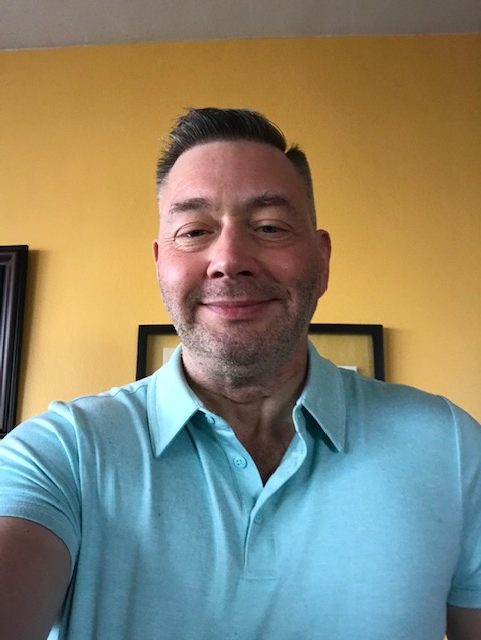
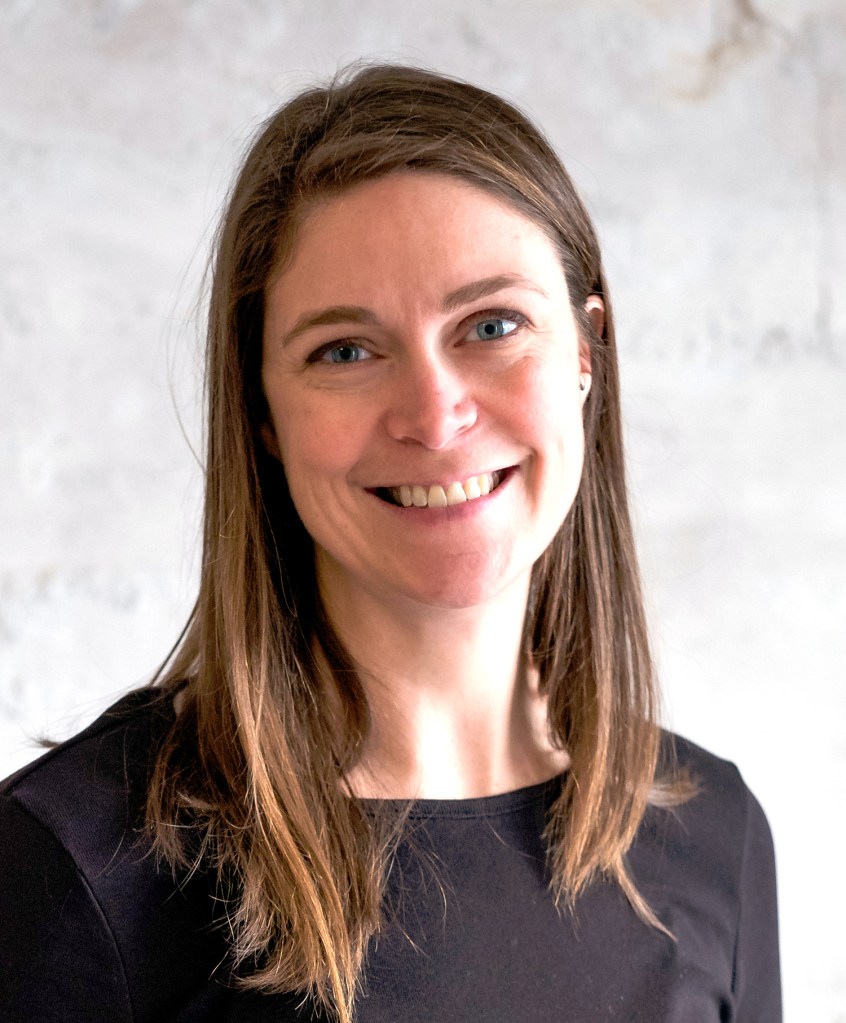
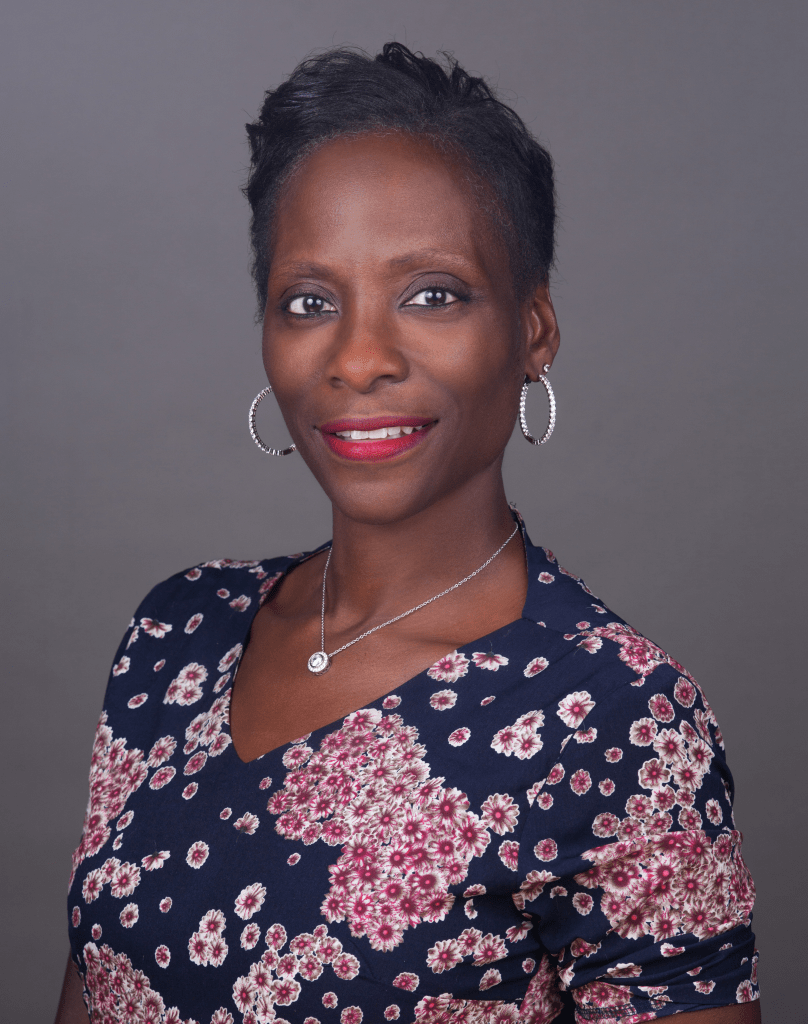
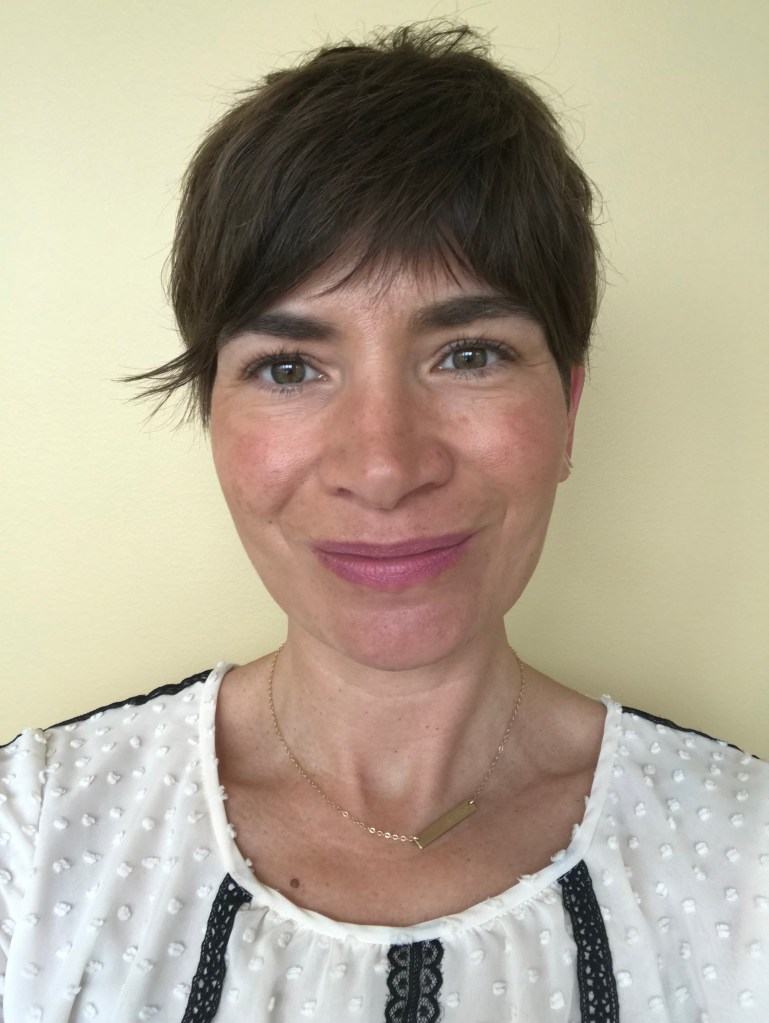
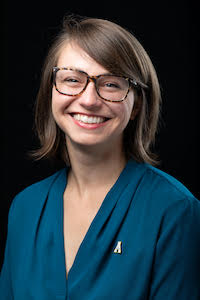
We caught up with the most recent pair of Career Navigator and trainee member: Dr. Kelsey Hassevoort, a Research Development Manager for the Interdisciplinary Health Sciences Institute at the University of Illinois Urbana-Champaign and Dr. Kellie Gross who recently accepted her first RD position at the Ohio State University Comprehensive Cancer Center and talked to them about their experiences with the program. 

Kelsey and Kellie met monthly and covered topics like creating job application materials, interview preparation, what a RD job could look like and networking. One of Kelsey’s favorite aspects of participating in the Career Navigator program was realizing how much in common she had with Kellie beyond their training as neuroscience researchers. The pair found common ground in their Midwestern roots, liberal arts education, and close family ties. Kellie similarly felt like she could relate to Kelsey from the beginning. This not only helped the pair form a strong bond, but also helped Kelsey tailor her advice. Kellie found the program “extremely helpful for my transition from postdoc to a full-time RD role.” The Career Navigator program further helped Kellie “feel welcomed into the NORDP community, and provided valuable structure and support to my career transition.” 

As with many mentoring positions, Kelsey was initially unsure about whether she would have enough useful information about job seeking in RD to be able to adequately support Kellie. But she was pleasantly surprised to discover “just how much information about searching and interviewing for RD jobs I’ve managed to absorb since starting in the field,” going on to say, “I fully credit NORDP’s professional development programming and my experience as a NORDP mentee, along with the opportunity to serve on multiple search committees at the University of Illinois, with providing so much useful information and advice about building a career and finding that first job in RD, which, in turn, I’ve been able to share with Kellie.”

Kellie felt that the Career Navigator program helped solidify her decision to pursue a career in RD. She noted, “Being able to hear in detail about someone else’s experiences working in RD, and seeing the level of support that NORDP has for its members’ mentorship and career development, further convinced me that I wanted to be a part of both this field and professional community.” 

As parting words of wisdom, Kelsey encourages pairs to approach the relationship with an open mind and be cognizant of the different skill sets each brings to the relationship. For Kelsey it was important to “be able to truly hear what Kellie wanted out of a career in research development, without projecting my own career aspirations onto our discussions.” Kellie wants trainee members to know that “it’s helpful to be specific about what you’re trying to get out of the program, whether that’s more information about RD careers, or guidance on navigating the job market or help with networking.” She adds, “I think a great aspect of this program is that you can make of it what you want, so don’t be afraid to speak up about what you need.”

The relationship Kelsey and Kellie have built has enriched them and allowed them to look at RD with a new perspective. As Kellie grows in her new role, she and Kelsey plan to keep in touch regularly and continue their mentoring relationship beyond the Career Navigator program. 

The Career Navigator program has led to four first-time RD positions, one RD postdoctoral position and one trainee member realizing a career in RD is not the right fit. The NORDP Mentoring Committee is engaged in formalizing the Career Navigators program in collaboration with the Member Services Committee.

To hear about this and other programs the NORDP Mentoring Committee has to offer, please plan to attend the NORDP Mentoring Committee Open House, a meeting dedicated to celebrating current Committee members, taking stock of committee accomplishments, and welcoming NORDP members who are willing to get involved. Mark your calendars for Thursday, January 27th at 1pm CST for the Mentoring Committee Open House. All NORDP members are invited to attend!

NORDP fosters a culture of inclusive excellence by actively promoting and supporting diversity, inclusion and equity in all its forms to expand our worldview, enrich our work, and elevate our profession.
Mentoring Philosophy: A Mentor’s True North

Contributed by Melissa Li, Mentoring Committee

Mentoring is a dynamic, multidimensional, and complex relationship. How do seasoned and new mentors and mentees navigate these relationships? A mentoring philosophy could act as a compass to help relationships find their true north. So, what is mentoring philosophy?  A mentoring philosophy is a statement of a mentor’s guiding principles and approach in the mentoring relationship. Mentoring philosophies evolve with people and relationships. A mentoring philosophy can help mentors steer varied mentoring relationships and guide their mentoring practice. 

To understand the creation and evolution of mentoring philosophies, the NORDP Mentoring Committee had the privilege of inviting two colleagues who are seasoned mentors to share their mentoring philosophies and how they have been evolving along their mentoring journeys. Rebekah Hersch, Interim Associate Vice President for Research and Innovation at George Mason University, and Etta Ward, Assistant Vice Chancellor for Research Development, Indiana University–Purdue University Indianapolis (IUPUI) have 20+ years of mentoring experience each. Rebekah and Etta have mentored diverse groups of mentees, including students, staff, faculty, postdocs, and alumni. Both are active mentors in the NORDP Mentoring Program.

At the early stage of Rebekah’s mentoring journey, she was more mission-oriented, dedicating help to solve her mentees’ problems, so that the mentees could achieve their goals. Two decades later, Rebekah now focuses more on fostering mentees’ independence by being an effective listener and empowering the mentees to find solutions themselves. Rebekah also believes in #PayingItForward. She attributes her success to many excellent mentors, from whom she has learned valuable strategies and tools that she has been applying when mentoring others. Rebekah also recognizes the importance of showing empathy to mentees and constantly seeking mentees’ feedback. What has remained a constant beacon in Rebekah’s mentoring philosophy is that she is committed to helping mentees achieve their goals for their professional development.

Etta started IUPUI’s first-ever Preparing Future Faculty (PFF) program in the early 2000s. While she did not formally develop a mentoring philosophy at that time, she was deeply driven by this type of work as her professional calling and purpose. Over the years and through the National Research Mentoring Network (NRMN) Entering Mentoring Facilitator training, she developed a simple but critical guiding philosophy: the mentee drives the relationship, the relationship must be reciprocal, and both the mentee and mentor must continue to #PayItForward. She refers to this philosophy at the beginning of every mentoring relationship in the many presentations she gives on the topic. Etta also realizes the critical importance of competency-based, culturally aware mentoring practices. She is intentional in her approach to integrate aspects of diversity, equity, inclusion, access, belonging, and justice (DEIABJ) throughout her mentoring efforts and to achieve a mutually beneficial experience.

As the NORDP community celebrates the National Mentoring Month, Etta and Rebekah are sharing their wise words with all of us: 

  • Do not be afraid to be a mentor or think that you are not ready. Everyone has something they bring to mentoring relationships. Mentors do not need to know all as they can help mentees by identifying experts who can help.
  • It is beneficial that mentees develop a network of multiple mentors. 
  • Mentors and mentees are encouraged to learn how to notice, name and nurture the various types of mentoring and other developmental relationships (coaching, sponsorship, etc.).
  • Take advantage of NORDP’s resources.

To celebrate National Mentoring Month, the NORDP Mentoring Committee is hosting an Open House, a meeting dedicated to celebrate current Committee members, take stock of our accomplishments, and welcome NORDP members who are willing to get involved. Mark your calendars for Thursday, January 27th at 1pm CST for the Mentoring Committee Open House. Email mentorprogram@nordp.org for the Zoom link. All NORDP members are invited to attend!

NORDP fosters a culture of inclusive excellence by actively promoting and supporting diversity, inclusion and equity in all its forms to expand our worldview, enrich our work, and elevate our profession.
January is National Mentoring Month

The Mentoring Committee invites every NORDP member to celebrate National Mentoring Month from January 1-31. Originally developed as a campaign to expand quality mentoring opportunities for youth, the month-designation can be a catalyst to remember the mentors and mentees who have supported you along your path.

Watch social media and engage in conversation on mentoring (using #NORDPMentoringMatters and #MentoringMonth), take time to listen to a podcast or two (The Science of Mentorship from the National Academies of Sciences, Engineering, and Medicine is a great listen), or explore the NORDP Wisdom Share Learning Library (register here if you don’t have an account in Wisdom Share). Here are some dates to make note of:

  • January 6: I am a Mentor Day – own it!
  • January 17: International Mentoring Day – #MentoringAmplifies support around the world
  • January 27: Thank Your Mentor Day –  share your story to inspire

Also explore some offerings from the National Research Mentoring Network (NRMN).

The National Research Mentoring Network (NRMN) is an NIH grant-funded initiative whose entire purpose is to diversify the STEM workforce by providing researchers across all career stages in the biomedical, behavioral, clinical, and social sciences field with evidence-based mentorship and professional development programming that emphasizes the benefits and challenges of diversity, inclusivity, and culture. Their program achieves that through mentorship, networking, and professional development through their online networking platform, MyNRMN, which has over 21,000 mentors and mentees.

NRMN Twitter Chat – Jan. 12 from 11am-12pm CST Follow the hashtag #NRMNchat

How to Leverage the NRMN Network Webinar Series (Monthly Series) – Jan. 17 at 11am CST. Register here: https://unthsc.zoom.us/webinar/register/WN_z3ZWYl8TRSyyHPosIoIc9w

Mentoring Month Webinar: The Importance of Mentorship Throughout Your Professional Journey w/ J. Marcela Hernandez – Jan. 27 at 11am CST. Register here: https://unthsc.zoom.us/webinar/register/WN_4laIf1V2Q8uFsm2N20F99g 

The NORDP Mentoring Program is a benefit available to all NORDP Members. The Mentoring Committee strives to provide resources and support for all NORDP Members interested in mentorship. To do this, the committee leverages national partnership and engages in a variety of scholarly activities. Members supporting members as mentors, mentees, or as part of a peer mentoring or learning group, making NORDP and the profession of research development a stronger community!

Applications will open in the spring for the 1:1 Mentoring Program. Peer Mentoring Groups are available to join any time, and we invite you to start 2022 by joining  and exploring opportunities within the Mentoring Committee. For more information, email the Mentoring Committee and a member of the Leadership Team will respond!

Happy New Year!

Representing NORDP at the University of New Mexico Mentoring Institute

Mentoring Committee Members Jan Abramson, Paula Carney, and Geoffrey Pollock represented NORDP at the University of New Mexico Mentoring Institute in late October. Addressing the conference theme Mentoring in an Interconnected World, the Mentor Training Team developed “Virtual Mentoring: You’ll Never Walk Alone.” The presentation, presented virtually (of course), provided a high-level overview of the NORDP 1:1 Mentoring Program.

To support virtual mentoring, we discussed the importance of 1) developing expertise in mentor training, 2) adapting the Center for Improvement of Mentored Experiences in Research’s (CIMER) Entering Mentoring curriculum for Research Development Professionals, and 3) developing and piloting virtual mentor training workshops. Because the NORDP 1:1 Mentoring Program has always been virtual, there was a great amount of experience and best practices to share.

Using the Mentoring Relationship Roadmap, participants were led through the support of the 1-year mentoring program. We had the opportunity to share lessons learned and adaptations that have been made, as well as program successes. The idea could not be simpler: help less experienced colleagues navigate the professional landscape by sharing relevant knowledge and insights. NORDP Mentor Training Team members shared knowledge and insights to foster development of mentoring in broader professional settings.

The presentation was a collaboration of the Mentor Training Team, and an article based on the work will be published in The Chronicle of Mentoring & Coaching later this year. Special thanks to all who were involved!

Partlow, K., Widmer, D., Severan-Webb, E., Sengupta, S., Pollock, G., Goff-Albritton, R., Finch, T., Dickey, E., Boman, K., Abramson, J., Carney, P. Virtual Mentoring: You’ll Never Walk Alone. The Chronicle of Mentoring & Coaching. Vol 5 (December 2021, Special Issue 14) pp 574-580.

A Quick Chat about Peer Mentoring Groups (PMGs)

To all members, as we begin a new year of mentoring, the NORDP Mentoring Committee offers Peer Mentoring Groups (PMGs). The seven PMGs are formed based on the corresponding Research Development pillars and provide an ideal platform for NORDP members to network with and learn from each other. We invite you to join a PMG! PMG sign-up is currently open at Wisdom Share.

Recently Melissa Li, Program Manager, Joint Institute for Translational & Clinical Research, University of Michigan joined the Leadership & Management PMG as a co-lead. Melissa interviewed the other co-lead, Katie Shoaf, Associate Director, Grants Resources & Services, Appalachian State University, about her PMG experience.

Melissa: First of all, what is the scope of activities of the Leadership & Management PMG? 

Katie: We cover everything from managing up to growing an RD office, supporting career development, and navigating conflicts. Anything that the group wants to chat about is on the table. Naturally, we spent a lot of time last year debriefing about the impacts of COVID on our workplace interactions. 

Melissa: What prompted you to join the PMG? Could you share a couple of PMG highlights since you joined the group? 

Katie: I have been involved with PMGs since the beginning. I serve on the Mentoring committee and the MESHH (mentorship, expertise, support, helping hands) subgroup that developed some of the tools to support the PMGs as they got started. Mentoring is so important, and I love the atmosphere of a support group clustered around an area of passion for folks. The Leadership & Management PMG has been a great fit. I’m in a quasi-leadership role as an Associate Director, but am very interested in professional development around leadership, so it’s been great to learn from my peers in this group. I’ve developed some really amazing relationships with my PMG cohort. It’s a different vibe than other committee work and other mentoring relationships, and has allowed me to grow alongside people I greatly respect. 

Melissa: Your PMG experience sounds great. How has the experience impacted your professional work? 

Katie: As with most mentoring and NORDP-related things, I learn so much from my peers and it is all translatable into my daily work. I get ideas about how to work better with others and positively impact research culture on my campus. There are also a lot of aspirational things that we discuss in these groups that spark discussions in my own office about long-term goals for RD on our campus. 

Melissa: The PMGs are currently open for sign-up. Any words to those who are considering/debating to join? 

Katie: Do it! It has been so great to build relationships in these types of groups. We support each other, share ideas, discuss our fears and areas of growth. It is a great, low-stakes way to get involved, meet new people, and leverage your NORDP membership. 

Melissa: Thank you so much for sharing your PMG experience and encouraging notes, Katie.

An overview on PMGs is available here. PMG sign-up is currently open at Wisdom Share. See this blog for more information on signing up for PMGs this year.

Please join us for a PMG Orientation on October 21 at 2:30-3:30pm EST. The Zoom link is https://us02web.zoom.us/j/81529400705.

Save the Dates: Expand your network by participating in the NORDP Peer Mentoring Groups!

“One mentor is almost never adequate for the mentee. [The PMG] helped us to focus on what we could address”- Jennifer Glass, NORDP Board member and Mentoring Committee member. 

The NORDP Mentoring Committee’s Peer Mentoring Groups* (PMG)  provide an ideal platform for NORDP colleagues to learn from each other. NORDP Mentoring Committee currently has 7 PMGs Peer Mentoring Groups, based on the pillars of Research Development. 

1.     Career & Professional Development: exploring how to become more efficient and effective in our roles

2.     Communication: promoting awareness of RD opportunities and publicizing research

3.     Enhancing Collaboration: building collaborations and interdisciplinary research programs

4.     Leadership & Management: leading in both official and unofficial capacities

5.     Mentorship: discussing and supporting mentoring best practices for mentors and mentees

6.     Proposal Development: supporting faculty grant seeking and increasing extramural funding

7.     Strategic Planning & Advancement: guiding policy and planning for enhanced research and scholarship

Learn more about PMGs here.

This year PMGs will use the Wisdom Share platform (https://nordpmentoring.mywisdomshare.com), which is the same platform that NORDP uses for its mentoring program.  Please mark your calendars for the following dates:

October 1, 2021 PMG sign-up opens in Wisdom Share: You can begin to sign up for one (or all 7!) of the PMGs. Signup will be open October 1. 

To sign up for a PMG:

  1. If you’ve not yet registered in Wisdom Share, sign up with a login and password here. 
  2. Under “Role,” choose “Peer Mentoring.”
  3. On your dashboard’s far right side, you will see the PMGs; simply click join for the group(s) of interest.

Already-registered users can go directly to their dashboards.

October 21, 2021 – 2:30-3:30pm EST PMG Orientation  – Come join your PMG colleagues to learn about the process, Wisdom Share functionality, and meet as a group. The Orientation will include an introduction to the seven PMGs, engaging in PMGs on Wisdom Share, and an opportunity to get acquainted with the PMGs real-time. Click here to join the orientation: https://us02web.zoom.us/j/81529400705

* Participation in Peer Mentoring Groups (PMGs)  is one of the many benefits of being a member of NORDP.

Mentor Dyad Reflections: Jessica Brassard/David Widmer

We hope you are enjoying the opening months of the 2021-2022 NORDP Mentoring Program and that you have had a chance to meet in your dyad! We are excited to share a piece of Mentoring Reflection by introducing Mentor David Widmer, Manager of Research Development and Outreach at Memorial Sloan Kettering Cancer Center, and Mentee Jessica Brassard, who recently transitioned from Michigan Technological University to a Graphic Designer position in the University of Michigan’s Research Development Office. Jess and David were paired for the 2020-2021 mentoring year and are continuing their engagement beyond the official program.

Short bios

David Widmer, PhD, is the Grants & Contracts Manager of Research Development & Outreach at Memorial Sloan Kettering (MSK) and has 20 years of research administration and research development experience.  David manages the G&C Funding Development Team (FDT) now in its 12th year of providing proposal development and funding acquisition support to MSK researchers. David’s outreach and training has focused on developing specific populations of investigators including junior faculty and post-doctoral researchers. David was part of the first NORDP mentoring class in 2011, has served on the Mentoring Committee since 2015, and served as MC co-chair from 2017-2021. This was his fifth year as a mentor. David is a Fulbright Scholar, a recipient of a Swiss Confederation fellowship, and has an MS in Cell & Developmental Biology, an MA in Humanities and Social Thought with a concentration in the History of Medicine, and a PhD in Behavioral & Molecular Neuroscience. 

Jessica Brassard is the Graphic Designer in the University of Michigan’s OVPR Research Development office. Jessica has a long background in fine art, design, and marketing and transitioned to research development in 2015 when she joined the Michigan Technological University RD team. She has experience with what we might think of as “core” RD responsibilities (faculty development, proposal development, strategic initiatives, workshops and training) but she has always loved the chance to work on visuals for proposals and science communication. She creates visuals that increase clarity and saliency for proposals and OVPR initiatives. This will be the fourth year that Jessica has participated in the NORDP Mentoring Program. She has been both a mentee, a mentor, and participated in a PMG or two. This year, she joined the Mentoring Committee and is focusing on the McMc (Mentoring Committee Marketing (sub)Committee). In all aspects of her life, Jessica strives to find ways to improve the world around her. 

  1. What influenced you to apply to be a mentor and a mentee for the 2020-21 NORDP Mentoring Program?
  1. JB — I believe I can learn something from everyone I meet. The NORDP Mentoring Program does a great job of creating opportunities to meet, build relationships, and learn from each other. 
  2. DW — My experience with the NORDP mentoring program previously has been very positive. I was in the first mentoring class in 2011 and my mentor helped me during a pivotal transition in my career of moving from Research Administration to Research Development. When I came to the Mentoring Committee in 2015, I started up again first as a mentee and then transitioned as both mentor and mentee. This upcoming year will be my fifth year as a mentor. My experiences with all my mentors drive me to want to pay it forward and the learning that happens with my mentee makes me want to mentor again. And by learning, I mean I learn from my mentees because I do every time. The mentoring experience shows that we all have something to share and that you might be in a better position to serve as a mentor now than you may think.
  3. What was your favorite part about your relationship?
  1. JB — As I have gotten to know David, I have enjoyed learning about his background. David has generously shared his published work which I have read and found fascinating. I enjoy spending time reflecting on the challenges he has faced over the past year in his institution and the issues I face in my institution. Having David’s perspective helps me reflect more clearly because he sees things from an outside point-of-view while still having the context of our RD mission. 
  2. DW — The camaraderie! Jess and I really clicked and talked about so much more than RD. I feel we have crafted an important connection that will last beyond the mentoring year. I even benefited from her baking skills and received a care packet for the Holidays.
  3. What surprised you about being a mentor or a mentee?
  1. JB — During the process of using the NORPD mentoring packet to reflect on my own progress, goals, and network, I am surprised by the progress I’ve made year to year. And again at the end of a mentoring year, I am surprised by the incredible benefit of the conversations we’ve had, despite shifting work priorities and adjusted meetings over the year. 
  2. DW — What’s surprised me from the start of mentoring was the reciprocal learning that happens. I taught enrichment to seventh and eighth graders in graduate school and staying one step ahead of them in topics and subjects was a challenge since they gave me perspectives I never had before. Mentoring kids I think put me in good stead to be a NORDP mentor although previous mentoring experience is not by any means a prerequisite for supporting your RD colleagues in mentoring.
  3. How has participation in the Mentoring Program helped broaden your horizons about Research Development in general and/or affected your daily work in particular?
  1. JB — In this year of the COVID-19 pandemic, I have struggled with the amount of work I can maintain in our new way of living and working. The Mentoring Program has helped “right-size” my expectations to the realities. While this is being done at my institution and within my unit, it is also extremely helpful to get perspective with both David and my other mentee. 
  2. DW — Bringing back to one’s home institution is an important benefit of NORDP membership and the Mentoring Program has helped me learn and grow in RD, and have colleagues to share and brainstorm ideas with to take back to MSK. The dyads and the Peer Mentoring Groups are great for that but they wouldn’t be such a success if it weren’t for the fabulous open and sharing NORDP membership.
  3. Any words of wisdom or encouragement for those wanting to apply next year? Any other thoughts you would like to share? 
  1. JB — Don’t get caught up in the tasks you might add to your list of to-dos or the additional meetings you need to schedule. Think of this as a year-long opportunity to get to know another human and add to your network!
  2. DW — If you think you are not ready to mentor, think again. Everyone has something to share, differing experiences to discuss, and perspectives that will broaden the horizons of another program. I thank Jess for broadening my horizons in our mentoring partnership this year.

Celebrating Mentoring Days Recap

This year’s Mentoring Program kicked off with an exciting two-day Celebrating Mentoring Days in June with more than 100 registrants! The event featured an inspirational presentation from our keynote speaker Dr. Kelly Diggs-Andrews on the science behind effective mentoring, and a special panel discussion on mentoring across differences – we would like to express a sincere ‘thank you’ to our guest panelists, Angela Clear, A.L. Carter, and Sarah Messbauer for sharing their experiences, perspectives and insight.

The event also brought a closure to the 2020-21 mentor-mentee cohort on a positive note through McHuddles for mentors and mentees, and it also launched the orientation activities for the 2021-22 Mentoring Program. A record-breaking 107 mentor-mentee pairs are participating in this year’s program. 

Other program highlights included demonstration of the newly adopted Wisdom Share software (many thanks to the NORDP Board of Director for their support!), a quick reboot of the On-board Packet tools, and a refresher on the Peer Mentoring Groups focusing on an array of research development topics, from Career & Professional Development, Leadership & Management to Proposal Development and more. 

It takes a village to organize and run the Celebrating Mentoring Days! We want to give a big shout-out to the MC organizers and the more than 30 MC member volunteers who made this year’s inaugural event a huge success! 

Having fun is better shared with others even in zoom!

Hats Off to 2021 NORDP Mentor Training Workshop Graduates!

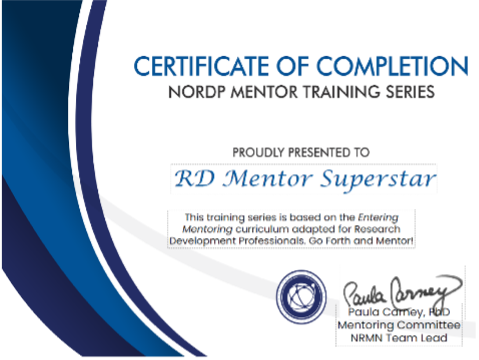
The NORDP Mentoring Committee’s Mentor Training Team held a mentor training workshop in May-June 2021. Twelve NORDP members from 10 states participated in the 5-week workshop, covering the 9-module Entering Mentoring curriculum initially developed for research mentors and tailored by the NORDP Mentoring Committee for RD professionals. Developed in collaboration with the University of Wisconsin Center for Improvement of Mentored Experiences in Research (CIMER), RD professionals explored key mentoring competencies that can benefit RD mentors and mentees that have been associated with improved career outcomes, employee engagement and retention, and more inclusive work environments. The workshop was facilitated by NORDP members Jan Abramson, Toni Blair, Kristin Boman, Paula Carney, Tabitha Finch, Rachel Goff-Albritton, Kathy Partlow, Erica Severan-Webb, and Samarpita Sengupta. All participants and facilitators are invited to participate in other Mentoring Committee activities. The next Mentor Training Workshop is being planned and will be announced soon. If you would like to be contacted when the next workshop series is scheduled, please complete this form.

Kate AlfieriBrooke Gowl
Colleen BivonaWendi Jensen
Emily DevereuxMelissa Li
Susan ElkinsSarah Robertson
Christina ErlienJaime Rubin
Becky FousheeMelissa Vaught

Mentoring Reflections: Carolynn Julien & Hollie Fuhrmann


Welcome to the third installment of Mentoring Reflections! This time, we chatted with Carolynn Julien at Hunter College, CUNY who served as mentor to Hollie Fuhrmann at the University of Utah. 

If you have not yet, don’t forget to register to participate in Celebrating Mentoring Days on June 29th and 30th. The two-day program will be packed with enlightening mentoring focused sessions, roundtables and networking events. 

  • What influenced you to apply to be a mentor and a mentee for the 2020-21 NORDP Mentoring Program? 

In 2013, Carolynn received a mentor from the NORDP Mentoring Program. Her relationship with her mentor is still ongoing and has become a very important relationship in her life. Due to the importance of this relationship, she decided to #PayItForward, as the Mentoring Committee likes to call it, and be a mentor. For some time, Hollie has wanted to engage in a formal one-on-one mentorship relationship with someone that was not also her director/supervisor. She really wanted to develop a relationship and expand her network. The NORDP Mentoring Program provided that opportunity for them both.

  • What was your favorite part about your relationship 

Carolynn has found the mentoring relationship to be extremely fruitful. The biweekly meetings with Hollie have been the highlight of her week! Although she and Hollie have different backgrounds and experiences, they have connected in a special and unique manner. Hollie really didn’t know what to expect going into this experience. It is important to note that they started to meet and build their relationship at the same time that world was shutting down due to the pandemic and as issues related to racism, discrimination, and violence were becoming something we could no longer ignore. Their mentoring relationship became a unique moment to examine and discuss these important issues because how can we successfully serve and advance the research missions of our institutes without acknowledging and addressing equity, diversity, and inclusion. They are both thankful for the opportunity to discuss and guide each other on this journey.

  • What surprised you about being a mentor or a mentee? 

Carolynn was surprised at how satisfying and enriching their relationship has become and didn’t expect the mentoring relationship to develop into such a personal relationship. Their mentoring relationship has developed so organically and been so responsive to their lived experiences during challenging times. It has also been very personal. Hollie didn’t expect to connect with Carolynn on such a deep and personal level, especially over Zoom. In the beginning, Hollie saw their meetings as a work-related task. Now, she really looks forward to them and sees them as a break from work or as an opportunity to share and reflect on work and life more broadly.

  • How has participation in the Mentoring Program helped broaden your horizons about Research Development in general and/or affected your daily work in particular?

In the last several months, Hollie and Carolynn have discussed several work-related matters and their mentoring relationship has been an invaluable resource. In addition, their shared experience and their unbiased, trusted advice has helped them navigate being RD professionals and allowed them an opportunity to celebrate themselves as women leaders.

  • Any words of wisdom or encouragement for those wanting to apply next year? Any other thoughts you would like to share? 

Just do it! And, be open to the experience! You will be surprised by the connections and the progress you will make as individuals and as a team.

If you would like to share your mentoring story, please contact mentorprogram@nordp.org.